Start Your Electric Toothbrush Project
Tell us your product requirements and target market. We will review the details and reply with the relevant next steps.

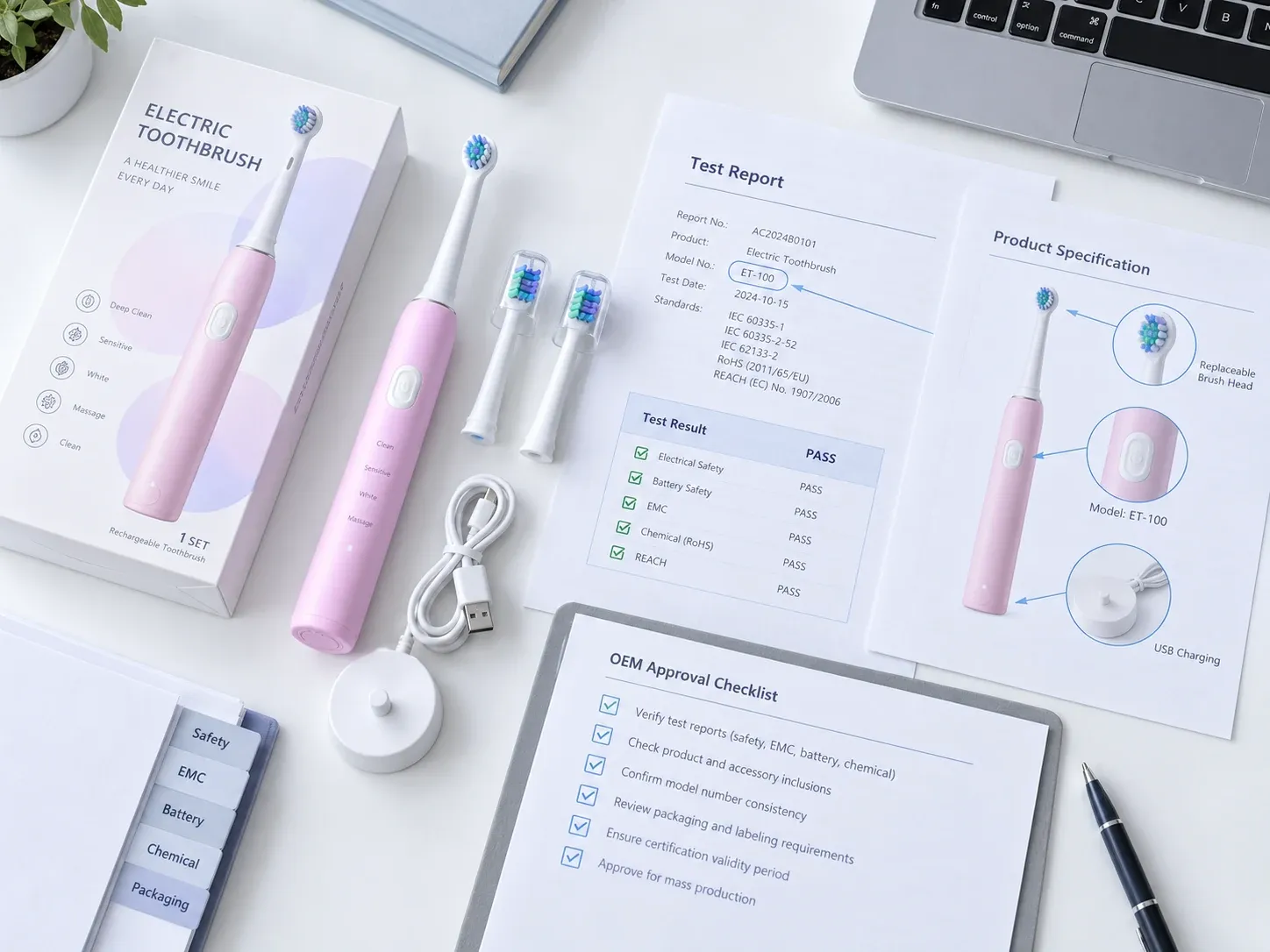
A test report is useful only when the buyer can connect the tested sample, model number, hardware configuration and test scope to the final product being approved.
Before relying on a report, verify what type of document it is, who issued it and which product was actually tested. Then compare the tested configuration with the battery, charger, PCB, motor or pump, firmware, radio functions and variants planned for production.
The test standard, edition, scope and target market also matter.
A report should be reviewed as configuration-specific evidence, not as a generic “pass certificate.”
This guide explains how to make that comparison step by step.
Every document review comes down to three questions:
A report supports a defined tested sample under a defined scope.
It should not automatically be transferred to:
This does not mean every small difference makes a report unusable.
The correct approach is impact review: identify the difference, assess whether it changes what the existing evidence represents, and determine whether additional documentation or verification is needed.
Keep this chain in mind throughout the review:
Report → Tested Sample → Tested Model → Critical Configuration → Variant → Final Production SKU → Target Market
Suppliers may send several types of documents during an OEM project.
They do not demonstrate the same thing and should not be treated as interchangeable.
| Document Type | What It Can Demonstrate | What It Does Not Automatically Demonstrate | Buyer Review Focus |
|---|---|---|---|
| Test report | Results for a defined sample, method, standard and scope | Coverage of future units, variants, other markets or the full product family | Sample identity, model, photos, test scope, standard edition |
| Certificate | A certification result under a defined scheme and scope | Universal compliance or coverage of unlisted variants | Issuer, certification scheme, model list, stated scope and conditions |
| Declaration of Conformity | A responsible party’s declaration that a specified product meets stated applicable requirements | Independent laboratory testing by itself | Product identity, legal entity, applicable legislation and standards |
| Supplier declaration / compliance statement | A supplier’s stated claim about a product, component or material | Independent laboratory evidence | Signatory, exact claim, evidence basis, revision |
| Material declaration | Stated material or substance information within a defined scope | Full finished-product compliance | Part number, supplier, revision and declared scope |
| Inspection report | Results or observations from a batch, sample or inspection event | Regulatory conformity or laboratory test performance | Inspection scope, criteria, sample or lot, issuer |
| Laboratory accreditation | Assessed laboratory competence within an accredited scope | Product certification or automatic coverage of every report from the lab | Accreditation body, applicable scope and current status |
Three distinctions are particularly important.
An accredited laboratory test report is not the same as product certification.
A Declaration of Conformity is not the same as an independent laboratory test report.
An inspection report is not regulatory evidence by itself.
A professional-looking PDF does not by itself establish authenticity.
Basic checks cannot replace formal verification, but they can help identify obvious inconsistencies early.
Review:
Some laboratories provide report-verification tools such as a portal, QR code or direct enquiry route.
Not all laboratories do, so the absence of an online verification portal is not automatically a problem.
Direct laboratory verification may be worth considering when:
ISO/IEC 17025 accreditation can provide confidence that a laboratory has been assessed for competence in defined activities.
It is a laboratory-competence signal, not a product approval.
Buyers should still check:
Not every test performed by an accredited laboratory is necessarily within its accredited scope.
Likewise, a test report from an accredited laboratory does not automatically certify the product for every market.
Accreditation can strengthen confidence in relevant test work, but product identity, report scope and target-market relevance still need separate review.
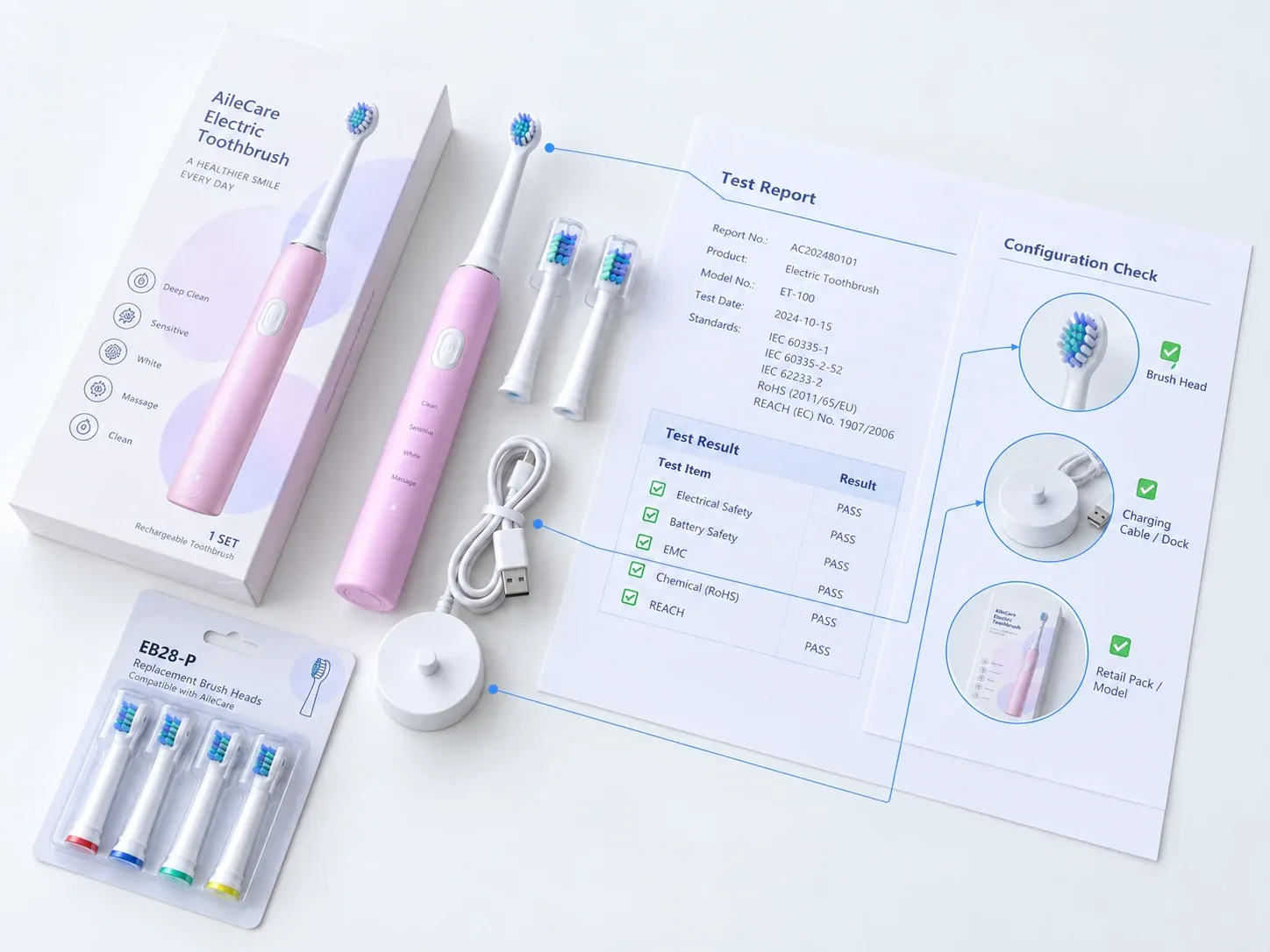
A description such as “electric toothbrush” or “water flosser” is too broad for a B2B product-approval decision.
Look for clear product identification in the report.
Useful fields may include:
Use the report information to build a traceable link between the tested product and the product planned for production.
| Situation | Buyer Interpretation | What Should Connect the Records |
|---|---|---|
| Exact model number matches | Stronger starting point, but not final proof | Photos, specification, configuration comparison and current revision |
| Parent model + derivative models | Family coverage may be possible | Explicit variant list, model-family table or technical difference statement |
| Private-label model uses a different number | May be supportable if the underlying configuration is aligned | Tested-model → supplier-model → buyer-model mapping |
| Same housing, different electronics | Higher potential mismatch | PCB, battery, charger, firmware and radio comparison |
| Same electronics, different accessories | Impact depends on the accessory | Bundle list, powered/passive distinction and adapter comparison |
| Same stated battery capacity, different battery | Potentially material difference | Chemistry, cell identity, pack structure and protection circuit |
| Same brand, new revision | Should not be assumed equivalent | Revision history and change-impact review |
Even when the model number matches exactly, check whether the tested revision and configuration are still the same as the version that will ship.
A common private-label situation looks like this:
Supplier tested model: ABC-01
Buyer-facing model: AC100
Changing a logo or brand name does not necessarily change the technical behavior of the product.
However, a different buyer-facing model number creates a traceability gap unless the relationship is documented.
The buyer should establish a controlled chain:
Tested Model → Supplier Production Configuration → Buyer / Private-Label Model
Supporting records may include:
A supplier statement can be useful as part of that traceability record.
It should not automatically be treated as sufficient for every product, market or conformity route.
Its relevance depends on the technical differences, target market, responsible party and applicable customer requirements.
Documentation responsibility can also vary by project structure. See our OEM vs ODM guide for the broader development and responsibility framework.
Similar housings can contain technically different products.
The visible product is therefore only one part of the comparison.
Review relevant battery information such as:
The same stated capacity does not prove that two batteries are technically identical.
Two batteries labeled “800 mAh,” for example, can still differ in cell identity, pack construction or protection circuitry.
Identify the charging arrangement represented in the report.
That may include:
Also confirm whether the adapter was supplied with the tested sample or excluded from the tested configuration.
A changed cable, adapter or charging base does not automatically require complete retesting.
It should, however, trigger an impact review where the supplied power configuration differs from what was evaluated.
Relevant differences may include:
Not every PCB revision requires complete retesting.
The key question is whether the revised electronics are still represented by the existing evidence.
Firmware can affect:
A cosmetic display change and a change to motor-control or charging logic do not have the same potential impact.
Ask whether the production firmware changes electrical operation, charging, safety functions or wireless behavior.
If it does, review whether the existing evidence remains applicable.
A non-Bluetooth SKU and a Bluetooth-enabled SKU should not automatically be assumed to share the same radio evidence.
Adding or changing:
can affect the relevant product evidence and documentation.
A module’s own approval or test evidence also does not necessarily end review of the complete host product.
A UN 38.3 test summary can support transport traceability for a lithium cell or battery design.
It does not, by itself, demonstrate compliance of the complete electric toothbrush, water flosser or other oral-care device.
Battery transport evidence and finished-product evidence should therefore be reviewed separately.
Do not stop at the word “PASS” on the report cover.
Review:
Also identify what kind of test work the document represents.
It may be:
A “PASS” result applies to the scope stated in the report.
It should not automatically be interpreted as proof that every requirement, product configuration or destination market has been addressed.
There is no single universal expiry period for product test reports.
Report age should trigger an applicability review, not an automatic decision that the report is valid or invalid.
Review the date together with:
An older report may still contain useful evidence if the tested configuration and applicable requirements remain appropriately aligned.
One report should not automatically be assumed to cover every sellable variant.
A useful approach is to compare the potential technical impact of each difference.
| Change | Potential Technical Impact | Buyer Question |
|---|---|---|
| Logo or brand change only | Lower | Does the commercial model still map clearly to the tested configuration? |
| Packaging-only change | Lower for product evidence | Is the underlying product unchanged and is the new labeling still accurate? |
| Passive accessory bundle | Lower in many cases | Are the accessories the same approved parts and is the new bundle clearly identified? |
| Color change using the same material system | Lower | Did resin, pigment, coating, plating or ink actually change? |
| Battery, cell or battery-pack change | Higher | Are chemistry, cell identity, protection and charging behavior still represented? |
| Charger, cable, base or charging-method change | Higher | Does the shipped power configuration match the tested setup? |
| PCB or electronics change | Higher | Does the new revision remain represented by the existing evidence? |
| Motor or pump change | Higher | Could electrical load, operating behavior or other evaluated characteristics change? |
| Firmware affecting product operation | Higher | Is the tested functional behavior still equivalent? |
| Radio or Bluetooth feature added | Higher | Does the final wireless configuration match the relevant evidence and conditions? |
“Lower potential technical impact” does not mean “automatically covered.”
Color changes are a good example.
A visual color change may have limited effect on electrical operation, but a new resin, pigment, coating, plating or ink may still need material and documentation review.
The tested sample represents one defined version of the product.
Mass production may later span:
Existing evidence remains useful only when production stays appropriately aligned with the configuration that was evaluated.
Several change-control terms are useful to recognize:
ECO / ECN
A controlled record of a design or component change.
PCN
A notice that a part, source, process or specification is changing.
Deviation
A controlled departure from an approved requirement, sometimes temporary.
Substitution
Replacement of an approved item with another.
Impact assessment
Review of what a proposed change may affect.
Delta / targeted test
Focused verification intended to assess a specific change.
When a change appears, ask:
There is no single universal answer.
The appropriate response depends on the product, the change, existing evidence and the target market.
Test evidence is interpreted in the context of the destination market.
This section is intentionally high-level.
For an EU project, confirm that:
Avoid treating a single generic “CE certificate” as the complete answer.
The useful buyer question is whether the applicable conformity documentation and supporting evidence correspond to the actual final product.
FCC-related evidence may be relevant where radio or digital-device requirements apply.
Where wireless functionality exists, compare the shipped radio configuration with the configuration represented in the supporting evidence.
Battery transport evidence should also be kept separate from finished-product evidence.
Do not assume every electric toothbrush requires FDA approval.
U.S. regulatory treatment can depend on the product’s intended use and claims. This guide focuses on evidence-to-product matching rather than product classification.
UK marking and documentation arrangements can differ between Great Britain and Northern Ireland.
These rules are also date-sensitive.
For a live project, check current UK government guidance and confirm that the product documentation and marking approach correspond to the actual destination and final configuration.
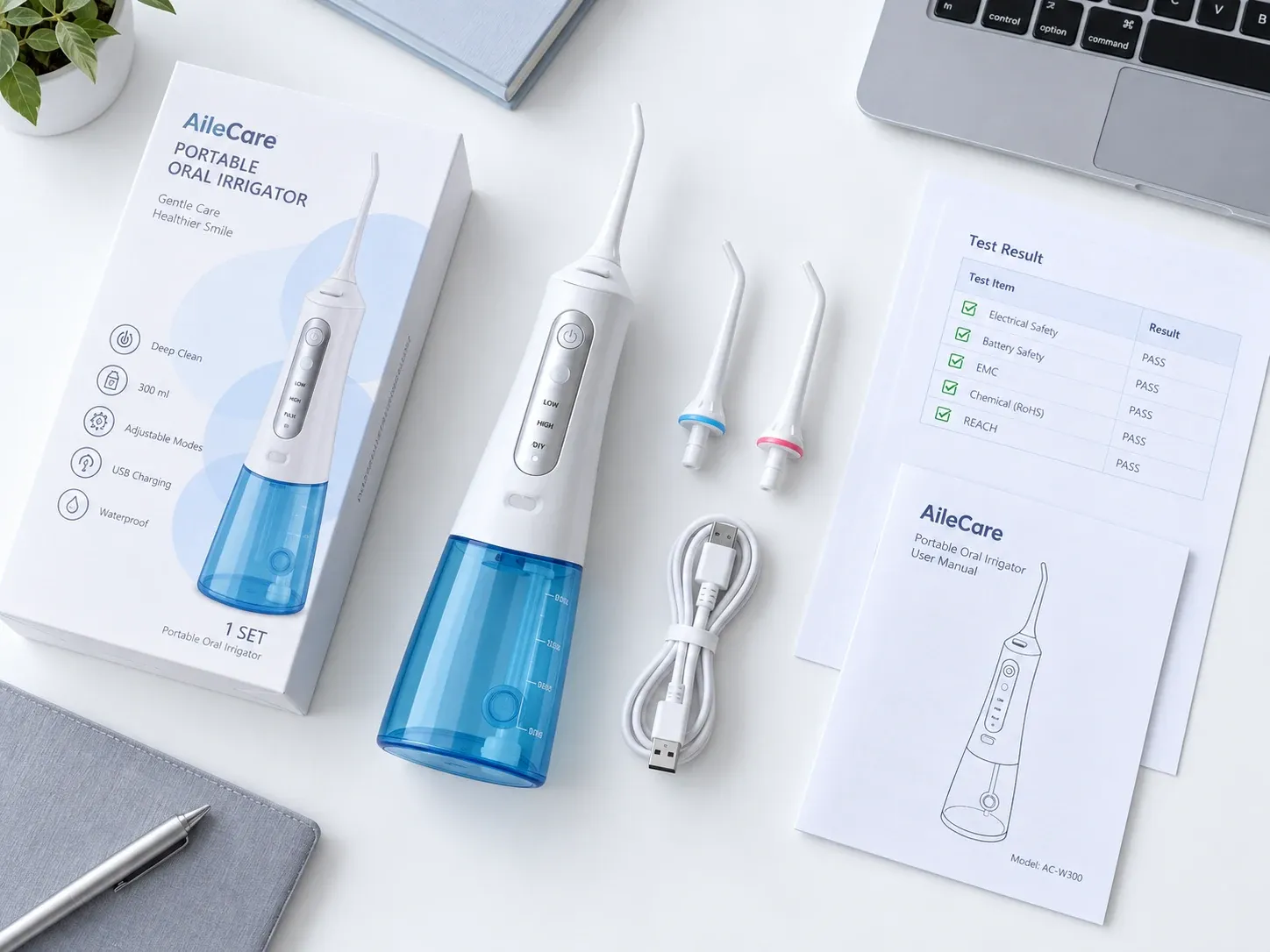
Compare the:
Reviewing an existing report is different from deciding what reliability testing a product should undergo.
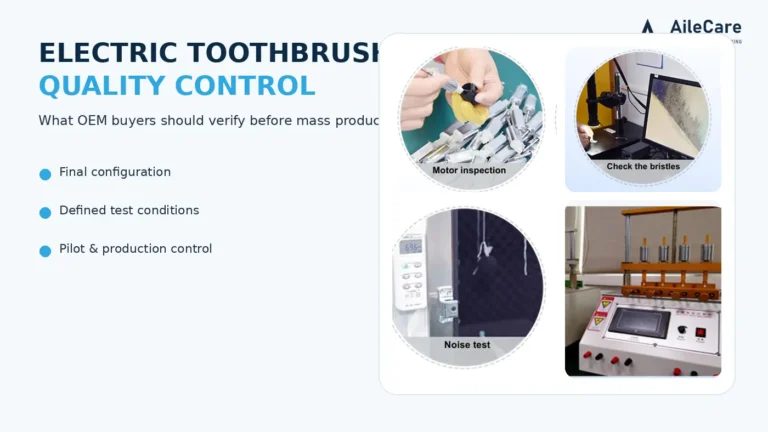
For the latter, see Electric Toothbrush Reliability Testing: What OEM Buyers Should Verify Before Mass Production.
Compare:
For product-side configuration decisions, see the Water Flosser Sourcing Guide.
Compare:
For the wider sourcing and compatibility process, see the Replacement Brush Head Sourcing Checklist.
| Buyer Mistake | Why It Matters | Safer Review Practice |
|---|---|---|
| Checking only the “PASS” result | The report may be partial or configuration-specific | Review sample identity, standard, clauses, scope and annexes |
| Ignoring model-number differences | Evidence may apply to another product | Document the tested-model → supplier-model → buyer-model relationship |
| Treating photos as complete proof | Photos cannot show hidden components or firmware | Use photos together with controlled configuration records |
| Assuming same housing means same model | Electronics, battery, firmware or radio may differ | Compare the technical configuration |
| Ignoring battery details | Same capacity can hide different cells or pack structures | Compare battery identity and configuration |
| Ignoring charger or adapter | Tested power setup may differ from the shipped bundle | Compare the cable, base and adapter arrangement |
| Assuming all variants are covered | Variants can change electronics, radio, materials or product identity | Request explicit variant coverage and technical comparison |
| Confusing a supplier declaration with a lab report | The documents provide different types of evidence | Identify issuer, scope and evidence basis |
| Assuming accredited lab = certified product | Accreditation concerns laboratory competence and scope | Review lab scope separately from product and market relevance |
| Accepting old evidence without change review | Product or requirements may have changed | Review report date together with revision and change history |
| Treating UN 38.3 as finished-product compliance | It relates to lithium battery transport testing | Use it as battery transport evidence and review the finished product separately |
| Not comparing the report with the final configuration | Production may have changed since testing | Compare the final controlled configuration before approval |
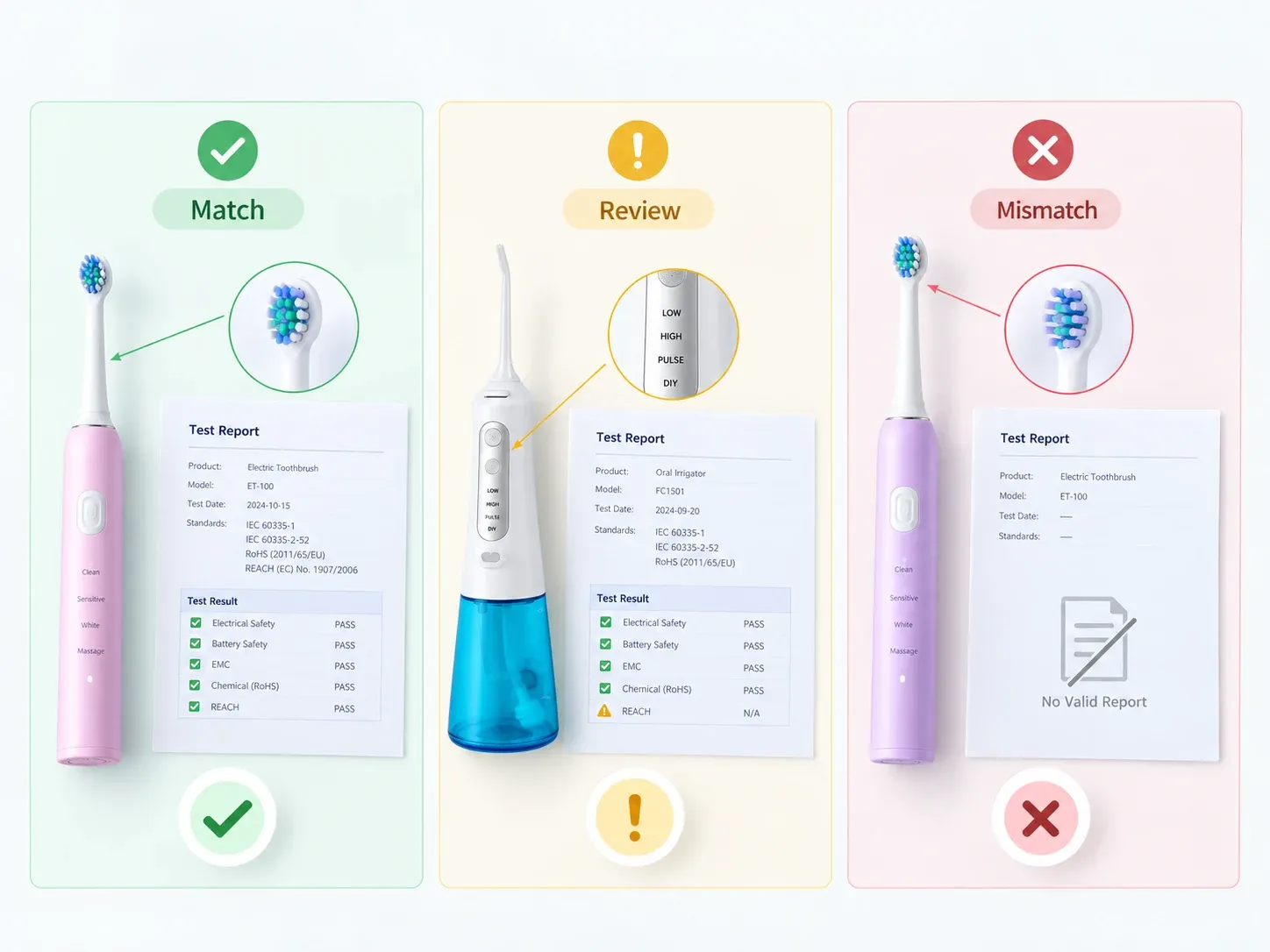
A simple triage model can help a project team decide what to investigate next.
This is project triage, not a regulatory approval status.
The report identity, tested model, configuration and stated scope appear sufficiently aligned for the next project-review step.
Example:
A difference exists but is documented or may be manageable after impact review.
Examples:
There is a significant mismatch, unclear product identity, unverified document or major configuration gap.
Examples:
Green means the document set appears sufficiently aligned for the next project review. It does not mean the product has automatically achieved regulatory approval in every market.
No.
A test report records results for a defined sample and test scope.
The EU Declaration of Conformity is the responsible party’s declaration that a specified product meets the applicable requirements, supported by the relevant technical documentation.
The product identity across these records should be consistent and traceable.
Sometimes.
The relationship between the tested supplier model and the buyer’s private-label model should be clearly documented and appropriate to the target market.
Without model mapping, the buyer-facing model may have no clear traceable connection to the tested sample.
No.
The same stated capacity can still involve a different cell, chemistry, pack structure, supplier or protection circuit.
Compare battery identity and configuration, not capacity alone.
A color-only change using the same underlying material system may have lower technical impact.
However, different resin, pigment, coating, plating or ink can still create material or documentation differences.
Confirm what actually changed.
There is no universal expiry period.
Review the report date together with product revisions, changes to applicable standards, market requirements and any stated report conditions.
No.
UN 38.3 evidence relates to lithium-cell and battery transport testing.
Finished-product evidence should be reviewed separately.
Yes.
A radio-enabled version should not automatically be assumed to share the evidence of a non-radio version.
The final radio configuration should be compared with the relevant evidence and its conditions.
First identify exactly what changed and why.
Then determine which product specifications, reports, declarations or other evidence may be affected.
Depending on the impact, the next step may be a documentation update, targeted verification, partial retesting or broader re-evaluation.
Templates supporting change review and configuration control can be linked from Project Resources.
Before relying on supplier test reports, prepare the final product model, target market, critical configuration, battery and charging setup, variant list and private-label model mapping.
AileCare can help clarify which project information should be compared when reviewing supplier evidence before product approval.