Start Your Electric Toothbrush Project
Tell us your product requirements and target market. We will review the details and reply with the relevant next steps.
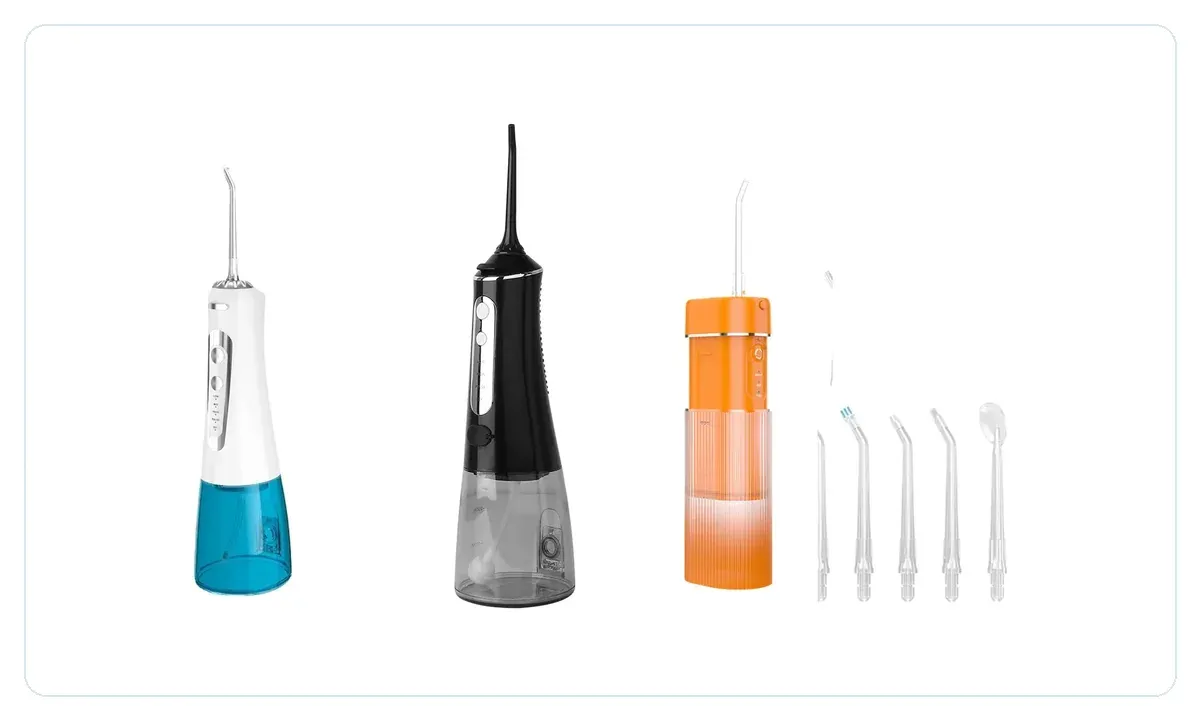
A supplier may use the word “customization” for all of these:
These are not equivalent projects.
Some changes can remain within an existing product platform. Others may require firmware or PCB revision, engineering work, tooling review, new tooling, new samples, validation or updated documentation.
The key question is not only “Can you customize it?” but “Is this already supported by the existing platform, or does it require engineering, tooling or new product development?”
For the broader sourcing process, see the Water Flosser Sourcing Guide.
These terms are often used together, but they describe different things.
| Term | What It Usually Means | What It Does Not Automatically Mean |
|---|---|---|
| Private Label | Existing product sold under the buyer’s brand | Unique structure or exclusivity |
| Logo Customization | Buyer logo added by a suitable process | Molded logo or unique housing |
| Packaging Customization | Buyer box, insert, labels and manual | Core-product engineering |
| Private Tooling | Buyer-specific or buyer-funded tooling arrangement | Guaranteed commercial exclusivity |
Private label is a commercial branding model, not a technical customization level.
A buyer can private-label an existing water flosser without changing its pump, reservoir, PCB or housing architecture.
For the broader difference between development routes, see OEM vs ODM for Oral-Care Products.
An existing platform is an established product architecture whose major systems are already defined and controlled.
It commonly includes:
The platform may support several cosmetic and configuration variants.
That does not mean every internal part can be changed independently.
Existing platform does not mean zero engineering.
Even without new tooling, a requested change may still require:
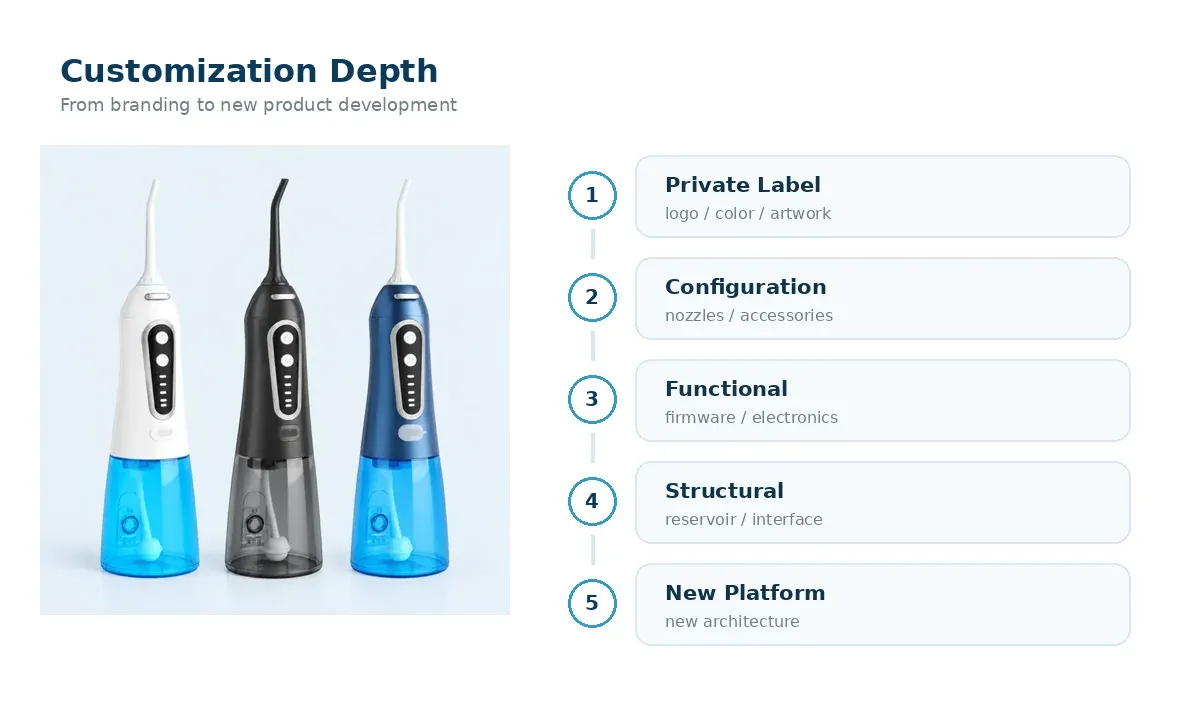
A useful way to discuss customization is to separate it by development depth.
| Level | Example Changes | What Usually Changes | Typical Development Impact |
|---|---|---|---|
| Level 1 — Private Label / Commercial | Printed logo, supported color, retail artwork, manual, barcode | Branding, packaging, SKU | Artwork and sample approval |
| Level 2 — Existing-Platform Configuration | Approved nozzle quantity/type, cable, adapter, charging base, case, existing firmware option | BOM, packaging, accessory set | Configuration control |
| Level 3 — Functional / Electronics | Mode logic, startup behavior, LED logic, timer, supported battery or charging changes | Firmware, PCB, power BOM | Engineering and functional-validation review |
| Level 4 — Structural | Reservoir geometry, nozzle interface, port opening, housing features, water-path parts | Housing, seals, fit, water path | Engineering, tooling review and focused revalidation |
| Level 5 — New Product Development | New architecture, new external form, proprietary nozzle ecosystem, different pump architecture or form factor | Core mechanical, electrical and fluid architecture | New development, tooling, samples, validation and documentation |
This is a practical sourcing framework, not an official industry classification.
One project can span several levels.
A printed logo combined with a new reservoir capacity and charging-port conversion is not a Level 1 project simply because branding is included.
The deepest requested change usually determines the real development scope.
Logo customization may use methods such as:
A printed or laser logo is generally a secondary process applied to an existing part.
A molded logo changes molded geometry and may require a tooling insert, cavity modification or other tooling review.
Not every branding method suits every housing material, texture or finish.
Confirm the actual method on the selected product and approve it on a physical sample.
Possible options may include:
A supported molded color may use the existing tooling.
A new texture, coating or material may require additional process or tooling review.
Changing housing color and changing housing geometry are fundamentally different development scopes.
Packaging changes are also usually separate from core-product engineering, although they still affect artwork, BOM and order configuration. See the Oral-Care Packaging Guide for OEM Projects.
Accessory customization may include:
These changes can affect:
without changing the architecture of the water flosser itself.
Core-product changes are different.
They may involve:
Do not treat accessory customization and core-product customization as the same development scope.
Lower-depth nozzle changes can include:
Deeper changes can include:
A new nozzle interface can affect:
Selecting another approved nozzle is a configuration decision. Redesigning the nozzle interface is a structural decision.
A mode label can be changed without changing what the water flosser actually does.
Label-related changes may include:
Functional changes may include:
For example, changing the printed word “Normal” to “Daily” may mainly affect artwork and instructions.
Changing the actual output behavior of that mode may require firmware review, hardware review, an engineering sample and functional validation.
Renaming a mode and changing the actual mode behavior are not the same customization.
Firmware changes are only possible where the selected platform supports them.
Possible areas include:
Before requesting firmware changes, ask:
A PCB change may become necessary if the buyer changes:
A different printed LED label may be an artwork change.
A different number of LEDs or a new display architecture can become a PCB, housing and firmware project.
A larger battery is not necessarily just a larger cell placed into the same housing.
It may affect:
Charging-port changes can also be deeper than they first appear.
Changing from one connector architecture to another may affect:
Changing the charging connector is not necessarily the same as changing the charging cable.
Selecting a different approved cable or adapter can be a configuration change.
Changing the physical charging port on the device is more likely to require engineering review. For battery and charging specification control, see Water Flosser Battery & Charging Systems.
Reservoir customization can range from relatively simple cosmetic changes to structural redesign.
Lower-depth changes may include:
Even these should be reviewed because material changes can affect appearance, molding, fit or sealing.
Deeper changes may include:
Changing reservoir capacity or architecture can affect:
A different reservoir capacity may be a structural change, not a catalog-value edit.
Buyers may ask:
These are not automatically simple feature selections.
Water output depends on the complete system, which may include:
A different pump may change output, power demand, noise, mounting or water-path requirements.
A new pressure target may involve firmware, pump, electronics or fluid-path changes rather than one isolated parameter.
A request for different pressure or pulse behavior should start with the target output and technical method, not the assumption that firmware alone can change it.
For how output specifications should be defined, see Water Flosser Product Specifications.
Changing housing color uses the existing part geometry.
Changing housing shape changes the part itself.
Geometry changes may include:
Tooling impact can follow several different paths:
A molded logo, small decorative feature or localized opening may be possible through an insert or localized tool change.
Major housing geometry, a new reservoir, a new nozzle interface or new molded water-path components may require new tooling.
The answer depends on the existing mold, part geometry, material and assembly interfaces.
Ask for a tooling review instead of assuming either outcome.
An existing product can use shared or public tooling while still allowing the buyer to customize:
Private tooling can refer to buyer-specific or buyer-funded tooling, but buyers should still clarify:
| Statement | Correct Interpretation |
|---|---|
| We have a custom logo | Not necessarily an exclusive design |
| We use a custom color | Not necessarily an exclusive product |
| We paid for private tooling | Ownership and exclusivity still need contractual definition |
| We changed packaging | Does not create technical exclusivity |
Technical customization and commercial exclusivity are different questions.
For tooling ownership and shared-mold questions, see Public Mold vs Private Tooling for Private Label Oral-Care Projects.
A buyer may ask:
“Can this product be changed from IPX5 to IPX7?”
That is not simply a labeling change.
An ingress-protection rating depends on the actual product configuration, including areas such as:
A different target may require:
An IP rating is an outcome of product design and validation, not a cosmetic customization option.
For how ingress-protection claims are validated, see Water Flosser Testing & Reliability.
Where the existing platform already supports them, some changes may not require new product tooling.
Examples can include:
But:
No new tooling does not mean no engineering, no samples and no validation.
A tooling-free change may still require:
| Development Depth | Possible Examples |
|---|---|
| Tooling Modification May Be Needed | Molded logo, localized decorative feature, button opening, port opening, localized housing feature |
| New Tooling May Be Needed | Major housing geometry, new reservoir geometry, new nozzle interface, new grip structure, new molded water-path parts |
| New Platform May Be Needed | Fundamentally different architecture, countertop-to-cordless change, proprietary nozzle ecosystem, major pump/output architecture change, unsupported electronics/display architecture or fundamentally different reservoir architecture |
These are not universal rules.
The result depends on the selected product platform, existing molds and requested change.
New tooling for one component also does not necessarily mean a completely new platform.
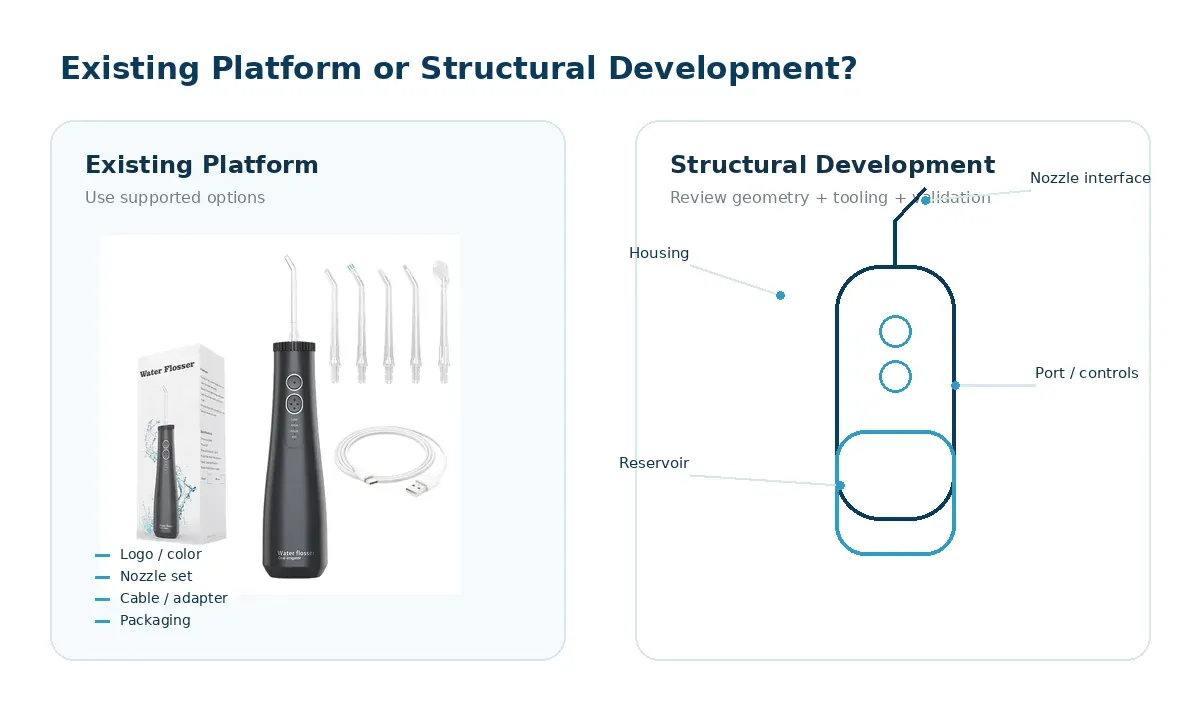
| Buyer Situation | More Suitable Path |
|---|---|
| Core architecture works and differentiation is mostly branding or configuration | Existing platform / private label |
| Existing approved nozzle, accessory or charging options meet the brief | Existing-platform configuration |
| Modes, indicators or supported power functions need revision | Functional customization, subject to engineering review |
| A distinct reservoir, nozzle interface, housing feature or water path is required | Structural / tooling project |
| A different form factor, pump architecture, proprietary ecosystem or unsupported electronics are required | New platform development |
Before requesting custom development, define what actually needs to be unique.
If differentiation can come from branding, color, packaging and existing configuration options, the existing platform may already satisfy the commercial goal.
Changes can make part of the existing validation evidence no longer applicable.
| Change | Validation Areas Potentially Affected |
|---|---|
| Pump | Pressure, flow, pulse, endurance, noise |
| Valve / Tubing / Seal | Leakage, output stability, water-path reliability |
| Reservoir | Fit, leakage, structure |
| Nozzle Interface | Fit, retention, removal, rotation, leakage |
| PCB / Firmware | Modes, indicators, output behavior |
| Battery / Charging | Charging, runtime, indicators, documentation |
| Charging Port | Charging, housing fit, ingress configuration |
| Housing / Port Cover | Structure, sealing, IP evidence |
| Material | Fit, sealing, dimensional stability, appearance |
Customization does not automatically require full retesting. It requires an impact review.
The deeper the change, the more existing validation evidence should be reviewed for continued applicability.
A customized project may require updates to:
A customized product should be controlled by the approved project revision, not only the supplier’s generic catalog page.
For engineering-change and repeat-order control, see BOM & Engineering Change Control.
Before sending an RFQ, divide the requirements into three groups:
Requirements that cannot change.
Elements that do not need differentiation.
Areas where the supplier’s established configuration is acceptable.
This prevents unnecessary engineering work when only a small number of features actually matter commercially.
A practical brief can include:
| Field | Buyer Should Define |
|---|---|
| Target Market | Destination markets, language and plug needs |
| Product Type | Cordless, countertop, travel or other |
| Reference Platform | Supplier model or reference concept |
| Target Positioning | Entry, mid-tier, premium, travel, family or other |
| Logo | Artwork, location, size and preferred process |
| Color / Finish | Color reference, matte, gloss or texture |
| Housing | Existing housing acceptable or unique elements required |
| Reservoir | Color, transparency, capacity, architecture and fill method |
| Output / Modes | Required modes, output behavior, memory and timer |
| Nozzle System | Quantity, type, identification and interface requirements |
| Battery / Charging | Runtime, connector, cable, adapter, base and plug |
| Controls | Icons, labels, buttons, LEDs and display |
| Accessories | Case, holder, replacement nozzles or other items |
| Packaging | Retail box, insert, manual, barcode and labels |
| Documentation | Required product, test and battery records |
| Exclusive Features | What must be technically or commercially unique |
| Must-Have Items | Non-negotiable requirements |
| Supplier-Standard Items | Elements that may remain unchanged |
| Optional Items | Areas open to supplier recommendation |
For how to structure the full brief, see How to Prepare an Oral-Care Product Brief Before Contacting an OEM Supplier.
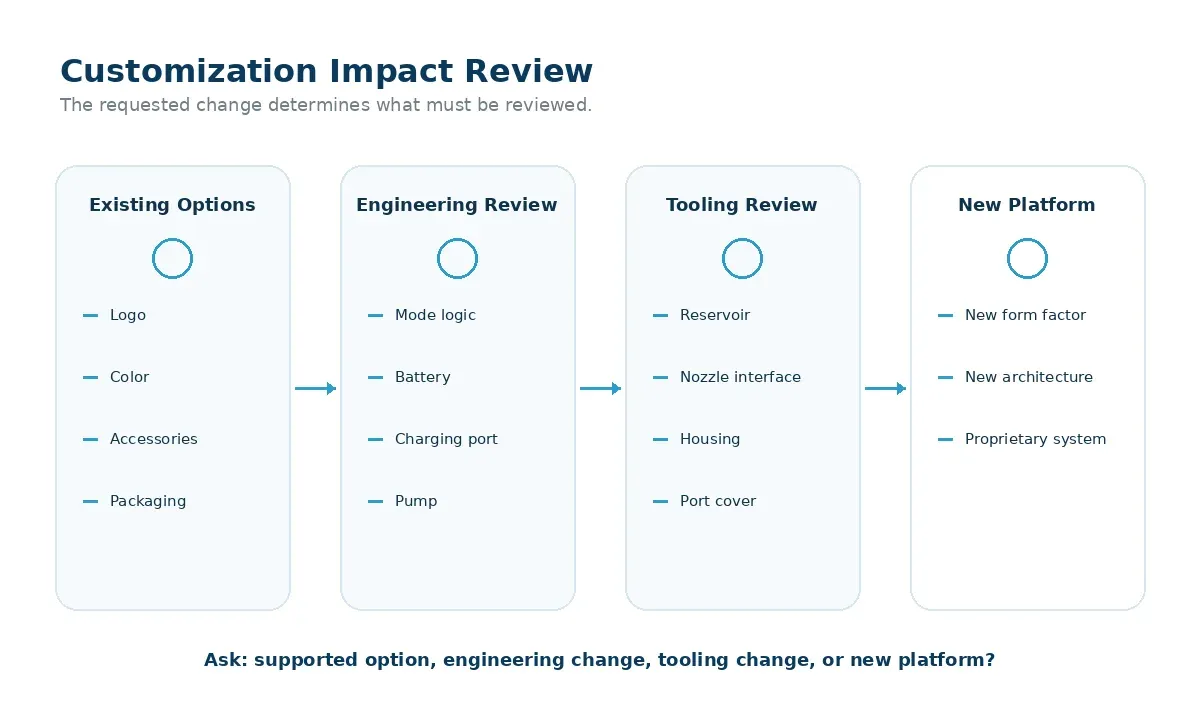
This matrix helps separate standard options from engineering work before samples or tooling begin.
| Customization Item | Existing Platform Support | Engineering Impact | Tooling Impact | Validation Impact | Buyer Should Confirm |
|---|---|---|---|---|---|
| Logo | Often supported | Usually low | Printed: usually none; molded: review may be needed | Durability review where relevant | Method, location, artwork, approved sample |
| Color | Often supported where options exist | Usually low | Depends on resin and finish | Appearance review | Color reference and consistency |
| Surface Finish | Depends on platform | Process review may be needed | Texture/coating may need review | Cosmetic and adhesion review | Finish sample and process |
| Packaging | Often supported | BOM and artwork impact | Usually none on core product | Claim/document review | Box, insert, manual, barcode |
| Nozzle Quantity | Often supported | BOM and packaging impact | Usually none | Compatibility confirmation | Quantity, pack-out, replacement supply |
| Nozzle Type | Depends on existing interface | Configuration or engineering | Depends on nozzle/interface | Fit and function review | Compatibility |
| Accessory Set | Often supported | BOM and packaging impact | Usually none on core product | Accessory review | Exact included items |
| Mode Name | Often supported | Artwork/manual impact | Usually none | Instructions must match | Naming and label revision |
| Mode Logic | Depends on firmware/PCB | May require engineering | Usually none directly | Function/output review | Supported behavior and firmware revision |
| LED / Display | Depends on hardware | May require firmware or PCB | Housing-window change may need review | Indicator review | Colors, icons and logic |
| Battery | Depends on cavity, PCB and charging system | May require engineering | May affect housing/cavity | Charging, runtime and document review | Pack, voltage, capacity and reference |
| Charging Cable | Often supported | BOM impact | Usually none | Accessory review | Type, length and packaging |
| Charging Connector | Depends on platform | Often engineering | Housing/port-cover review may be needed | Charging and ingress review | PCB, port, cable and cover |
| Reservoir Color | Often possible | Material/cosmetic review | Depends on material/process | Fit/sealing review if material changes | Transparency, material and color |
| Reservoir Capacity | Often structural | Engineering review likely | Tooling review likely | Fit, leakage and water-path review | Geometry, fill, sealing and packaging |
| Reservoir Architecture | Usually deeper change | Engineering required | Tooling review likely | Leakage, fit and output review | Fixed, removable, telescopic or fill method |
| Nozzle Interface | Usually structural | Engineering required | Tooling review likely | Fit, retention and leakage review | Coupling, release and sealing |
| Pump | Depends on existing options | Engineering review | May affect mounting/water path | Output, endurance and noise review | Pump reference and output basis |
| Pressure / Pulse | Depends on system capability | Firmware, PCB, pump or water-path review | Depends on technical solution | Output and reliability review | Target, method and technical approach |
| Water Path | Usually engineering change | Engineering required | May involve molded parts | Leakage and output review | Tubing, valves, seals and joints |
| Housing Geometry | Usually structural | Engineering required | Tooling review likely | Structure, fit and IP review | Geometry and internal layout |
| Material | Depends on component and process | Material/process review | May affect tooling/process | Fit, sealing and appearance review | Material grade and component scope |
| Port Cover | Depends on platform | May require engineering | Housing/tooling review may apply | Ingress and fit review | Geometry, material and sealing |
| IP Target | Not a simple option | Design and sealing review | May require structural/tooling review | Ingress evidence required | Exact claimed configuration |
This is a decision aid, not a universal rulebook.
The final answer for every item depends on the selected platform and supplier engineering review.
Before approving development, ask:
A supplier’s answer should make the development scope clearer before quotation, tooling or sampling begins.
After customization, a repeat order should reference:
Do not reorder a customized water flosser only by the supplier’s catalog model name.
The commercial name may stay the same while internal configuration changes.
For approved-sample control, see Golden Sample Approval for Oral-Care OEM Projects.
Before asking for a custom water flosser, decide:
The objective is not to customize as many features as possible.
The goal is to customize the features that matter to the product while keeping the development scope controlled.
If an existing platform already meets the core product requirements, define the few features that truly need to change before moving into structural or tooling development.
Where the platform supports them, lower-depth changes may include printed or laser branding, supported colors, packaging, nozzle quantity, approved nozzle types, accessory sets, cable or adapter configuration and existing firmware options.
Each item still needs supplier confirmation. Even without new tooling, changes may require BOM updates, samples, artwork approval or documentation revisions.
No.
Private label generally means an existing product is sold under the buyer’s brand, with buyer-specific logo, packaging, SKU or instructions.
It does not automatically include a unique housing, proprietary nozzle system, private mold or product exclusivity.
A custom-designed product involves deeper structural or new-development work.
Often, if the selected color or finish is already supported by the existing housing, material and process.
However, a new material, texture or coating may require additional process or tooling review.
Changing color is also different from changing geometry. Geometry changes the physical part and can affect tooling and assembly.
It depends on the platform.
A connector change can affect the PCB, housing opening, port cover, charging cable and ingress-protection configuration.
Some platforms may already support an alternative connector. Others may require engineering or tooling modification.
The supplier should identify which components and validation evidence the change affects.
Sometimes, but it may be a structural change.
A different capacity can affect reservoir geometry, housing fit, balance, water intake, seals, water path, packaging and validation.
It may also require tooling review.
Changing reservoir color or transparency is generally a different and lower-depth request than changing reservoir architecture.
Not necessarily.
Water output depends on the pump, motor, PCB, firmware, battery and water path together.
Some platforms may support alternative programmed output settings, but a different target can also require pump, electrical or fluid-path changes.
Start with the required output and ask how the supplier proposes to achieve it.
Not automatically.
Private tooling can describe buyer-specific or buyer-funded tooling, but tooling ownership, permitted use, maintenance and commercial exclusivity are separate commercial terms.
A custom logo or custom color also does not create an exclusive product design.
Any exclusivity should be defined clearly in the commercial agreement.
Changes to the pump, valves, tubing, seals, reservoir, nozzle interface, PCB, firmware, battery, charging port, housing, port cover or materials can affect previously validated product characteristics.
Each relevant change should trigger an impact review to determine which previous evidence remains applicable and which checks need repeating.
Not every change requires full retesting.