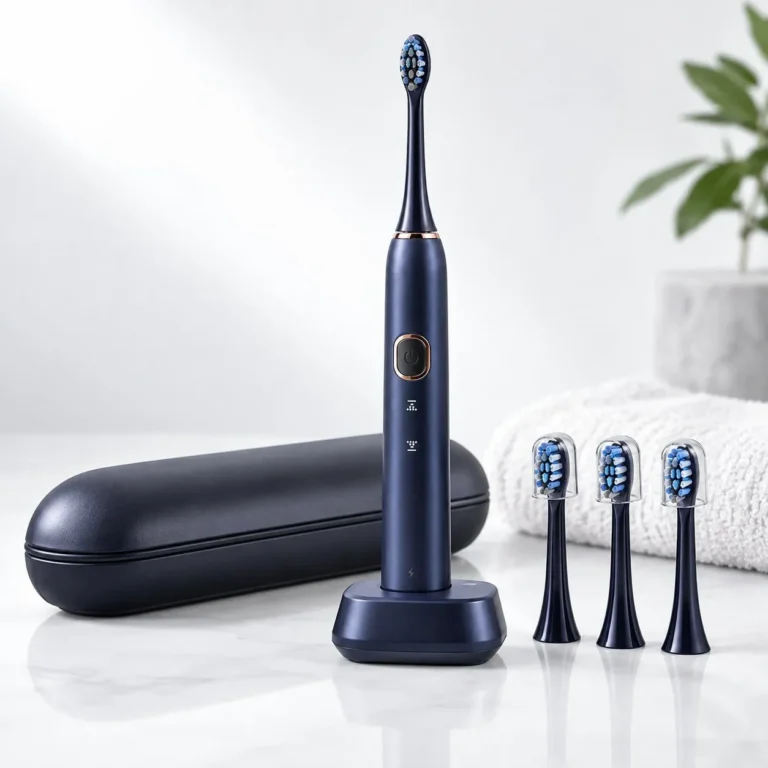
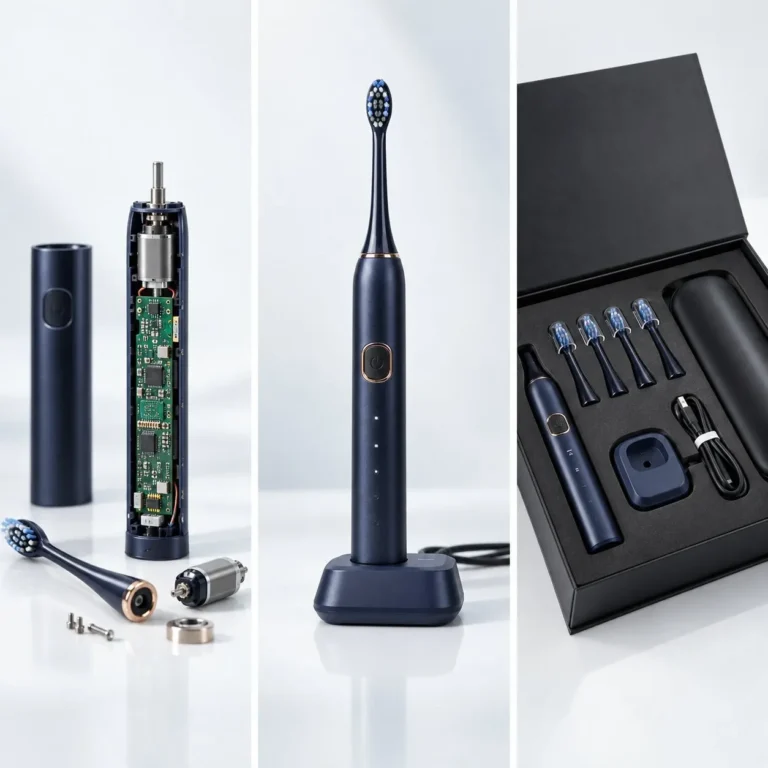
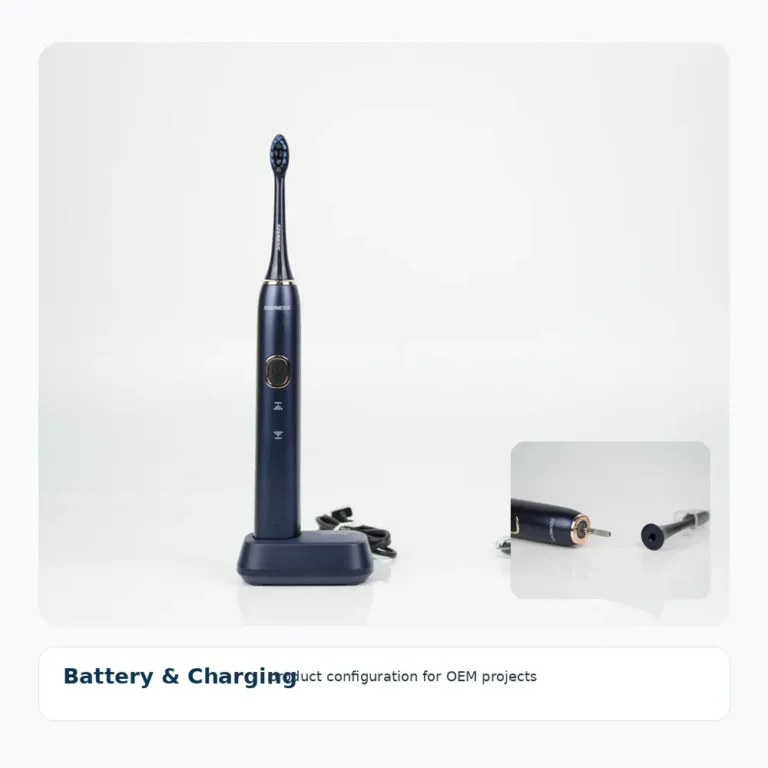
Start Your Electric Toothbrush Project
Tell us your product requirements and target market. We will review the details and reply with the relevant next steps.

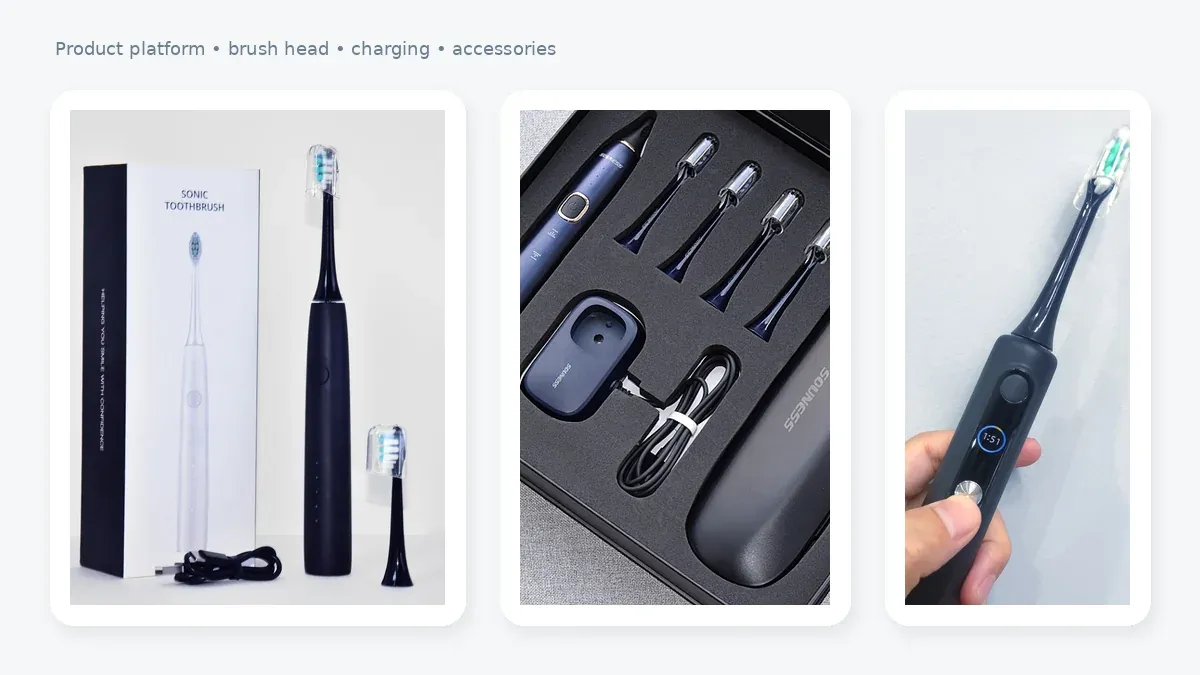
Before comparing electric toothbrush models for an OEM or private-label project, define the product platform and motion architecture, the movement metric and its measurement definition, the mode and intensity logic, the battery and runtime basis, the charging configuration, the ingress claim, the brush-head ecosystem, the accessory bundle, and the target-market version.
A feature name or headline number is not a complete specification.
Two similar-looking handles can differ in drive system, measured movement, control logic, battery, charging and refill ecosystem.
This guide gives B2B buyers a practical specification framework for turning supplier marketing language into comparable product definitions.
The first specification decision is the platform.
That may be an adult rechargeable sonic-style handle, an oscillating or rotating format, a simpler vibration-driven product, a battery-powered compact model, or a kids-oriented platform.
Platform choice affects the brush-head ecosystem, available battery and charging configurations, feature scope and later customization decisions.
Comparing mode counts across different platforms before defining the platform itself can create misleading comparisons.
A supplier’s housing shape or mode names do not prove that two products use the same internal architecture.
Two handles with similar exteriors can still use different drive systems and behave differently in operation.
The platform question therefore comes before the feature-count question.
Record what the brush head physically does.
Depending on the platform, that may be:
Then record the stated movement unit, the measurement point, and whether the figure describes the motor, shaft or brush head itself.
The brush-head system belongs in the platform decision rather than being treated only as an accessory.
Define:
The selected handle platform can also affect the later refill strategy, so replacement-head availability should be considered before final model selection.
Bristle fields can remain high-level at this stage:
For compatibility verification and refill sourcing control, see the Replacement Brush Head Sourcing Checklist.
This is one of the most important parts of electric toothbrush model comparison.
Common movement terms can describe different physical measures.
| Term | Why It Can Be Ambiguous | What the Buyer Should Define |
|---|---|---|
| Vibration frequency | May describe an electrical, motor, shaft or brush-head measure | Measurement point, unit, operating mode and load condition |
| Strokes / movements per minute | May count bristle-tip, head or drive movement | What component moves and how movements are counted |
| Oscillations per minute | May not show angular sweep or whether another movement is included | Oscillation definition, angular movement where relevant and test condition |
| Rotations per minute | Can describe motor RPM rather than brush-head action | Whether the figure refers to motor speed, shaft speed or head rotation |
| Amplitude | A frequency figure alone does not show movement distance | Measurement method, location and whether amplitude changes by mode |
| Motor RPM | Does not necessarily equal brush-head movement | Transmission relationship and resulting brush-head motion |
Established brands also use different public terms such as “bristle movements per minute” and “microvibrations per minute.”
Those figures should not automatically be treated as equivalent metrics.
A headline number is only useful for comparison when the measurement definition, operating mode, measurement point and test condition are clear.
A higher figure does not by itself establish a better product.
For B2B comparison, ask the supplier to state:
Mode names such as “clean,” “sensitive,” “whitening” or “massage” are user-facing labels.
They are not complete technical definitions.
For supplier comparison, separate four things:
Mode count
The number of named operating programs.
Intensity levels
Adjustable output settings within or across modes.
Mode behavior
The movement or power setting, timer duration, pacer sequence and feedback behavior associated with each mode.
Control logic
Startup default, short-press versus long-press behavior, last-mode memory, auto shut-off, lock and indicator behavior.
A product advertised as “five modes” may have five independently programmed settings.
Another may use fewer named modes with several intensity levels.
These are different control structures and should not be compared by mode count alone.
A controlled specification should therefore record the logic behind each mode.
Timer and pacer functions should also be treated as product logic.
Define:
“Smart pressure sensor” and “pressure control” can describe different implementations.
Define whether sensor-based pressure detection actually exists.
Then define:
Pressure feedback should be specified as a device function.
Avoid attaching unsupported oral-health outcome claims to the feature.
Battery capacity alone does not establish finished-product runtime.
Runtime can also depend on:
Record battery and runtime as separate specification areas.
Relevant fields may include:
The runtime test basis is especially important.
Ask how the claim was calculated:
A statement such as “30-day battery life” is difficult to compare without those assumptions.
Use this rule:
Compare battery capacity together with a defined runtime test basis. Do not treat higher mAh as automatic proof of longer finished-product runtime.
Charging configuration can affect:
Possible charging architectures include:
Define:
USB-C is not automatically the preferred option for every project.
The appropriate charging approach depends on the intended product architecture, sealing, accessory bundle, target market and commercial positioning.
“Waterproof” is broad marketing wording.
An IP classification under IEC 60529 is a more specific enclosure-protection claim, but it still needs context.
For example, in IPX7, the “X” means that a solids-ingress numeral is not stated.
The rating relates to defined test conditions and should not be interpreted as proof that the product is protected against every possible real-world exposure.
For sourcing purposes, record:
How to review whether supporting evidence actually matches the final shipped product is covered in How to Review Oral-Care Product Test Reports Before OEM Approval.
Define the physical control system.
That may include:
Also define button logic:
Bluetooth or app-connected products should be treated as a distinct configuration when the connected functions affect hardware, firmware or documentation.
Potential smart functions can include:
A connected SKU should therefore have its own clearly defined scope in the model-comparison table rather than being treated simply as “the same handle plus an app.”
“White,” “premium finish” and “soft touch” are not complete specifications.
Where relevant, define:
Useful dimensional fields can include:
These dimensions can affect accessory fit, packaging and shipping.
The accessory bundle should also be compared like-for-like.
Confirm:
Two handles that look identical may still represent different commercial configurations when the charging method, included heads, case or adapter differs.
The intended destination market should be defined before quotations are compared.
Depending on the project, market-specific differences can include:
A supplier may describe two configurations under the same general platform even though the commercial setup for each market is different.
For B2B comparison, make the target market part of the specification from the beginning.
Supplier pages often use short marketing terms.
The buyer’s job is to convert those terms into comparable definitions.
| Marketing Wording | What the Buyer Should Ask | Controlled Specification Approach |
|---|---|---|
| “40,000 vibrations” | What moves, where is it measured, in which mode and under what condition? | State movement metric, unit, measurement point, mode and condition |
| “30-day battery life” | Based on what session length, mode, intensity and depletion endpoint? | State capacity and defined runtime basis separately |
| “5 cleaning modes” | What changes in each mode? Are intensity levels separate? | Record mode logic, timer, pacer and memory behavior |
| “Smart pressure sensor” | Is there an actual sensor? What feedback and motor response occur? | Define detection method, trigger, feedback and control response |
| “IPX7 waterproof” | Which product configuration was evaluated and what evidence supports it? | Record IP claim, configuration and evidence reference |
| “Fast charging” | From what starting charge and using what input? | State charging-time basis and input conditions |
| “Ultra-quiet motor” | Measured how, at what distance and in which mode? | Use a noise claim only where a defined method and evidence exist |
| “Soft brush head” | Which filament, stiffness designation, profile and end treatment? | Reference an agreed brush-head specification |
| “Medical-grade material” | Which material, component and evidence support the wording? | State the actual material and avoid broad claims without evidence |
Put shortlisted models into one comparison table.
The buyer-requirement column should come first.
Define what the project needs before reviewing what each supplier offers.
| Specification | Buyer Requirement | Supplier A | Supplier B | Supplier C | Notes / Evidence Needed |
|---|---|---|---|---|---|
| Product platform / motion type | Physical brush-head movement | ||||
| Movement metric and definition | Unit, measurement point, mode, condition | ||||
| Modes and intensity levels | Logic behind each mode | ||||
| Timer / pacer / memory | Press logic and defaults | ||||
| Pressure feature | Detection, feedback and control response | ||||
| Battery | Chemistry, capacity, voltage, structure | ||||
| Runtime basis | Defined use-cycle assumptions | ||||
| Charging configuration | Cable, dock, input and adapter inclusion | ||||
| Charging-time basis | Input and starting battery state | ||||
| Ingress claim | Product configuration and evidence reference | ||||
| Brush-head system | Interface and refill availability | ||||
| Included heads and caps | Type and count | ||||
| UI / indicators | Buttons, LEDs, display and lock | ||||
| Smart features | Bluetooth, app and firmware scope | ||||
| Materials / CMF | Material, color, finish and logo process | ||||
| Dimensions / weight | Handle, base and case where relevant | ||||
| Accessory bundle | Like-for-like bundle confirmation | ||||
| Target-market configuration | Plug, languages, labels and documentation |
This framework can also support later RFQ, sample and project-planning work.
For project-stage templates and planning tools, see Project Resources.
Define:
Convert marketing claims into controlled definitions.
Confirm whether movement figures use comparable:
Also align:
Separate existing platform differences from genuine customization requests.
Fix the shortlisted platform and intended configuration.
Confirm:
Identify which product claims may later require supporting evidence.
Compare physical samples against the same specification framework.
Confirm:
Reliability and validation questions should then be reviewed through Electric Toothbrush Reliability Testing: What OEM Buyers Should Verify Before Mass Production.
If core specifications change after samples have already been requested, earlier comparisons may need to be repeated.
Stabilizing the comparison criteria before sample development can reduce avoidable rework.
| Buyer Mistake | Why It Matters | Safer Practice |
|---|---|---|
| Comparing price and appearance only | Similar housings can use different drive, battery and charging systems | Compare against one controlled specification table |
| Comparing vibration figures without definitions | Terms may describe different physical measures | Request metric, measurement point, mode and condition |
| Comparing mode count only | Labels do not define operating behavior | Compare mode logic and intensity architecture |
| Treating battery capacity as runtime | Capacity does not represent load or use-cycle assumptions | Record capacity and runtime basis separately |
| Ignoring charging configuration | It can change construction, accessories, packaging and market setup | Define charging method and included components early |
| Ignoring the brush-head ecosystem | Handle choice can affect the later refill strategy | Define interface and refill direction before selection |
| Using marketing language in the brief | Creates quotation and sample ambiguity | Convert marketing wording into controlled definitions |
| Leaving target market undefined | Plug, languages, labels and documentation may differ | State destination market before comparison |
| Changing core specifications after samples begin | Earlier sample comparisons may no longer be equivalent | Stabilize core comparison fields before sample requests |
Start with the product platform and motion architecture, brush-head ecosystem, movement metric and measurement definition, mode and intensity logic, battery and runtime basis, charging configuration, ingress claim, accessory bundle and target market.
These fields provide the foundation for supplier comparison.
Not necessarily.
A stated figure can describe motor RPM, shaft movement, brush-head action or another defined measure.
Without a measurement definition and point, two figures should not automatically be treated as comparable.
No.
A movement figure alone does not establish overall product quality or suitability.
Compare the figure together with its definition, measurement conditions and overall platform configuration.
Modes are named operating programs.
Intensity levels are adjustable output settings within or across those modes.
Two products with the same number of modes can still use very different control logic.
No.
Finished-product runtime also depends on operating load, motion system, mode, intensity, timer behavior and other conditions.
Compare battery capacity together with a defined runtime test basis.
Ask for the test assumptions behind the claim.
These may include:
Runtime claims are easier to compare when the underlying assumptions are reasonably similar.
It can.
A different charging method may change the product construction, sealing, accessory bundle, packaging contents, market configuration or documentation.
Charging architecture should therefore be treated as a controlled specification field.
It should be treated as a defined ingress-protection claim tied to a stated product configuration and supporting evidence.
It should not be interpreted or marketed simply as “completely waterproof.”
Prepare the platform direction, target markets, movement and mode requirements, battery and charging direction, ingress claim, brush-head plan and accessory bundle before requesting a project review.
A controlled specification can make supplier quotations easier to compare and reduce avoidable back-and-forth during later sample and development stages.
Before comparing electric toothbrush models for an OEM or private-label project, define the product platform and motion architecture, the movement metric and its measurement definition, the mode and intensity logic, the battery and runtime basis, the charging configuration, the ingress claim, the brush-head ecosystem, the accessory bundle, and the target-market version.
A feature name or headline number is not a complete specification.
Two similar-looking handles can differ in drive system, measured movement, control logic, battery, charging and refill ecosystem.
This guide gives B2B buyers a practical specification framework for turning supplier marketing language into comparable product definitions.
The first specification decision is the platform.
That may be an adult rechargeable sonic-style handle, an oscillating or rotating format, a simpler vibration-driven product, a battery-powered compact model, or a kids-oriented platform.
Platform choice affects the brush-head ecosystem, available battery and charging configurations, feature scope and later customization decisions.
Comparing mode counts across different platforms before defining the platform itself can create misleading comparisons.
A supplier’s housing shape or mode names do not prove that two products use the same internal architecture.
Two handles with similar exteriors can still use different drive systems and behave differently in operation.
The platform question therefore comes before the feature-count question.
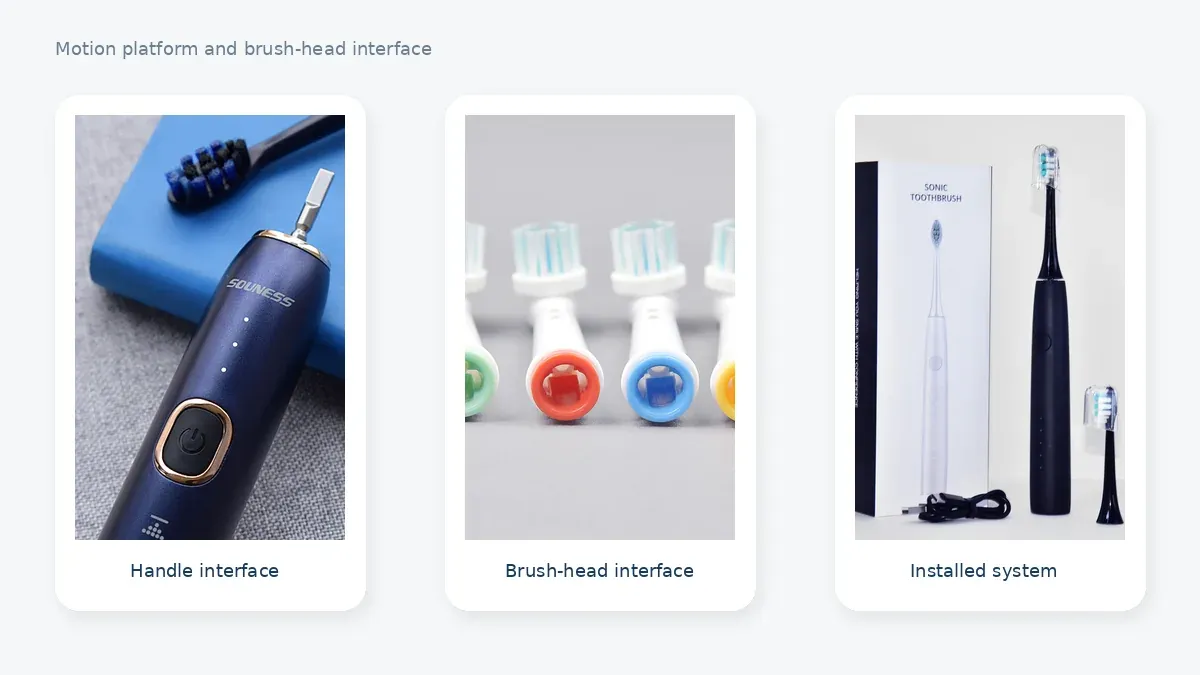
Record what the brush head physically does.
Depending on the platform, that may be:
Then record the stated movement unit, the measurement point, and whether the figure describes the motor, shaft or brush head itself.
The brush-head system belongs in the platform decision rather than being treated only as an accessory.
Define:
The selected handle platform can also affect the later refill strategy, so replacement-head availability should be considered before final model selection.
Bristle fields can remain high-level at this stage:
For compatibility verification and refill sourcing control, see the Replacement Brush Head Sourcing Checklist.
This is one of the most important parts of electric toothbrush model comparison.
Common movement terms can describe different physical measures.
| Term | Why It Can Be Ambiguous | What the Buyer Should Define |
|---|---|---|
| Vibration frequency | May describe an electrical, motor, shaft or brush-head measure | Measurement point, unit, operating mode and load condition |
| Strokes / movements per minute | May count bristle-tip, head or drive movement | What component moves and how movements are counted |
| Oscillations per minute | May not show angular sweep or whether another movement is included | Oscillation definition, angular movement where relevant and test condition |
| Rotations per minute | Can describe motor RPM rather than brush-head action | Whether the figure refers to motor speed, shaft speed or head rotation |
| Amplitude | A frequency figure alone does not show movement distance | Measurement method, location and whether amplitude changes by mode |
| Motor RPM | Does not necessarily equal brush-head movement | Transmission relationship and resulting brush-head motion |
Established brands also use different public terms such as “bristle movements per minute” and “microvibrations per minute.”
Those figures should not automatically be treated as equivalent metrics.
A headline number is only useful for comparison when the measurement definition, operating mode, measurement point and test condition are clear.
A higher figure does not by itself establish a better product.
For B2B comparison, ask the supplier to state:
Mode names such as “clean,” “sensitive,” “whitening” or “massage” are user-facing labels.
They are not complete technical definitions.
For supplier comparison, separate four things:
Mode count
The number of named operating programs.
Intensity levels
Adjustable output settings within or across modes.
Mode behavior
The movement or power setting, timer duration, pacer sequence and feedback behavior associated with each mode.
Control logic
Startup default, short-press versus long-press behavior, last-mode memory, auto shut-off, lock and indicator behavior.
A product advertised as “five modes” may have five independently programmed settings.
Another may use fewer named modes with several intensity levels.
These are different control structures and should not be compared by mode count alone.
A controlled specification should therefore record the logic behind each mode.
Timer and pacer functions should also be treated as product logic.
Define:
“Smart pressure sensor” and “pressure control” can describe different implementations.
Define whether sensor-based pressure detection actually exists.
Then define:
Pressure feedback should be specified as a device function.
Avoid attaching unsupported oral-health outcome claims to the feature.
Battery capacity alone does not establish finished-product runtime.
Runtime can also depend on:
Record battery and runtime as separate specification areas.
Relevant fields may include:
The runtime test basis is especially important.
Ask how the claim was calculated:
A statement such as “30-day battery life” is difficult to compare without those assumptions.
Use this rule:
Compare battery capacity together with a defined runtime test basis. Do not treat higher mAh as automatic proof of longer finished-product runtime.
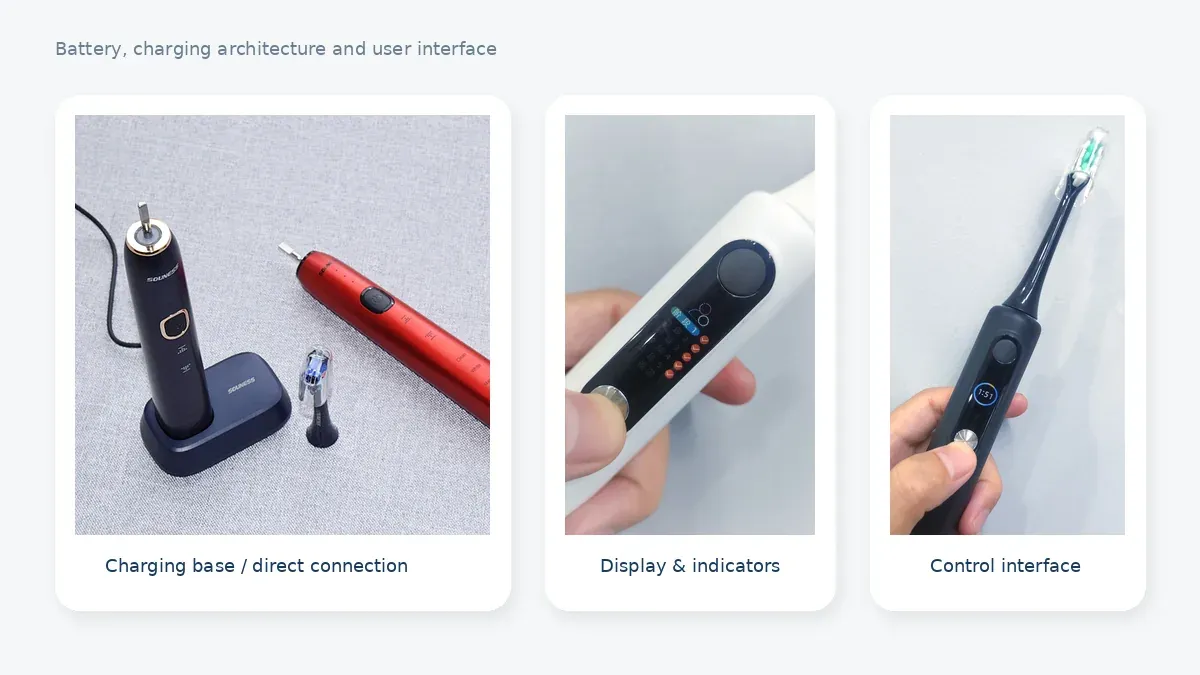
Charging configuration can affect:
Possible charging architectures include:
Define:
USB-C is not automatically the preferred option for every project.
The appropriate charging approach depends on the intended product architecture, sealing, accessory bundle, target market and commercial positioning.
“Waterproof” is broad marketing wording.
An IP classification under IEC 60529 is a more specific enclosure-protection claim, but it still needs context.
For example, in IPX7, the “X” means that a solids-ingress numeral is not stated.
The rating relates to defined test conditions and should not be interpreted as proof that the product is protected against every possible real-world exposure.
For sourcing purposes, record:
How to review whether supporting evidence actually matches the final shipped product is covered in How to Review Oral-Care Product Test Reports Before OEM Approval.
Define the physical control system.
That may include:
Also define button logic:
Bluetooth or app-connected products should be treated as a distinct configuration when the connected functions affect hardware, firmware or documentation.
Potential smart functions can include:
A connected SKU should therefore have its own clearly defined scope in the model-comparison table rather than being treated simply as “the same handle plus an app.”
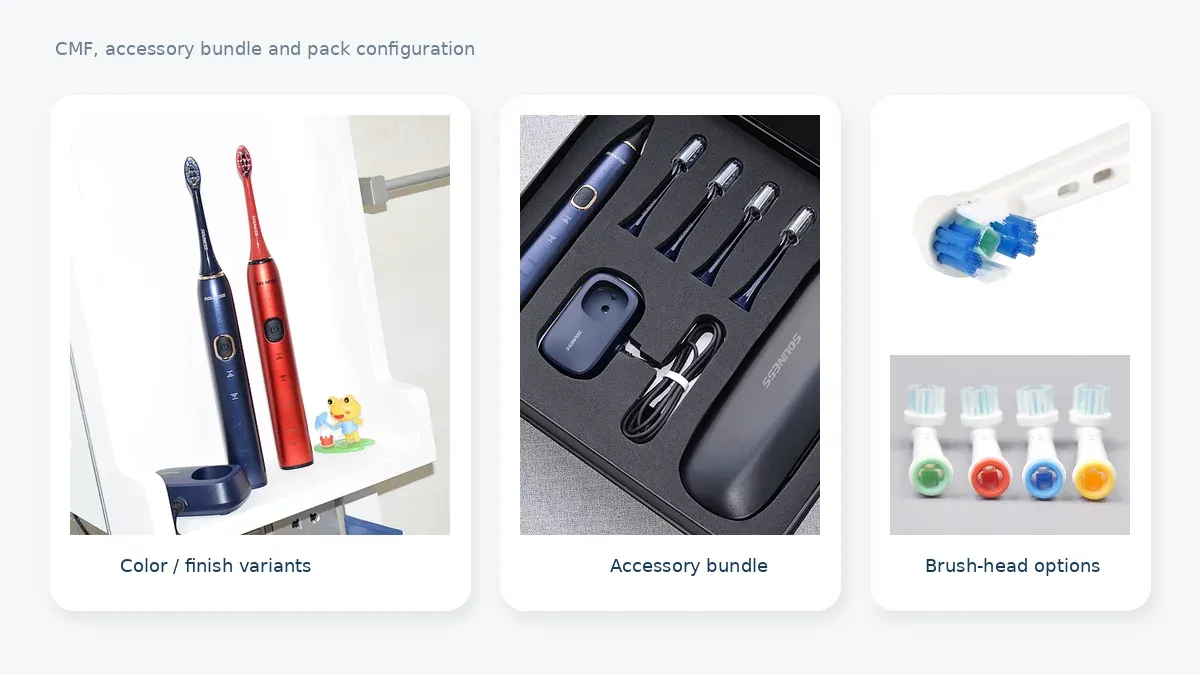
“White,” “premium finish” and “soft touch” are not complete specifications.
Where relevant, define:
Useful dimensional fields can include:
These dimensions can affect accessory fit, packaging and shipping.
The accessory bundle should also be compared like-for-like.
Confirm:
Two handles that look identical may still represent different commercial configurations when the charging method, included heads, case or adapter differs.
The intended destination market should be defined before quotations are compared.
Depending on the project, market-specific differences can include:
A supplier may describe two configurations under the same general platform even though the commercial setup for each market is different.
For B2B comparison, make the target market part of the specification from the beginning.
Supplier pages often use short marketing terms.
The buyer’s job is to convert those terms into comparable definitions.
| Marketing Wording | What the Buyer Should Ask | Controlled Specification Approach |
|---|---|---|
| “40,000 vibrations” | What moves, where is it measured, in which mode and under what condition? | State movement metric, unit, measurement point, mode and condition |
| “30-day battery life” | Based on what session length, mode, intensity and depletion endpoint? | State capacity and defined runtime basis separately |
| “5 cleaning modes” | What changes in each mode? Are intensity levels separate? | Record mode logic, timer, pacer and memory behavior |
| “Smart pressure sensor” | Is there an actual sensor? What feedback and motor response occur? | Define detection method, trigger, feedback and control response |
| “IPX7 waterproof” | Which product configuration was evaluated and what evidence supports it? | Record IP claim, configuration and evidence reference |
| “Fast charging” | From what starting charge and using what input? | State charging-time basis and input conditions |
| “Ultra-quiet motor” | Measured how, at what distance and in which mode? | Use a noise claim only where a defined method and evidence exist |
| “Soft brush head” | Which filament, stiffness designation, profile and end treatment? | Reference an agreed brush-head specification |
| “Medical-grade material” | Which material, component and evidence support the wording? | State the actual material and avoid broad claims without evidence |
Put shortlisted models into one comparison table.
The buyer-requirement column should come first.
Define what the project needs before reviewing what each supplier offers.
| Specification | Buyer Requirement | Supplier A | Supplier B | Supplier C | Notes / Evidence Needed |
|---|---|---|---|---|---|
| Product platform / motion type | Physical brush-head movement | ||||
| Movement metric and definition | Unit, measurement point, mode, condition | ||||
| Modes and intensity levels | Logic behind each mode | ||||
| Timer / pacer / memory | Press logic and defaults | ||||
| Pressure feature | Detection, feedback and control response | ||||
| Battery | Chemistry, capacity, voltage, structure | ||||
| Runtime basis | Defined use-cycle assumptions | ||||
| Charging configuration | Cable, dock, input and adapter inclusion | ||||
| Charging-time basis | Input and starting battery state | ||||
| Ingress claim | Product configuration and evidence reference | ||||
| Brush-head system | Interface and refill availability | ||||
| Included heads and caps | Type and count | ||||
| UI / indicators | Buttons, LEDs, display and lock | ||||
| Smart features | Bluetooth, app and firmware scope | ||||
| Materials / CMF | Material, color, finish and logo process | ||||
| Dimensions / weight | Handle, base and case where relevant | ||||
| Accessory bundle | Like-for-like bundle confirmation | ||||
| Target-market configuration | Plug, languages, labels and documentation |
This framework can also support later RFQ, sample and project-planning work.
For project-stage templates and planning tools, see Project Resources.
Define:
Convert marketing claims into controlled definitions.
Confirm whether movement figures use comparable:
Also align:
Separate existing platform differences from genuine customization requests.
Fix the shortlisted platform and intended configuration.
Confirm:
Identify which product claims may later require supporting evidence.
Compare physical samples against the same specification framework.
Confirm:
Reliability and validation questions should then be reviewed through Electric Toothbrush Reliability Testing: What OEM Buyers Should Verify Before Mass Production.
If core specifications change after samples have already been requested, earlier comparisons may need to be repeated.
Stabilizing the comparison criteria before sample development can reduce avoidable rework.
| Buyer Mistake | Why It Matters | Safer Practice |
|---|---|---|
| Comparing price and appearance only | Similar housings can use different drive, battery and charging systems | Compare against one controlled specification table |
| Comparing vibration figures without definitions | Terms may describe different physical measures | Request metric, measurement point, mode and condition |
| Comparing mode count only | Labels do not define operating behavior | Compare mode logic and intensity architecture |
| Treating battery capacity as runtime | Capacity does not represent load or use-cycle assumptions | Record capacity and runtime basis separately |
| Ignoring charging configuration | It can change construction, accessories, packaging and market setup | Define charging method and included components early |
| Ignoring the brush-head ecosystem | Handle choice can affect the later refill strategy | Define interface and refill direction before selection |
| Using marketing language in the brief | Creates quotation and sample ambiguity | Convert marketing wording into controlled definitions |
| Leaving target market undefined | Plug, languages, labels and documentation may differ | State destination market before comparison |
| Changing core specifications after samples begin | Earlier sample comparisons may no longer be equivalent | Stabilize core comparison fields before sample requests |
Start with the product platform and motion architecture, brush-head ecosystem, movement metric and measurement definition, mode and intensity logic, battery and runtime basis, charging configuration, ingress claim, accessory bundle and target market.
These fields provide the foundation for supplier comparison.
Not necessarily.
A stated figure can describe motor RPM, shaft movement, brush-head action or another defined measure.
Without a measurement definition and point, two figures should not automatically be treated as comparable.
No.
A movement figure alone does not establish overall product quality or suitability.
Compare the figure together with its definition, measurement conditions and overall platform configuration.
Modes are named operating programs.
Intensity levels are adjustable output settings within or across those modes.
Two products with the same number of modes can still use very different control logic.
No.
Finished-product runtime also depends on operating load, motion system, mode, intensity, timer behavior and other conditions.
Compare battery capacity together with a defined runtime test basis.
Ask for the test assumptions behind the claim.
These may include:
Runtime claims are easier to compare when the underlying assumptions are reasonably similar.
It can.
A different charging method may change the product construction, sealing, accessory bundle, packaging contents, market configuration or documentation.
Charging architecture should therefore be treated as a controlled specification field.
It should be treated as a defined ingress-protection claim tied to a stated product configuration and supporting evidence.
It should not be interpreted or marketed simply as “completely waterproof.”
Prepare the platform direction, target markets, movement and mode requirements, battery and charging direction, ingress claim, brush-head plan and accessory bundle before requesting a project review.
A controlled specification can make supplier quotations easier to compare and reduce avoidable back-and-forth during later sample and development stages.