Start Your Electric Toothbrush Project
Tell us your product requirements and target market. We will review the details and reply with the relevant next steps.

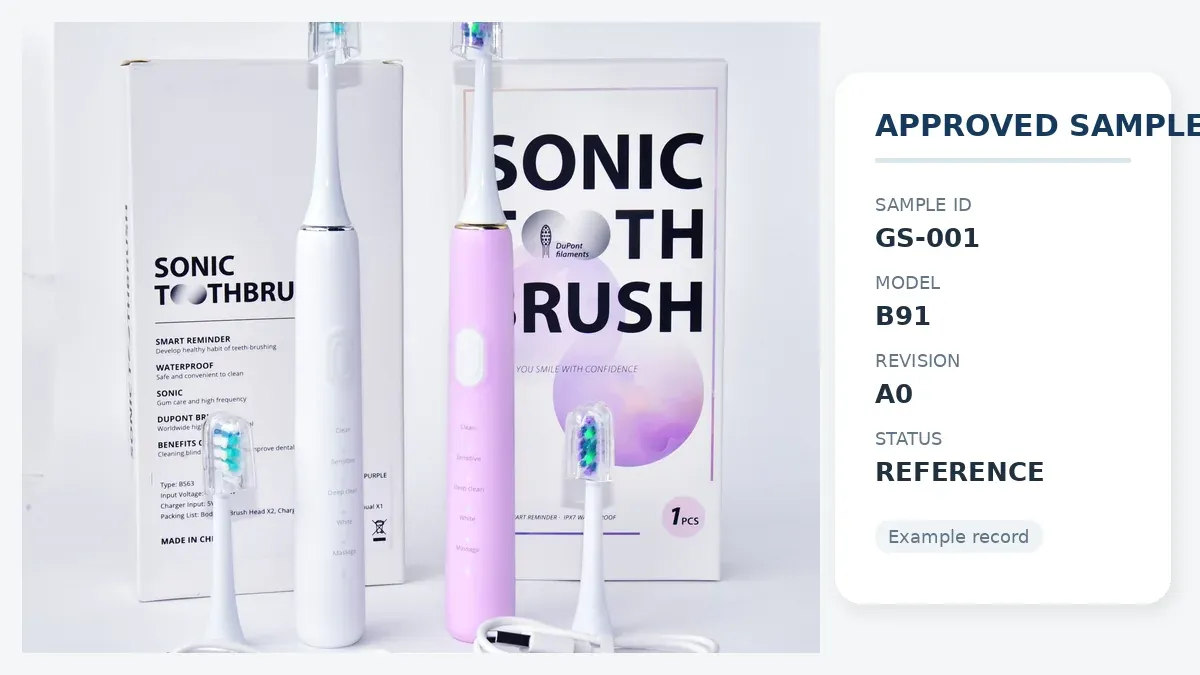
A golden sample is not simply “the perfect product.”
It is an identified approved reference tied to a defined product configuration, revision and approval scope.
Before mass production, a B2B buyer should confirm what the sample represents, which documents control it, whether accessories and packaging are included in the approval scope, who retains the reference, and how later product changes will be handled.
Used correctly, a golden sample reduces ambiguity during production and inspection.
Used as a substitute for written specifications, tolerances and controlled documents, it creates a false sense of control.
This guide explains the difference.
An approved production reference — often called a golden sample — is a physical sample used to help interpret an agreed product standard during production, inspection and later comparison.
It should work alongside controlled documentation such as:
It does not replace those documents.
Its value comes from three things:
One terminology caution is important.
“Golden sample” is common industry language, but it is not one universally standardized sample category.
Different suppliers may use the term differently.
The practical solution is to define the sample and its approval scope for each project rather than relying on the label alone.
Sample terminology can differ between suppliers and industries.
The buyer should therefore focus on what the sample represents rather than its name.
| Term | Common Practical Use | What the Buyer Should Clarify |
|---|---|---|
| Golden sample | Physical reference for an approved intended result | Which product configuration and revision it represents |
| Approved sample | A sample formally accepted at a defined project stage | What was approved: appearance, function, configuration, pack-out or another scope |
| Reference / master sample | Retained comparator, sometimes for a specific attribute | Whether it represents the whole product or only color, finish or another characteristic |
| Pre-production (PP) sample | Sample produced before mass production | Whether it uses final tooling, materials, components and processes |
| Production sample | Sample taken from actual production output | Whether it comes from pilot production, first production or stable mass production |
| Limit / boundary sample | Reference showing an acceptable or unacceptable cosmetic boundary | Which issue it represents and how the boundary should be interpreted |
The practical rule is simple:
Identify the sample’s scope, not just its name.
A hand-finished development sample, an approved color reference and a unit taken from production are not the same control.
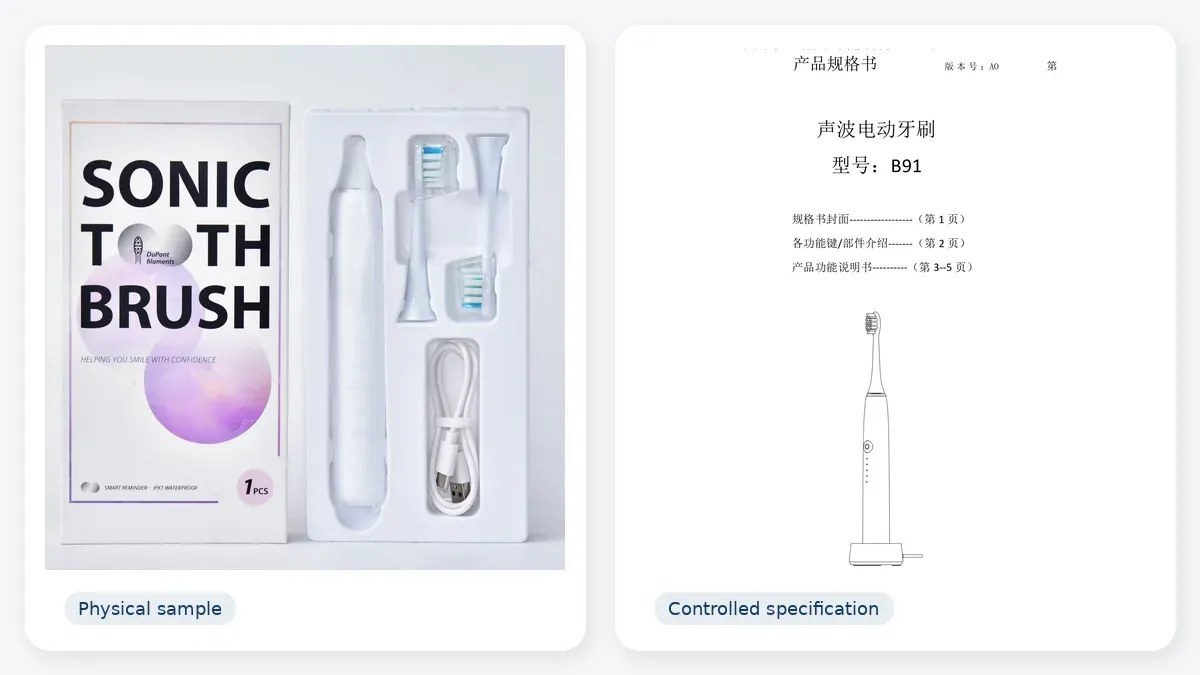
The written specification defines controlled requirements.
The physical reference helps demonstrate the agreed result.
A well-controlled project usually needs both.
A physical sample is particularly useful for characteristics that are difficult to describe completely in words, such as:
However, a physical sample cannot reliably show or define everything.
It does not by itself establish:
Two units can look nearly identical while differing internally.
Tolerances are especially important.
One sample represents one actual produced condition. It does not show the full acceptable range around that condition.
The golden sample should therefore complement specifications, drawings, configuration records and acceptance criteria.
It should never replace them.
Link the sample to a clear documented identity.
That may include:
Without these identifiers, an old reference can become ambiguous after the product is revised.
This is where a physical reference is particularly useful.
It can help communicate:
Where a cosmetic issue is subjective, separate limit or boundary samples can be useful.
These show the acceptable edge of a defined visual condition.
They complement the main approved reference rather than replacing it.
Color may also be controlled through:
The appropriate method depends on the project.
Appearance approval is not the same as functional approval.
The reference should be linked to the controlled functional requirements.
For an electric toothbrush, that may include:
For a water flosser, that may include:
For replacement brush heads, interface fit and the exact approved head variant may be relevant.
The controlled definition of electric toothbrush functions belongs in the Electric Toothbrush Product Specifications guide.
Reliability and validation planning are covered separately in Electric Toothbrush Reliability Testing.
The golden sample does not replace either of those controls.
A visual reference cannot prove which battery, PCB, seal, filament or other component is inside the product.
Where these items are controlled, link the approved sample to the applicable:
A full proprietary BOM does not need to be treated as the only possible control.
The important point is that the approved configuration can be reconstructed later.
A product sample does not automatically approve the complete pack-out.
The following may require separate approval:
State whether the approved reference represents:
Packaging structure and artwork have their own approval logic.
See the Oral-Care Packaging Guide for OEM Projects for the packaging side of the project.
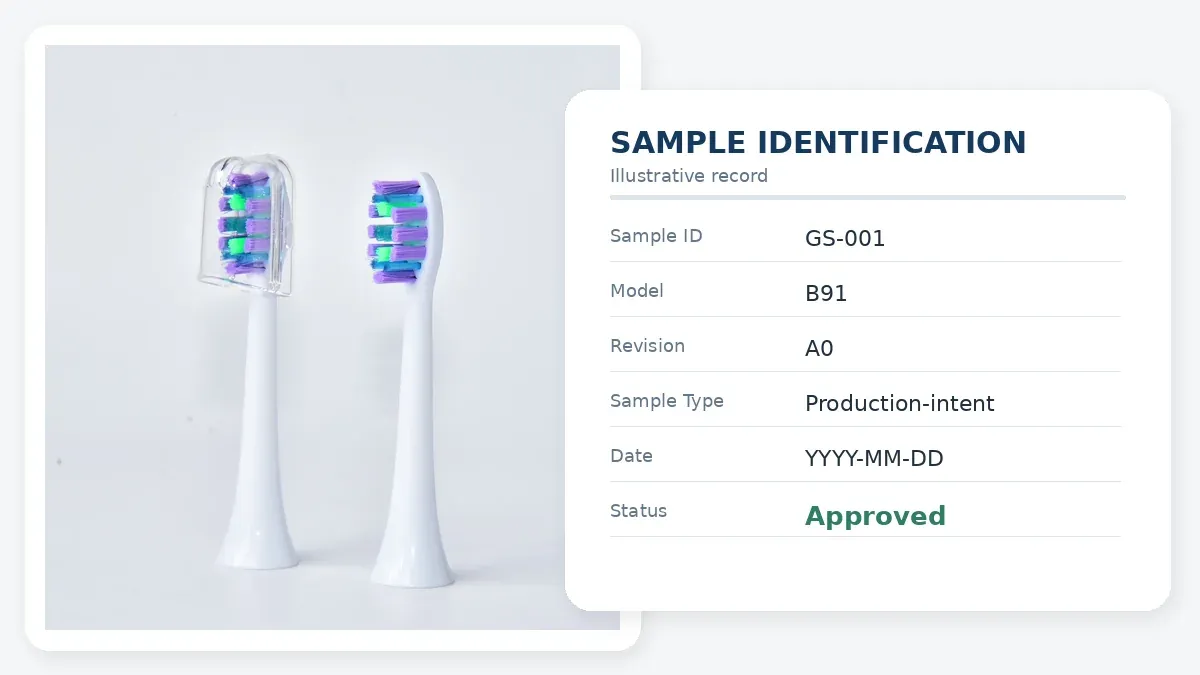
The approval record does not need to be complicated.
It does need to be specific enough that the project team can identify exactly what was approved later.
A useful record may include:
These are practical controls rather than one universal legally required form.
The goal is traceability.
A third party reviewing the project later should be able to answer:
A message such as:
“Looks good, proceed.”
does not answer those questions.
It can be useful for both buyer and supplier to retain identified reference samples.
An inspection party may also need access to the current reference where agreed.
The most important controls are:
An obsolete golden sample left in circulation can create incorrect production or inspection decisions.
There is no universal retention period.
Retention should be agreed according to project needs such as:
A development sample may not fully represent routine mass production.
It may be:
That does not make the sample useless.
It means its status must be clear.
The buyer should know whether the approved reference is:
Development sample
Used primarily to approve direction, appearance or early functionality.
Production-intent sample
Built to represent the intended final materials, components, tooling and processes as closely as practical.
Production sample
Taken from actual production output.
Where project risk, a major revision or process maturity justifies it, an early production unit can also be compared with the approved baseline before larger-volume release.
The important question is not what the stage is called.
It is:
Does actual production output still represent the approved product configuration?
An approved reference remains useful only while production stays traceable to the configuration it represents.
Changes that may require review include:
Not every change requires complete retesting or a completely new approval cycle.
Instead, assess the change’s potential effect on:
The appropriate response may be:
A revised configuration should be documented as a revised configuration.
It should not quietly continue under an old reference that no longer represents the product.
| Buyer Mistake | Why It Creates Risk | Better Practice |
|---|---|---|
| Approving by chat message only | Sample identity, revision and scope remain unclear | Use an approval record linked to the identified sample |
| Approving appearance but not configuration | A correct-looking unit can contain different internal components or firmware | State exactly what the approval covers |
| No sample ID or revision | Old and current samples can become mixed | Mark model, revision, date and status |
| Relying on photos alone | Photos cannot confirm tactile finish, fit or hidden configuration | Use photos as supporting records, not the sole reference |
| Treating the sample as the specification | Tolerances, components and acceptance criteria remain undefined | Link the sample to controlled documents |
| Allowing unreviewed substitutions | Similar-looking parts can still affect function or evidence | Establish change-notification expectations |
| Confusing development and production samples | Development units may not represent routine output | Record the production status of the sample |
| Approving the product but not the pack-out | Manual, caps, inserts or carton may remain unresolved | Define product and packaging approval scopes separately |
| Expecting zero production variation | Manufacturing works within controlled tolerances | Evaluate output against documented requirements and permitted variation |
| Using “same quality” as the criterion | Subjective language cannot guide inspection consistently | Define observable criteria and use limit samples where useful |
During production or inspection, the approved physical reference can help compare:
It is especially useful where visual or cosmetic requirements are difficult to express completely in text.
However, inspectors still need controlled written information.
That can include:
Lot acceptance should be based on the agreed inspection criteria and sampling approach.
The golden sample supports interpretation.
It is not the complete acceptance system by itself.
Confirm the approved:
Confirm:
Confirm:
Confirm:
The development route changes what must be controlled.
Approval may focus on:
The project also needs clear control of the changed:
A custom project normally requires a more detailed controlled baseline.
That may include:
For the wider development-route decision, see OEM vs ODM for Oral-Care Products.
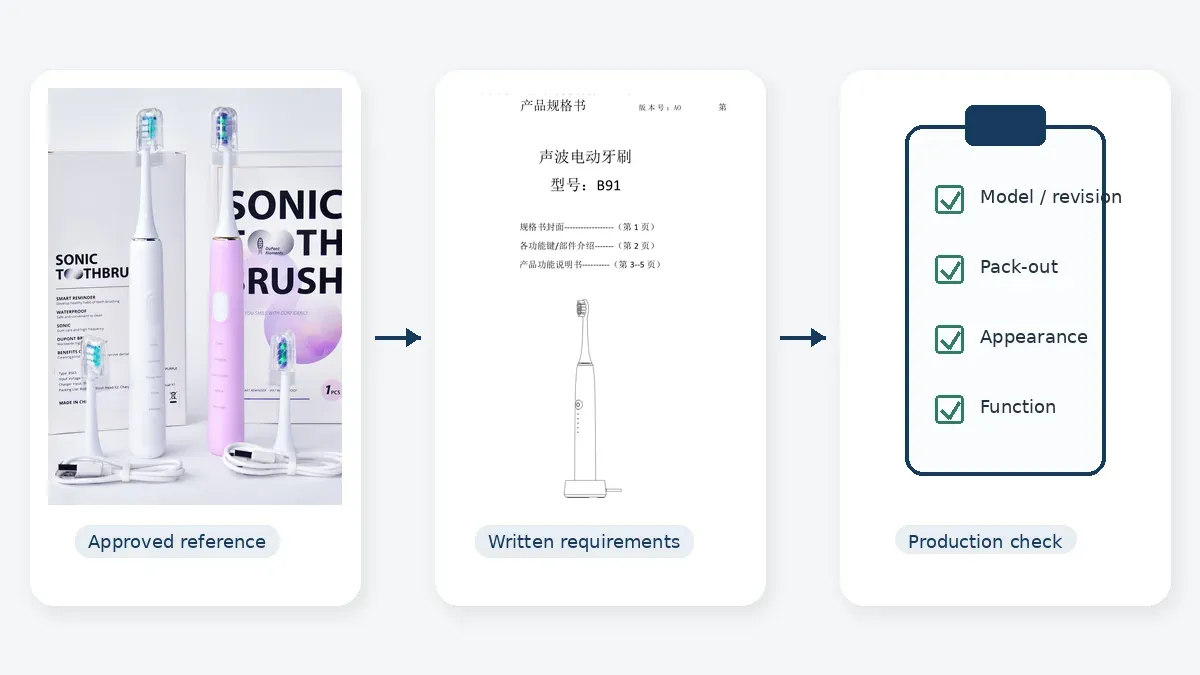
A useful approval sequence is:
Golden sample approval establishes a baseline.
Mass-production output is then evaluated against the documented requirements and permitted variation.
The physical sample helps interpret that baseline.
It does not replace it.
For related approval, configuration and change-control resources, see Project Resources.
A golden sample is an identified physical sample approved as a reference for a defined product configuration.
It can help buyer, supplier and inspection teams interpret the agreed product standard during production and inspection.
Because the term is used differently across suppliers, the project’s own definition and approval scope are more important than the label.
No.
A physical sample cannot completely define internal materials, components, firmware, tolerances, test methods or acceptance criteria.
It should be used together with controlled specifications and other project documents.
A golden sample is an approved reference.
Depending on the project, it may be a development-stage, production-intent or actual production unit.
A production sample is taken from production output.
The project should clearly identify which type of sample is being used as the approved reference.
Not in every measurable detail.
Manufacturing works within controlled requirements and permitted variation.
Production should conform to the approved specifications and acceptance criteria, while the golden sample helps interpret appearance and other agreed characteristics.
It is often useful for both buyer and supplier to retain clearly identified references.
An inspection party may also need access where agreed.
The project should define custody, marking, revision control and replacement of obsolete samples.
There is no universal retention period.
Retention should reflect project needs such as ongoing production, inspections, complaints, repeat orders and future revisions.
First identify what changed and whether the change affects the approved product configuration.
Then review its potential impact on function, appearance, fit, claims, packaging, documentation and existing evidence.
Depending on the impact, the project may need updated documents, a revised reference sample, targeted verification or broader revalidation.
No.
Product approval and packaging approval can have different scopes.
Manuals, inserts, retail cartons, labels, artwork and pack-out should be explicitly included if they are intended to form part of the same approval.
Before production release, confirm the approved reference’s identity, revision, scope, linked documents, pack-out boundary, retention arrangements and change-notification expectations.
A controlled reference system — physical sample plus written documentation — helps buyer and supplier work from the same approved baseline.