Start Your Electric Toothbrush Project
Tell us your product requirements and target market. We will review the details and reply with the relevant next steps.
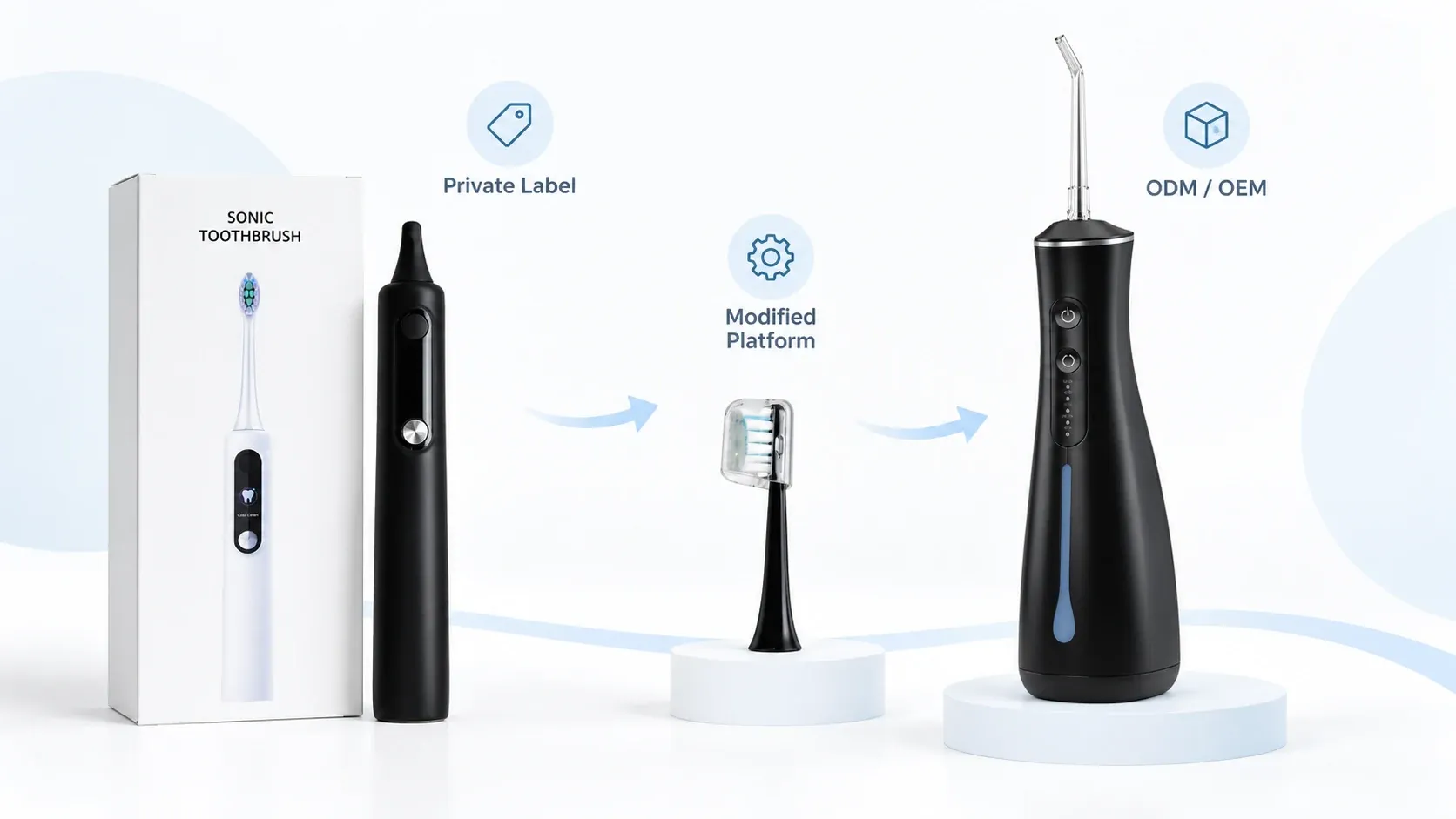
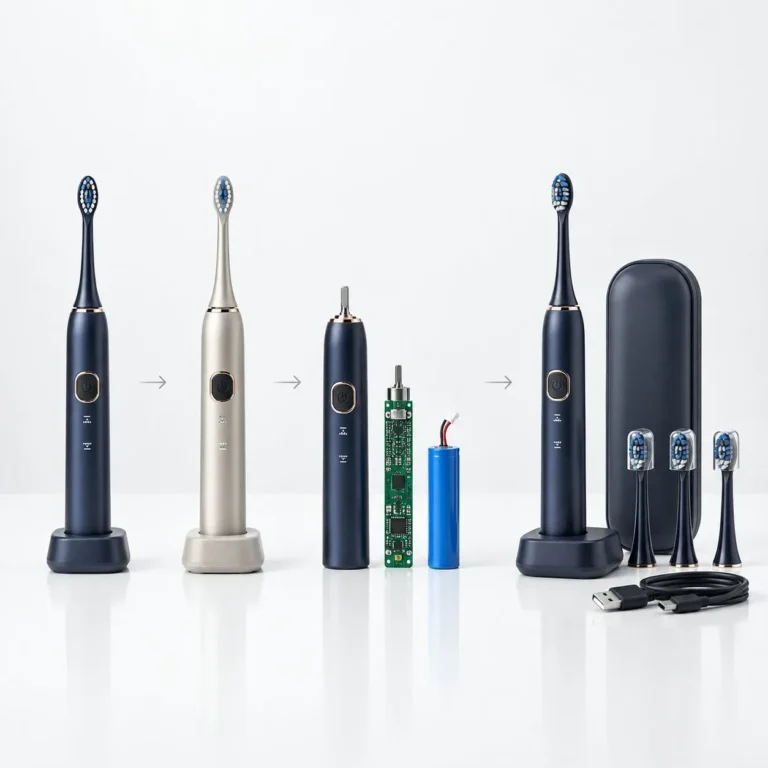
For oral-care hardware, OEM versus ODM is rarely a simple binary choice. In practice, a buyer can brand an existing product, customize an existing platform cosmetically, change selected functions or components, use an ODM development route, supply a buyer-controlled OEM design, or develop a fully custom product.
These routes form a spectrum, not two boxes. The right route depends on how much differentiation, engineering input, design control and product ownership your project actually needs—and on how the final product configuration will be controlled across future orders.
This guide compares practical development routes for electric toothbrushes, replacement brush heads and water flossers, and provides a framework for choosing between them.
There is no single cross-industry definition of OEM, ODM, private label or white label, and suppliers may use these terms differently.
One supplier’s “OEM service” may mean printing your logo on an existing product. Another supplier may use “OEM” for a project where the buyer provides CAD files, specifications, BOM information and firmware requirements.
These terms describe common collaboration patterns rather than one universal project taxonomy.
In practical use:
White label usually means a standardized product sold under more than one buyer’s branding, with minimal buyer-specific engineering.
Private label means the product is sold under your brand. The underlying product may range from a standard model to a selectively customized one. Private label describes the commercial arrangement, not necessarily who created the original design, and it does not automatically include exclusivity.
ODM usually means the development partner provides or controls the underlying platform and design architecture, then adapts it to buyer requirements. The buyer may receive customization without automatically receiving ownership of core drawings, firmware or platform IP.
Buyer-specified OEM usually means the buyer provides or controls a defined design and specification package, while the manufacturing partner produces to that specification and may provide DFM and production support. The buyer commonly controls the design intent, but ownership and usage rights depend on the actual agreement.
Custom development involves more substantial new design or architecture work, such as a new handle geometry, charging architecture, brush-head interface or structural design.
One more category is especially useful for oral-care projects: the modified existing platform.
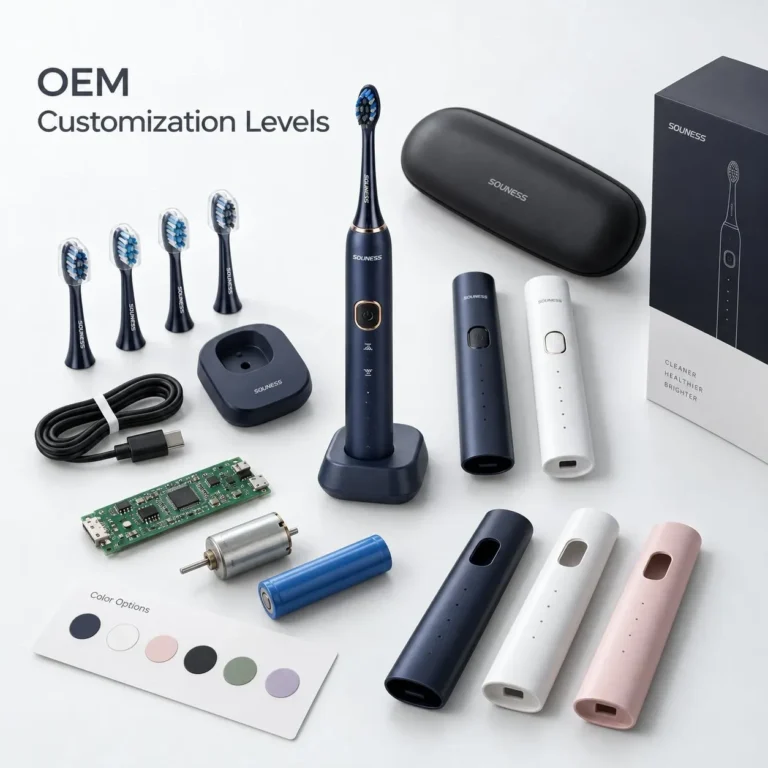
Many real projects sit between simple private label and full custom development. An existing sonic toothbrush platform may keep its basic architecture while the buyer changes the color and finish, logo, brush-head selection, charger or base, accessories and packaging.
Certain modes, battery options, LEDs or component choices may also be considered, subject to technical review.
A custom color does not make a project “custom development.”
Because terminology varies, buyers should confirm the actual project scope instead of relying only on the supplier’s label.
Clarify:
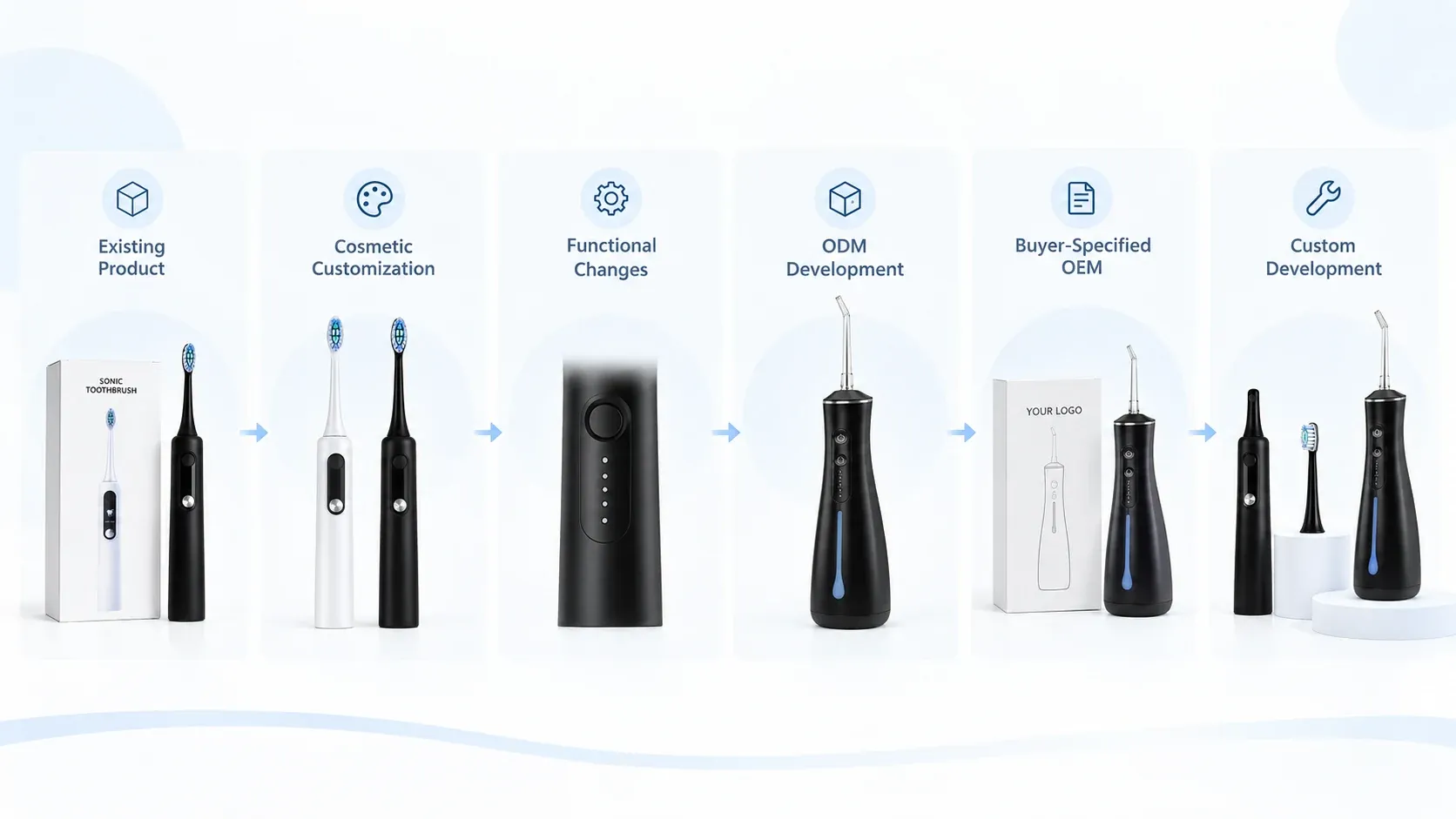
| Route | Starting Point | Typical Buyer Input | Customization Depth | Engineering Involvement | Platform / Tooling | Main Buyer Approvals |
|---|---|---|---|---|---|---|
| Existing product + logo / packaging | Catalogue product | Brand assets, packaging brief | Low | Limited | Existing | Product, branding, packaging |
| Existing platform + cosmetic customization | Existing platform | CMF, logo, bundle requirements | Low–moderate | Finish, material and decoration review | Existing | Appearance, branding, packaging |
| Existing platform + functional/component changes | Modified platform | Functional and configuration requirements | Moderate | Usually deeper technical review | Existing but may be affected | Configuration, samples, review scope |
| ODM development | Partner platform or requirements-led design | Requirements, features, approval criteria | Moderate–high | Central part of project | Often existing or modified | Requirements, samples, validation, release |
| Buyer-specified OEM | Buyer-controlled design package | Drawings, specifications, BOM, firmware requirements | Potentially high | Buyer-led with manufacturing input | Depends on design | Design, samples, validation, production release |
| Fully custom development | Concept or new architecture | Product brief, market needs, staged approvals | High | Central throughout | Often new or substantially modified | Concept through production release |
These routes should be treated as a spectrum.
ODM is not always faster. OEM is not always more expensive. Private label does not automatically mean a lower MOQ, and custom development does not automatically produce a better product.
The actual project outcome depends on factors such as:
Where dedicated tooling becomes part of the project, ownership and usage rights should be reviewed separately. See Public Mold vs Private Tooling for Private Label Oral-Care Projects for a deeper discussion.
Instead of asking only whether a project “is OEM or ODM,” buyers should answer several more practical questions.
If the platform existed before your project, the baseline architecture will often remain controlled by the original platform or manufacturing partner unless a different arrangement is agreed.
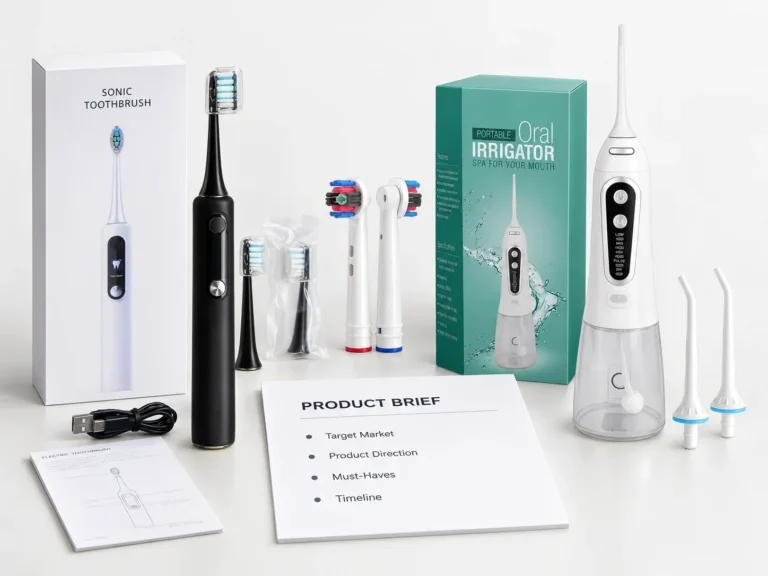
A list such as “three modes, two-minute timer and travel case” is a product requirement, not necessarily a controlled product specification.
Someone must translate commercial requirements into technical documents that can be reviewed, sampled and reproduced.
Customization requests can become engineering tasks.
Clarify who evaluates feasibility, who implements the change and who confirms that the revised configuration is acceptable.
Separate:
This defines the real project scope more accurately than the words OEM or ODM.
Ownership and control should not be assumed from the project label.
Clarify rights to:
The approved product is a configuration, not simply a toothbrush handle.
The approved version may include the handle, brush head, motor, battery, charger, firmware, materials, accessories, packaging and documentation.
This should also be clear before production begins.
If change control is not defined, future reorders can drift from the originally approved configuration.
Start with one question:
Do you already have a controlled product design and specification package?
If yes, evaluate a buyer-specified OEM or contract-manufacturing route.
Your priority is finding a manufacturing partner that can reproduce the controlled design, provide manufacturing feedback and manage production execution.
If no, ask:
Can an existing product platform meet the commercial objective?
If yes, consider private label or a modified existing platform.
Differentiation may come from:
This can create a differentiated commercial product without changing the underlying architecture.
If an existing platform cannot meet the project requirements, evaluate ODM or custom development.
The next question is:
Do the requested changes affect critical technical elements?
Examples include:
If yes, deeper engineering review and potentially broader validation or documentation planning may be required.
If no, branding, CMF, accessories, product bundles and packaging customization may be sufficient.
The decision is not absolute. Whether a change is cosmetic or engineering-level depends on the selected platform, components, materials and manufacturing process.
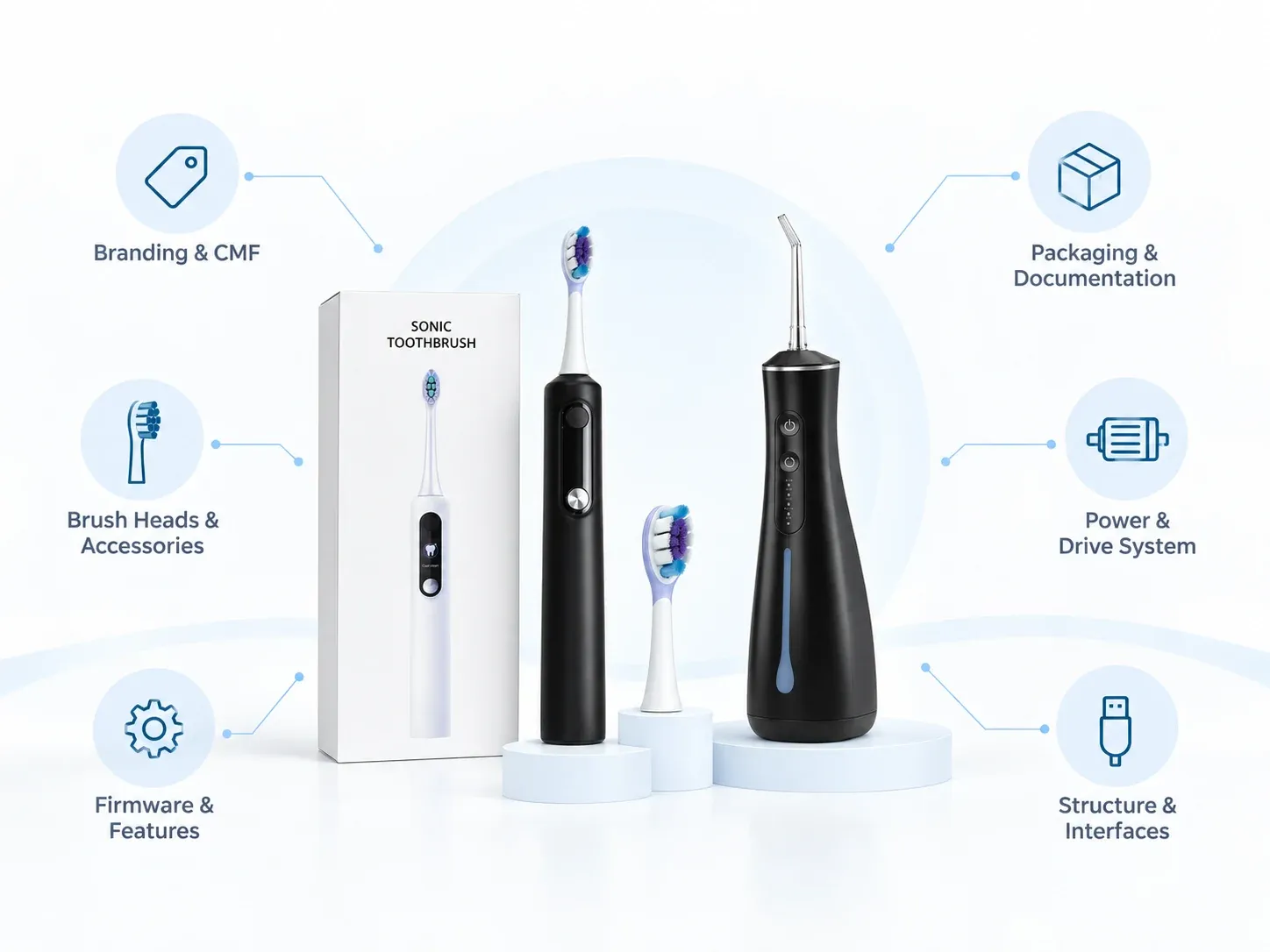
Customization can be grouped into several levels.
The deeper the change, the more likely it is to affect engineering, validation or documentation.
Examples include:
These may be relatively limited changes, but print method, adhesion, pigments, coatings and materials can still require technical review.
Examples include:
These are often primarily packaging and documentation tasks, but the final artwork should correspond to the confirmed product configuration, target market and included accessories.
Examples include:
Selecting an existing approved option can be relatively straightforward.
Changing brush-head geometry, mechanical fit, retention characteristics or the charging arrangement may require deeper review.
Examples include:
These changes are rarely purely cosmetic.
A battery change, for example, may affect runtime, charging behavior, transport documentation and the relevance of existing test evidence.
Examples include:
These changes may affect control behavior, power consumption, user interface, manuals and market-specific requirements.
Examples include:
Changes at this level often move the project toward deeper ODM or custom-development work.
The key principle is simple:
A visually small change can have a larger technical effect.
That does not mean every product change automatically requires new testing or certification.
It means the change should be reviewed against the final configuration. It may require engineering review or affect validation scope.
For a deeper look at the validation stage, see Electric Toothbrush Reliability Testing: What OEM Buyers Should Verify Before Mass Production.
The table below is a project-planning framework, not a legal allocation of responsibility.
Actual responsibilities should be confirmed in the project scope and relevant commercial or development agreements.
| Project Stage | Buyer Typically Provides / Approves | Manufacturing Partner Typically Supports |
|---|---|---|
| Product brief | Target market, channel, required features, brand position, expected quantity | Platform options, feasibility feedback, scope clarification |
| Product specifications | Mandatory requirements, intended bundle, claims, priorities | Technical feasibility, configuration options, design limitations |
| Design / engineering | Buyer-owned files where applicable, design approvals | Engineering according to agreed route, DFM input |
| Samples | Consolidated feedback, approval or rejection | Sample preparation, revision identification, change tracking |
| Packaging / artwork | Logo files, languages, claims, barcode/SKU data | Dieline coordination, structural review, production feedback |
| Testing / compliance planning | Target market, final configuration, approval criteria | Configuration data, sample coordination, test/document support according to scope |
| Production approval | Approved configuration, artwork, release criteria | Production control, traceability and approved-version management |
| Change control | Approval of requested changes | Impact assessment, revised documentation and configuration control |
Two buyer-side responsibilities are often underestimated.
First, appoint one person with authority to consolidate product, artwork and technical decisions.
Second, consolidate sample feedback before sending it to the project partner. Fragmented feedback makes revision control much harder.
The following examples illustrate project logic. They are not AileCare customer case studies.
Example A: Existing sonic platform + logo + branded packaging
This is generally an existing-platform private-label route.
The core product architecture remains standard while the branding and retail presentation change.
Example B: Existing platform + colors + brush-head bundle + travel case
This is a modified existing platform.
Differentiation comes from appearance, accessories and bundle strategy, while the core architecture may remain unchanged.
Example C: Battery, charging, modes or LED changes
This is deeper functional or component customization.
Firmware, power, electronics or charger configuration may be affected, so technical review is needed before confirming the project scope.
Example D: New handle geometry or charging architecture
This typically moves the project toward ODM or custom development.
Housing design, internal layout, waterproof structure, tooling and validation planning may all become part of the development scope.
An existing compatible interface with branded multipack packaging is generally a private-label route.
An existing interface with customized bristle colors, trim patterns or packaging is closer to a modified existing platform.
A new neck or head geometry may move the project toward deeper ODM or custom development.
A new proprietary connection interface typically moves the project toward a full custom-development scope because the handle and brush head become a linked mechanical system.
For brush-head physical quality, including filament tip finishing, see What End-Rounding Quality Means for Brush Head Safety.
An existing cordless water flosser with logo and packaging only is generally a private-label project.
Changing nozzle sets, colors, travel accessories or packaging on an existing platform is closer to a modified-platform project.
A new reservoir, nozzle architecture, pump behavior or structural configuration may require deeper ODM or custom development because the fluid path, power system and sealing design may be affected.
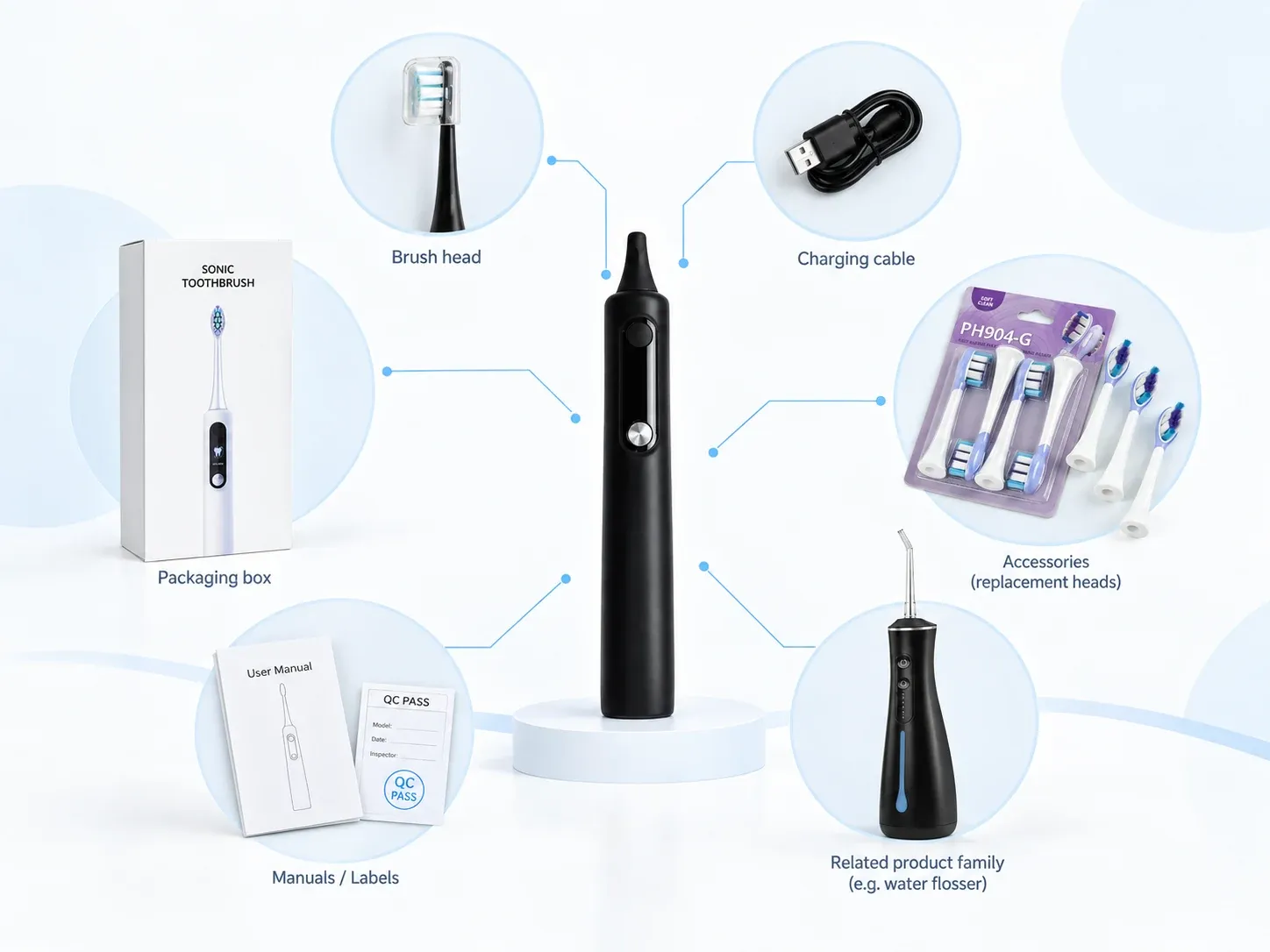
The product approved for mass production is not merely “the toothbrush.”
The final production configuration may include:
This matters because production approval applies to a defined configuration.
If part of that configuration changes after approval, the engineering, validation, documentation or production-release impact may need to be reviewed.
Before authorizing production, confirm:
For detailed pre-production validation considerations, see Electric Toothbrush Reliability Testing: What OEM Buyers Should Verify Before Mass Production.
A custom color, logo or package does not automatically transfer rights to the baseline design, firmware, drawings, tooling or platform IP.
Separate brand ownership from platform and design rights.
Private label does not tell you:
Define the actual configuration and responsibilities.
One supplier’s OEM service may be another supplier’s ODM or private-label service.
Ask what each party actually controls and delivers.
Changing batteries, chargers, motors, firmware or interfaces can affect functionality, documentation, validation and transport requirements.
Changes should be reviewed before being accepted into the production configuration.
Packaging depends on:
Packaging development can begin earlier, but final approval should correspond to the approved product configuration.
A sample may be approved for:
These are not the same.
Record the revision, what was reviewed and what remains open.
For electric toothbrushes, replacement heads are part of the product system.
The connection interface, compatibility, refill packaging and long-term replacement strategy may influence the development route from the beginning.
Before committing to a development route, answer these questions:
For practical RFQ, sample, approval and production tools, visit Project Resources.
No.
Private label describes selling a product under your brand. ODM describes the development relationship and usually involves a supplier or development partner providing or controlling the underlying product platform.
A private-label project may use an ODM platform, but the two terms describe different parts of the project.
No.
Starting from an existing platform may reduce development work, but total project timing still depends on customization, packaging, validation, buyer approvals, component availability and production planning.
Often, yes.
Typical areas may include color, finish, logo, brush-head selection, accessories and packaging.
Functional or component changes may also be possible, but they require technical review on the specific platform.
The ODM partner often controls the baseline product architecture.
Rights to customized design elements, tooling, firmware and technical documentation depend on the commercial and development agreement.
These rights should be clarified before development begins.
Tooling ownership depends on the commercial arrangement.
Who pays for the tooling, who may use it and whether exclusivity applies should be agreed separately.
See Public Mold vs Private Tooling for Private Label Oral-Care Projects for more detail.
Sometimes.
The connection interface, mechanical fit, retention and drive behavior must be compatible with the exact handle configuration.
A customized brush head should therefore be reviewed against the intended handle rather than assumed to be interchangeable.
A battery or charger change alters the product configuration and should trigger an impact review.
The engineering, validation, documentation and market-specific implications depend on the exact change and the final product.
The approved production configuration should be clear before release.
This normally includes the relevant sample revision, product configuration, BOM direction, firmware, packaging, manuals, labels and agreed release criteria, together with a defined process for approving later changes.
Share your product category, target market, reference product, required differentiation, customization scope and packaging plan.
AileCare can review the project scope and help clarify the next sourcing and development steps based on the confirmed product and project requirements.
Still at the supplier-identification stage? Start with How to Source Electric Toothbrushes for Private Label & OEM Projects.