Start Your Electric Toothbrush Project
Tell us your product requirements and target market. We will review the details and reply with the relevant next steps.

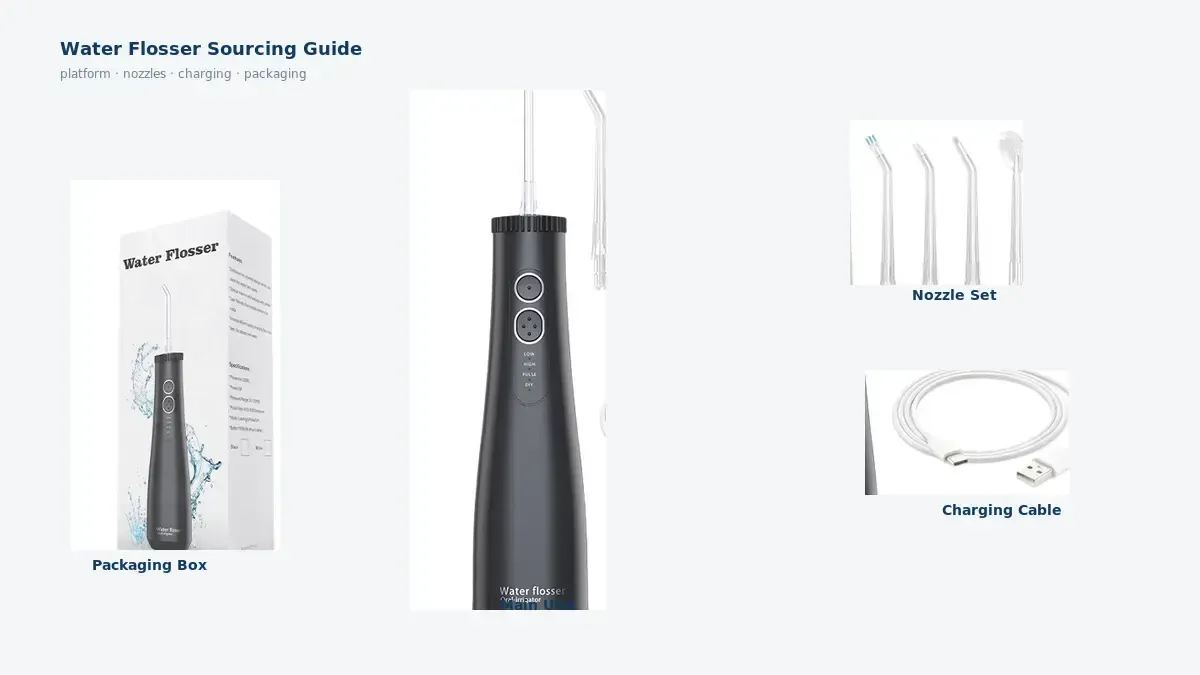
Before approving a water flosser for an OEM or private label order, a buyer should verify the complete product configuration: pump and water path, reservoir and nozzle system, pressure and mode behavior, battery and charging setup, sealing design, accessories, packaging, documentation, and production change controls.
A similar-looking exterior does not prove the same hydraulic performance, reliability, or production consistency. Two water flossers with almost identical housings can differ in pump architecture, seals, battery, firmware, and assembly method.
This guide explains what B2B buyers should verify at each stage of water flosser sourcing, from platform selection to mass production and reorder control.
Platform choice affects almost everything downstream: reservoir size, battery, packaging footprint, accessories, charging configuration, and documentation scope.
Define the target market, sales channel, intended product position, and required configuration first. Then compare platforms against those requirements.
| Platform | Main Trade-Off for the Buyer |
|---|---|
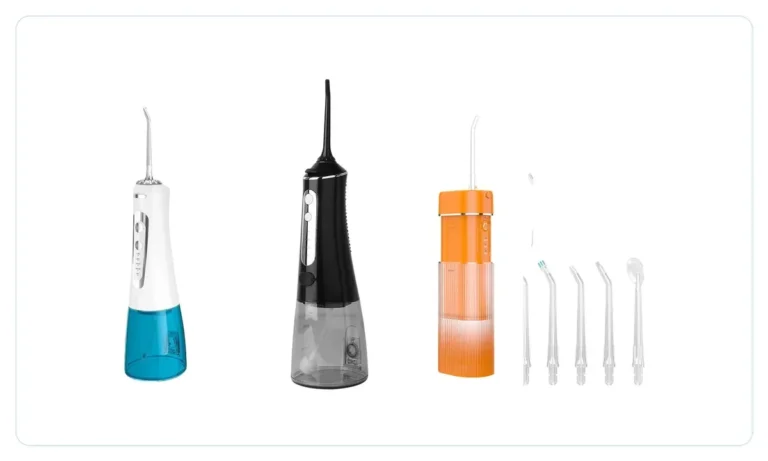
| Cordless water flosser | Common option for rechargeable private-label projects; balances tank capacity, runtime and portability, while adding battery and charging requirements |
| Compact / portable | Smaller packaging and stronger travel positioning, but usually less space for reservoir and battery |
| Collapsible / travel | Differentiated structure, but introduces more moving interfaces, seals and deformation risks to control |
| Countertop | Supports larger reservoirs and accessory sets, but increases packaging size and power-supply considerations |
| Integrated tank | Fewer removable joints, but cleaning access and refill design may be more limited |
| Removable tank | Easier access for filling and cleaning, but adds valves, latches and sealing interfaces |
Also decide whether the project uses an existing platform, a modified platform, or deeper custom development.
That development route affects engineering scope, tooling, approvals, and configuration control. For a deeper explanation, see OEM vs ODM for Oral-Care Products: Which Development Route Fits Your Project?
For broader supplier evaluation, see How to Source Electric Toothbrushes for Private Label & OEM Projects. This guide focuses specifically on the technical and sourcing decisions unique to water flossers.
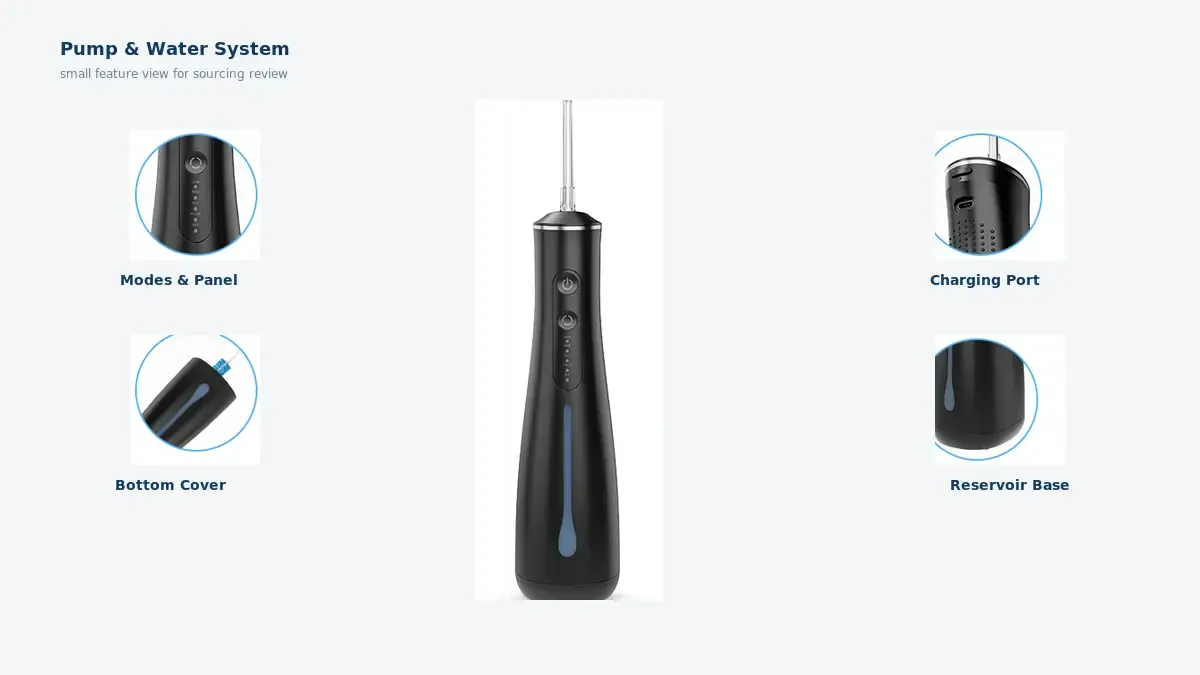
Pressure is a system outcome, not simply a pump specification.
Actual output can be influenced by the pump and motor, water path, reservoir valve, nozzle, priming condition, battery state, firmware, and pressure mode.
This is why two supplier specification sheets cannot always be compared using one headline pressure figure.
Before comparing pressure claims, ask how the figure was obtained.
Useful questions include:
A single pressure figure without defined test conditions is difficult to compare as a controlled product specification.
Instead of relying on terms such as “high pressure” or “powerful cleaning,” define the expected pressure and flow behavior by mode and review it on actual samples.
Buyers should also pay attention to:
These characteristics depend on the complete hydraulic system rather than the pump alone.
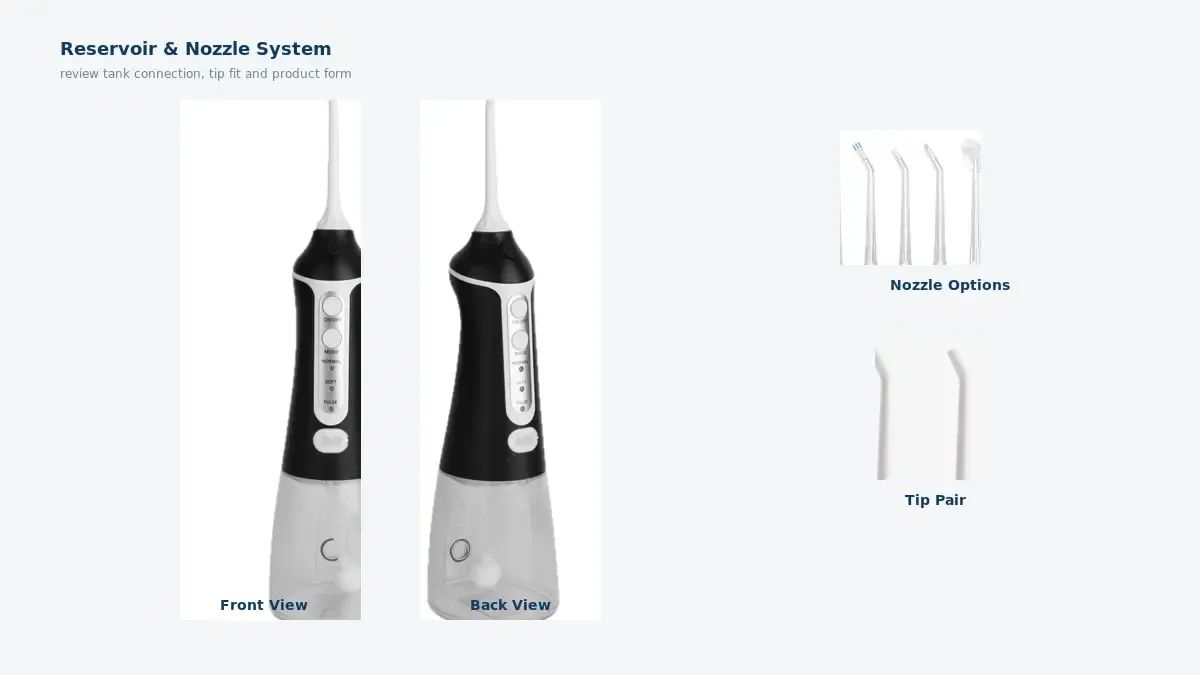
The reservoir is not simply a water container.
Its valve, seal, latch, fill opening, drainage design, connection to the pump, and molded structure all affect product performance and production consistency.
For removable reservoirs, review:
Collapsible or travel-oriented reservoirs introduce additional flexible or moving interfaces. Those interfaces may require additional review for sealing, deformation, and repeated-use durability.
The nozzle system should also be treated as a controlled part of the product.
Confirm:
A nozzle can fit physically and still leak, rotate poorly, transmit pressure inconsistently, or detach during operation.
Compatibility should therefore be reviewed against the intended product configuration, not assumed from appearance.
If replacement nozzles will become a recurring SKU, the same configuration-control principles used for replacement brush heads are useful. See the Replacement Brush Head Sourcing Checklist for more detail on interface and reorder control.
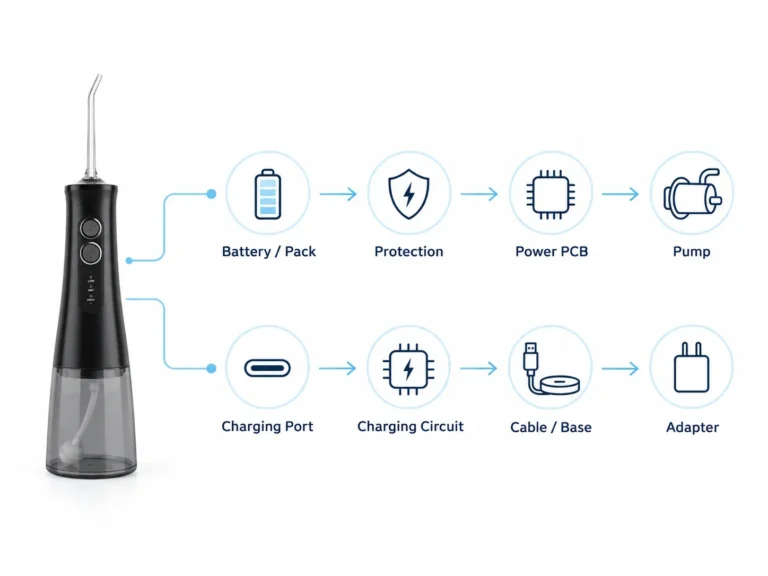
For rechargeable water flossers, define the battery and charging configuration clearly.
Relevant items may include:
The cable, charging base, and adapter are part of the final product configuration. Changing them can affect packaging, documentation, labeling, and target-market requirements.
A claim such as “40 uses per charge” is difficult to evaluate without understanding the conditions behind it.
Runtime can depend on:
Battery capacity alone does not prove finished-product runtime.
When comparing products, ask suppliers to explain the test basis behind runtime claims.
Different documents address different parts of the battery and finished-product system.
| Evidence | What It Addresses |
|---|---|
| Cell / battery safety evidence | The battery itself within the applicable standard or specification |
| UN 38.3 test summary | Transport-related evidence for the applicable lithium battery type |
| Finished-product electrical safety evidence | Charging circuit, enclosure and complete product configuration |
| Market compliance documentation | Requirements related to the destination market and final configuration |
No single battery document automatically covers the complete product, every shipping route, and every market requirement.
Documentation should be reviewed against the actual battery, finished product, destination market, and shipment configuration.
Three different concepts are often mixed together:
The three should not be treated as equivalent.
A tested IP rating supports a defined product configuration, while production sealing consistency depends on how that same configuration is manufactured repeatedly.
An IP rating is based on defined test conditions. For example, IPX7 relates to temporary immersion under specified conditions within the relevant ingress-protection framework.
It should not be interpreted as proof that a product can tolerate every real-world water exposure, temperature, aging condition, or impact scenario.
The result also relates to the configuration that was tested.
If the following items change, buyers should review whether the existing evidence remains relevant:
Important sealing points on a water flosser can include:
Production sealing consistency can be influenced by tooling condition, gasket dimensions, gasket compression, welding, assembly, screw torque, and general workmanship.
Buyers should ask:
For more on the distinction between qualification testing and routine QC, see Electric Toothbrush Reliability Testing: What OEM Buyers Should Verify Before Mass Production.
Mode count is not automatically a quality advantage.
Five modes are not necessarily better than three. Mode names also have limited value unless the behavior behind each mode is clearly defined.
A controlled specification may need to define:
Firmware controls many of these functions.
For that reason, firmware version should be treated as part of the controlled product configuration.
A firmware change may alter mode behavior, indicators, timers, or instructions without changing the external appearance of the product.
| Risk Area | What the Buyer May Observe | Type of Check |
|---|---|---|
| Pump not priming | No flow or delayed flow after filling | Functional |
| Inconsistent pressure or flow | Weak, unstable, or inconsistent jet between samples | Functional |
| Internal or joint leakage | Dripping at tank, handle, tubing, or nozzle interface | Functional / Process |
| Weak tank latch or valve issue | Tank movement, poor seating, dripping | Functional / Dimensional |
| Nozzle detachment or leakage | Tip loosens, rotates incorrectly, or leaks | Functional / Mechanical |
| Charging failure | Unit fails to charge or shows unstable charging indication | Electrical / Functional |
| Water ingress | Moisture, fogging, corrosion, or water around sealed areas | Sealing / Process |
| Wrong firmware or mode sequence | Product behavior differs from approved sample or manual | Functional |
| Cosmetic defects | Tank haze, scratches, flash, gaps, print defects | Visual |
| Packaging or accessory error | Damaged nozzles, moving tank, missing cable or accessories | Packaging |
Not every test or inspection item needs to be performed on every production unit.
Extended-duration, destructive, cycling, and aging tests may be used during qualification, periodic validation, or change-triggered review.
Routine production QC may instead focus on agreed visual, functional, leak, charging, configuration, and packaging checks.
The appropriate scope depends on the product architecture, claims, target market, known risks, and agreed quality plan.
“Sample approved” is too vague for a product that contains multiple hydraulic, electrical, mechanical, and firmware systems.
Different sample stages may approve different aspects of the project.
| Sample Type | Main Purpose | Does Not Automatically Approve |
|---|---|---|
| Stock / reference sample | Initial platform direction | Buyer’s final configuration |
| Color / CMF sample | Color, transparency, finish, logo placement | Hydraulic performance, firmware, packaging |
| Functional sample | Pump, pressure, modes, reservoir, nozzle and charging behavior | Final materials or production process |
| Packaging sample | Structure, protection, accessory placement and artwork | Final product functionality |
| Production-intent sample | Intended final configuration for production | Future substitutions or later changes |
| Golden sample | Retained reference for production and reorder comparison | Anything outside the recorded revision |
A useful sample-approval record should identify:
The approval scope is especially important.
Approving appearance is not the same as approving hydraulic performance.
Approving a functional sample is not the same as releasing the final configuration for mass production.
A water flosser pack may contain:
Each included item should be part of the controlled pack configuration.
Common packaging issues can include:
For e-commerce projects, buyers should also consider whether the retail packaging alone is suitable for parcel delivery or whether additional outer protection is needed.
Where functional or leak testing involves water during production, buyers should ask how drainage, drying, and visual inspection are managed before packing, so residual water or water marks do not become a packaging issue.
Packaging approval should use:
Approving artwork files alone is not the same as approving the complete packed product.
The required documentation depends on the product, destination market, charger configuration, battery, claims, and sales channel.
Depending on project scope, buyers may request:
At a high level, IEC 60335-2-52 addresses safety requirements for electric oral-hygiene appliances, including oral irrigators, within its scope.
Buyers should confirm the applicable market route, current standard edition, and final battery and charging configuration rather than treating one standard or report as a blanket approval for all versions.
There is no universal certification package for every water flosser.
Documentation can change depending on:
The supplier should therefore know the intended destination markets at RFQ stage.
Also communicate:
For broader documentation planning, see the AileCare Quality page.
Most importantly, test evidence should match the product actually being shipped.
A report for another model, another battery, another charger, or another product revision should not automatically be treated as evidence for the final configuration.
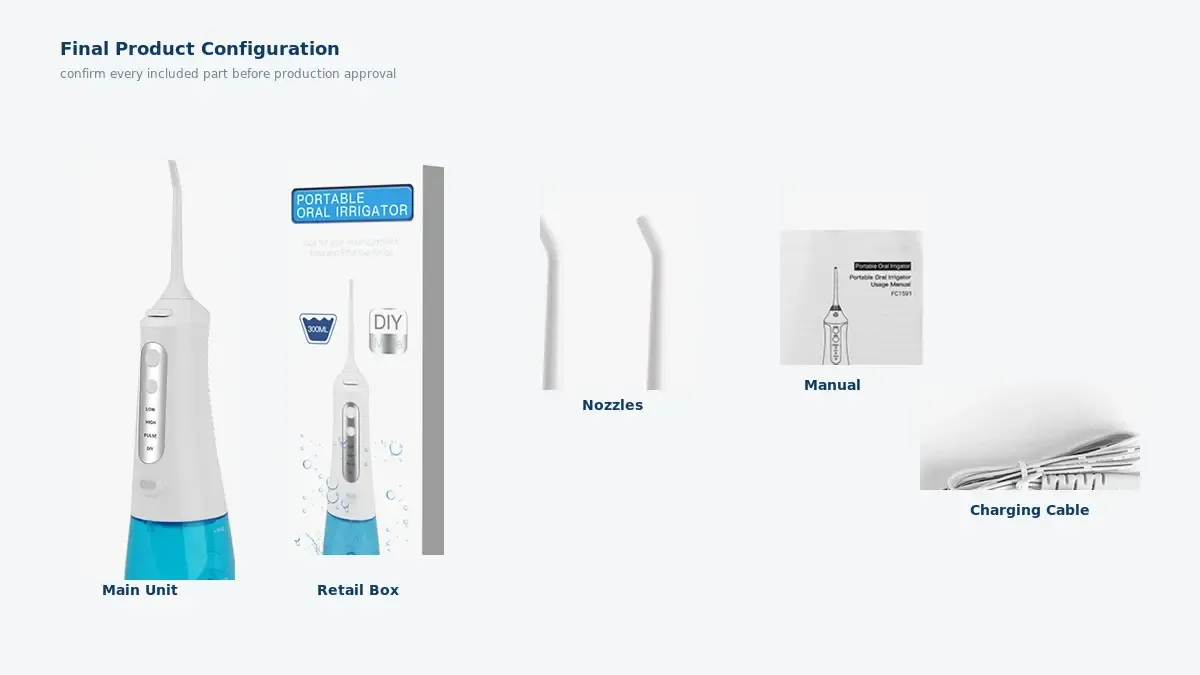
Mass-production approval should apply to one clearly defined configuration.
Before production release, confirm and freeze:
A water flosser should be approved as a complete system.
The pump, seals, tank, nozzle, battery, PCB, firmware, charging system, and packaging interact with each other.
Approving only the external housing or a retail sample is not the same as approving the full production configuration.
Likewise, “same model” is not a sufficient production specification if critical components or revisions are not controlled.
A repeat order should be treated as a controlled continuation of the approved configuration.
It should not simply be described as “the same water flosser.”
Between production runs, suppliers may propose or implement changes involving:
These changes can affect performance, sealing, documentation, appearance, packaging, or production consistency.
Before confirming a reorder, ask whether any relevant tooling, component, material, firmware, packaging, or artwork has changed since the approved production version.
Where useful, compare the current production configuration with the retained golden sample and controlled product specification.
Not every substitution requires complete redesign or complete retesting.
The correct approach is to review whether the proposed change requires:
Practical tools for sample approval, configuration control, production release, and reorder checks are available under Project Resources.
Provide the target market, sales channel, platform type, reservoir direction, nozzle and accessory requirements, mode expectations, charging configuration, branding, packaging direction, and intended product claims.
More complete RFQ information makes supplier quotations easier to compare.
Compare them only when the test conditions are reasonably clear.
Ask about the measurement point, operating mode, nozzle, reservoir condition, battery state, and whether the stated value represents peak, average, or sustained output.
The exterior does not show the complete hydraulic and electrical system.
Products with similar housings may use different pumps, motors, water paths, valves, seals, batteries, PCBs, firmware, and assembly methods.
Runtime can change with mode, pressure setting, pump load, session length, battery state, and control logic.
Battery capacity alone does not define the finished product’s operating time.
IPX7 is an ingress-protection classification associated with temporary immersion under defined test conditions.
It should not be interpreted as proof that the product is protected against every possible real-world water exposure. Buyers should also confirm that the available evidence matches the final product configuration.
A functional sample is used to review product behavior such as pump operation, pressure, modes, reservoir, nozzle, and charging.
A production-intent sample is intended to represent the final product configuration planned for mass production, including controlled components, firmware, materials, accessories, and packaging.
Depending on the target market and final configuration, buyers may request the product specification, controlled configuration record, relevant electrical safety and EMC evidence, battery documentation, UN 38.3 information where applicable, IP evidence where claimed, material declarations, inspection criteria, packaging specification, artwork revision, traceability records, and change-control documentation.
The complete production configuration should be controlled.
This can include the pump, motor, firmware, PCB, reservoir, seals, nozzle system, battery, charging components, materials, colors, accessories, packaging, artwork, manual, labels, inspection criteria, and approved sample reference.
A proposed change should go through change control.
The change should be reviewed to determine whether updated documentation, new samples, reapproval, or revalidation is needed.
Undocumented substitutions are an important reorder risk because they can affect performance, sealing, documentation, or consistency without changing the visible model name.
Prepare the target market, product platform, reservoir and nozzle configuration, pressure and mode requirements, charging setup, accessory bundle, packaging direction, and intended product claims before requesting a project review.
A clearly defined starting configuration makes supplier quotations easier to compare and helps establish a controlled path from samples to mass production.
Browse current options on our Water Flossers category page.