Start Your Electric Toothbrush Project
Tell us your product requirements and target market. We will review the details and reply with the relevant next steps.

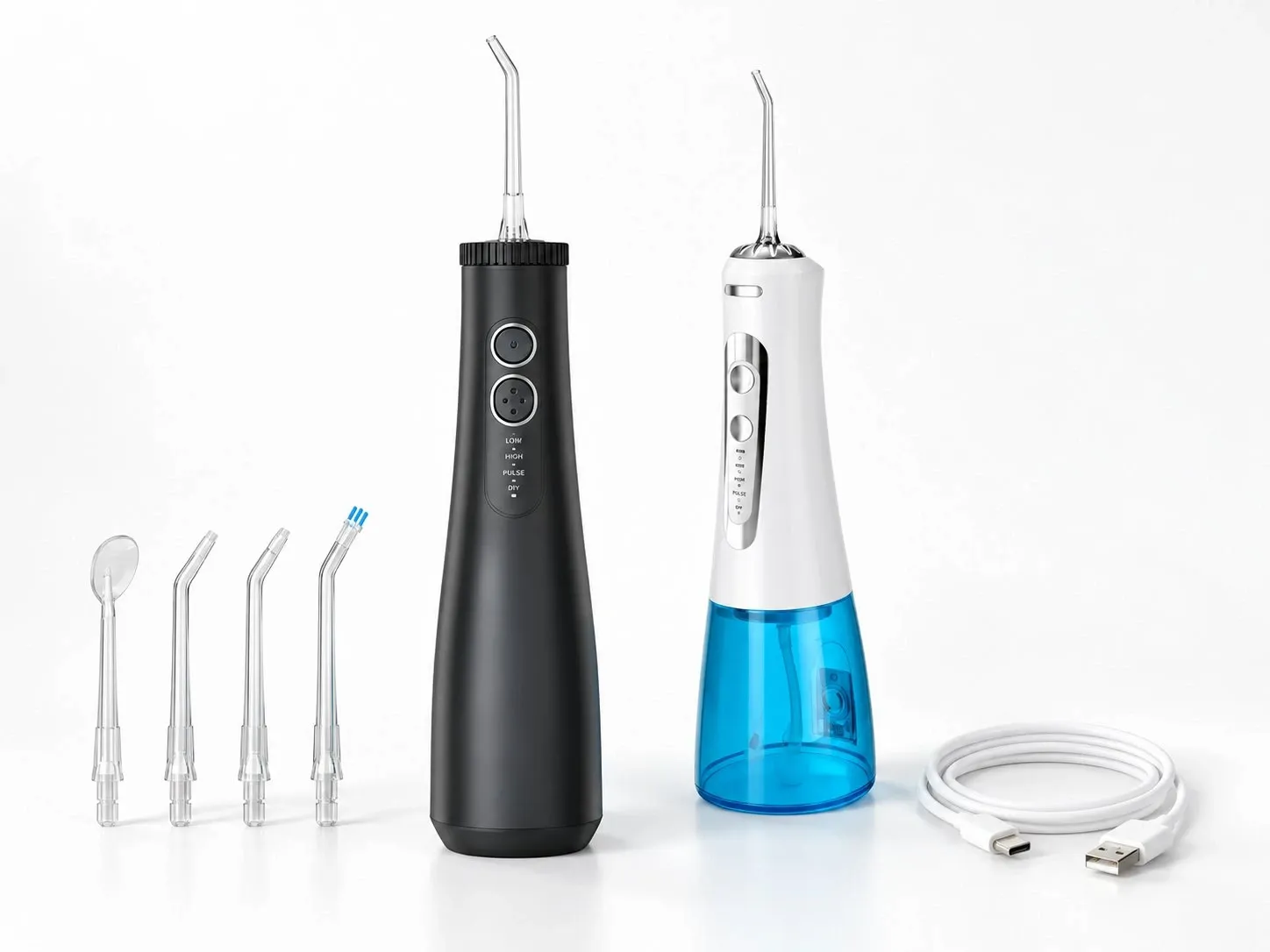
Supplier A quotes a water flosser with a 2000 mAh battery, USB-C charging and 30-day battery life.
Supplier B lists exactly the same three features.
The two products may still differ in battery reference, nominal voltage, runtime assumptions, charging input, cable and adapter configuration, charging electronics, indicator logic, protection functions, charging-port design and approved revision.
Before treating the quotations as equivalent, buyers should define the complete battery and charging configuration.
A battery-capacity number and charging connector are not enough to compare two water flosser power systems.
For the overall product configuration, see:
For the overall product configuration, see Water Flosser Product Specifications.
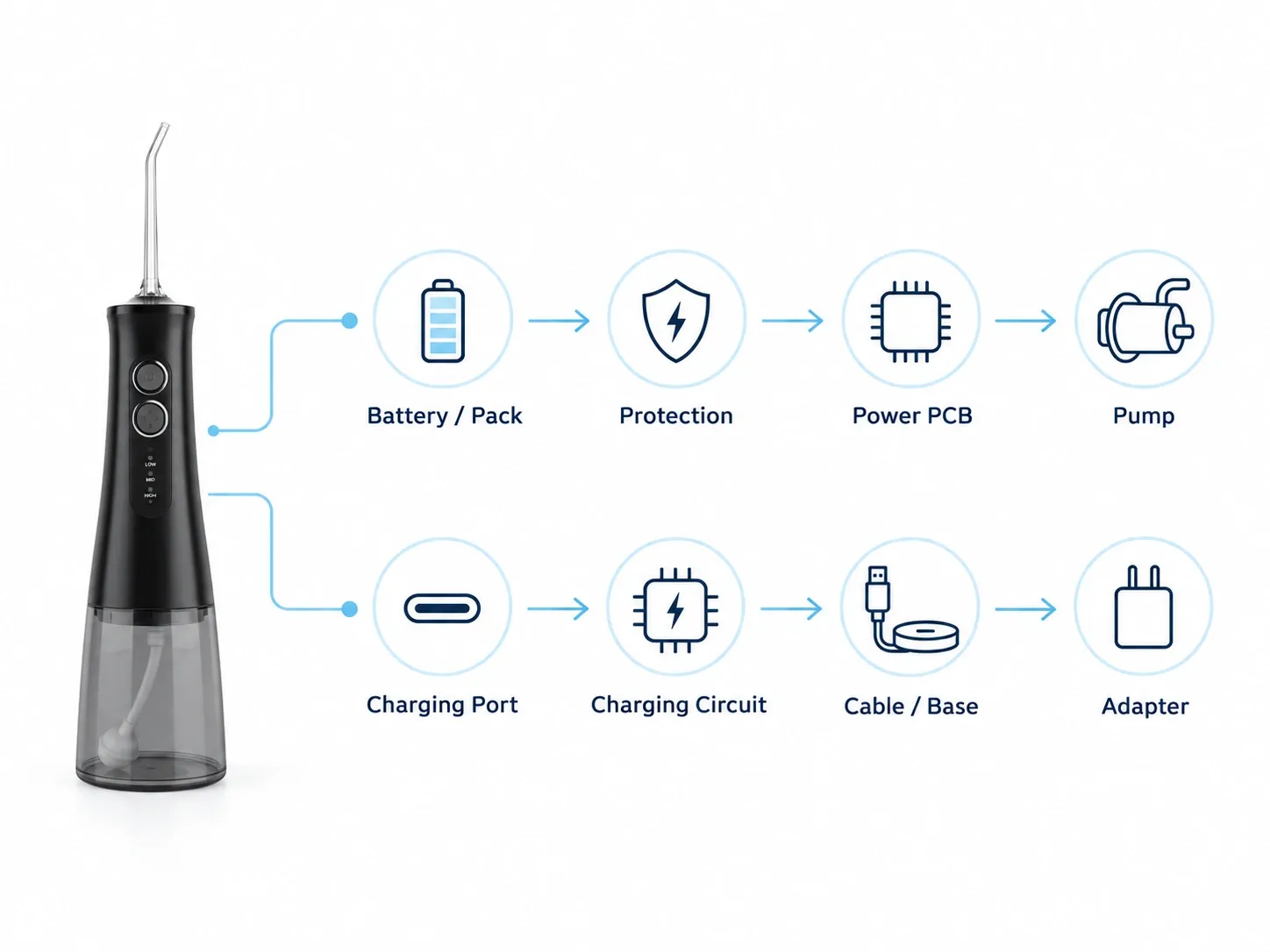
A practical buyer-side view of the power system has two parts.
Battery side:
Battery Cell / Pack
→ Protection
→ Power-Management PCB
→ Pump / Motor Load
Charging side:
Charging Port / Charging Interface
→ Charging Circuit
→ Cable / Charging Base
→ Adapter, if supplied
Other controlled functions may include:
Not every water flosser uses every component.
This is a sourcing map rather than an engineering schematic. The important point is that battery capacity is only one part of the complete power system.
Water flosser power architectures may include:
Not every cordless water flosser uses the same battery architecture.
Useful buyer fields include:
Terms such as “lithium-ion” and “lithium-polymer” may be used differently in commercial product descriptions.
The label alone does not define the approved battery.
Where battery identity matters, record:
For repeat-order control, the supplier’s approved battery or pack reference is more useful than a generic statement such as:
“Lithium battery.”
Battery capacity is commonly stated in mAh.
But mAh alone is not a complete energy comparison when nominal voltage differs.
A simple relationship is:
Wh = V × Ah
This does not mean sourcing managers need to engineer the battery system.
It means that two batteries with the same mAh figure may not represent the same nominal energy.
Where relevant, record:
together rather than comparing mAh alone.
Battery capacity is an input.
Runtime is an outcome.
Actual runtime can also depend on:
Two water flossers with the same mAh rating can have different runtimes.
A higher mAh figure should therefore not automatically be interpreted as longer runtime or better battery performance.
Supplier documentation may use terms such as:
Terminology can vary.
Do not force one definition onto every supplier.
Instead, record:
Then define runtime separately.
The appropriate level of battery control depends on the project.
| Project Type | Practical Battery Control |
|---|---|
| Existing-Platform Private Label | Supplier’s approved battery or pack reference plus change notification |
| Long-Term Repeat-Order Project | Stronger control of pack identity or cell model where relevant |
| Engineering-Sensitive Project | Battery pack, charging PCB and relevant firmware revision controlled together |
Not every buyer needs to specify a named battery-cell brand.
The important point is that the battery should not be treated as an invisible component that can be substituted freely when it affects runtime, charging, fit, documentation or product claims.
Runtime can be marketed as:
A claim such as “30 days” depends on assumptions including:
These assumptions are not standardized across suppliers.
“30 days” is a usage claim, not a self-contained battery specification.
| Claim | What It Describes |
|---|---|
| 20 Minutes Total Runtime | Aggregate operating duration under stated conditions |
| 30 Days Between Charges | Usage-based claim dependent on session length and use frequency |
These claims should not be compared directly unless their operating assumptions are aligned.
Power demand may change with:
A runtime figure measured in one mode may not represent the same result in another mode.
If runtime is an important purchasing criterion, ask:
Which mode and operating condition support the stated runtime claim?
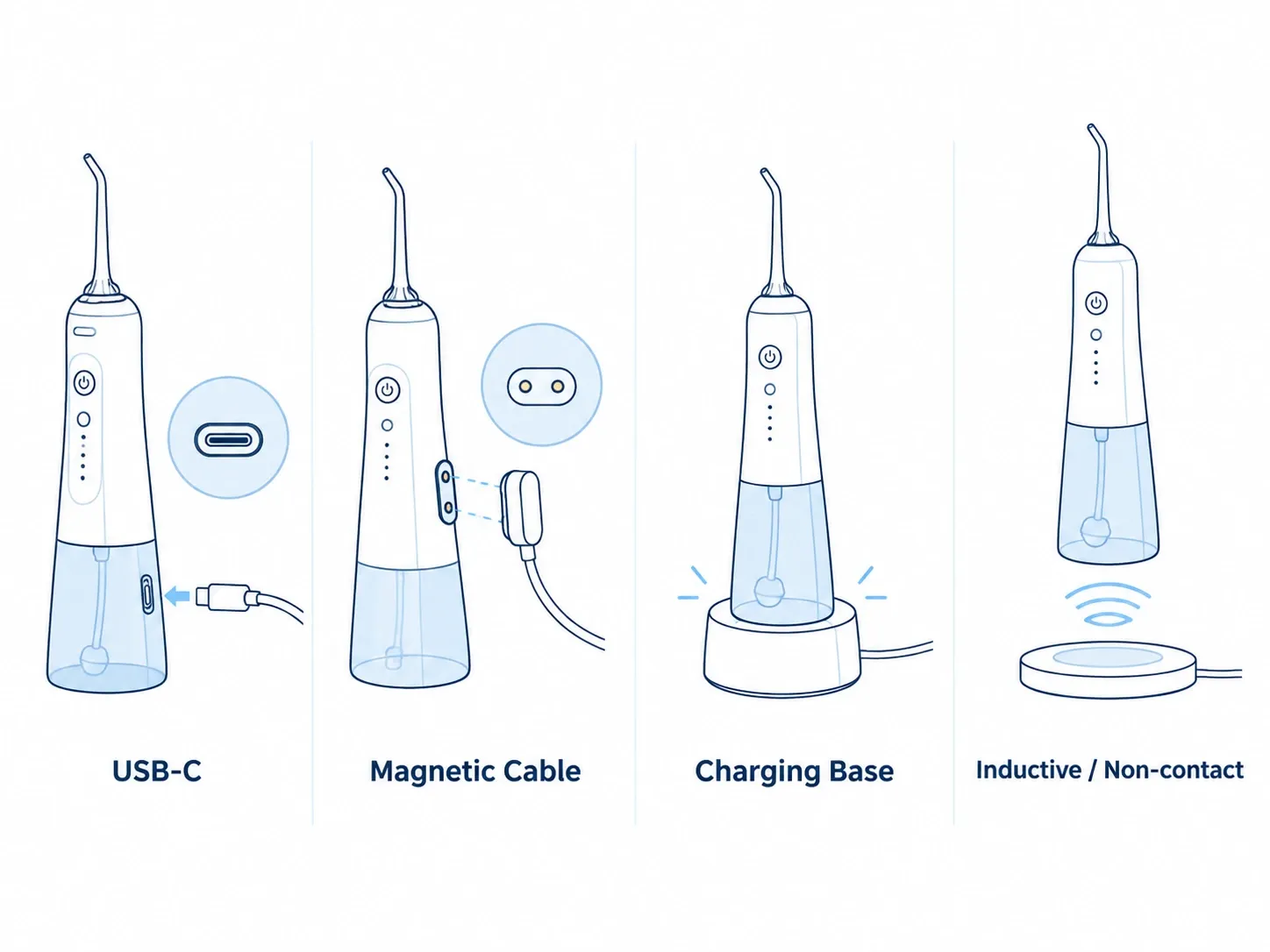
Water flosser charging configurations may include:
No charging method is universally better.
Each can affect:
USB-C identifies a connector format.
It does not by itself prove:
For a USB-C water flosser, define:
USB-C is a connector specification, not a charging-performance specification.
Micro-USB may still appear on established product platforms.
It should not automatically be interpreted as poor quality.
For sourcing purposes, consider:
The question is whether the charging system fits the intended project, not whether one connector is universally superior.
Magnetic charging may use:
Useful buyer fields include:
Magnetic charging does not automatically mean waterproof charging or superior safety.
Inductive or non-contact charging typically adds a product-specific charging base or coil system.
That changes what needs to be specified:
It does not automatically mean the product has a higher ingress-protection rating.
A charging specification should identify:
“USB charging” alone does not tell the buyer what will ship in the box or which input condition supports the advertised charging time.
| Configuration | What Must Be Defined |
|---|---|
| Cable Only | Connector, cable type, length and relevant rating |
| Cable + Adapter | Cable plus adapter reference, output and plug |
| Charging Base + Cable | Base reference, input, cable and packaging |
| Charging Base + Adapter | Full base, cable, adapter and plug configuration |
Two identical water flossers with different charging accessories are not the same quotation.
The charging accessory BOM should therefore be aligned before unit prices are compared.
Where a wall adapter is supplied, buyers may need to define:
Applicable requirements vary by destination market and delivered configuration.
Do not assume one adapter or one documentation set automatically applies everywhere.
Charging time can depend on:
Record where relevant:
Charging time without the charger or input condition is incomplete.
Before accepting a fast-charging claim, ask for:
If the charging condition cannot be defined, the claim should not automatically be treated as a controlled product specification.
Most private-label projects do not require the buyer to control individual semiconductor part numbers.
More practical controls may include:
The exact charging IC only needs buyer-level control when project risk or technical requirements justify it.
What matters more is that core charging-system changes are identified and reviewed.
Depending on the battery and electronics architecture, possible functions may include:
Do not assume every model includes every function.
The useful buyer question is:
Which protection functions are implemented in this exact battery and PCB revision?
Low-battery behavior may include:
The actual behavior should be recorded rather than assumed.
This becomes part of:
Possible visible states include:
If a device displays a battery percentage, do not automatically assume that it represents precise state-of-charge measurement.
The buyer should approve the visible indicator behavior rather than infer the internal estimation method.
Charging interfaces may use:
An IP rating applies to a defined finished product under specified test conditions.
Buyers should therefore confirm:
The IP claim, port design and instructions should describe the same approved product.
IPX7 does not mean “safe to charge while wet.”
Where a charging-port cover is used, relevant fields may include:
Do not assign an arbitrary durability-cycle requirement.
Where cover durability matters, it should be evaluated through the agreed project validation plan.
Battery architecture can be described as:
This distinction can affect:
Applicable market requirements should be confirmed for the actual product and destination.
Certain travel platforms may use AA or AAA batteries rather than an integrated rechargeable system.
Useful specification fields include:
These products use a different power architecture and should not be compared directly with rechargeable products on charging time or between-charge runtime.
Where lithium batteries are used, transport-related documentation may include:
These documents serve a different purpose from finished-product compliance records.
| Document / Evidence | Typical Scope |
|---|---|
| Cell Documentation | Individual battery cell |
| Battery-Pack Documentation | Assembled battery pack |
| Transport Documentation | Relevant transported lithium cell / battery |
| Adapter Documentation | Supplied charging accessory |
| Finished-Product Safety / EMC Documentation | Complete water flosser |
Battery transport documentation does not replace finished-product compliance evidence.
Likewise, a finished-product report does not automatically identify the exact approved cell or battery pack.
Each document should be checked against the configuration it actually covers.
Depending on the project, relevant references may include:
That does not mean every water flosser project requires the same set of reports or certificates.
Applicability depends on:
The required document scope should be confirmed for the actual project.
| Claim | What It Describes |
|---|---|
| “30 Days Between Charges” | Short-term use duration under stated usage assumptions |
| “X Cycles” | Long-term battery aging under defined charge/discharge conditions |
A meaningful cycle-life claim needs context such as:
Runtime between charges and long-term battery cycle life should therefore remain separate specifications.
A replacement battery with the same mAh figure may still differ in:
Battery substitution should trigger a specification-impact review.
This does not mean every battery substitution requires complete redevelopment.
The review should consider whether the change affects:
For how substitutions are reviewed and approved, see BOM & Engineering Change Control.
A battery is not the only power-system component that may change between orders.
Cable changes may affect:
Adapter changes may affect:
Charging-base changes may affect:
Where these items are supplied with the product, they should remain part of the approved configuration.
A practical buyer specification can include:
| Field | Priority | What to Record |
|---|---|---|
| Product Model / Revision | Essential | Supplier model and approved revision |
| Battery Type / Chemistry | Essential | Rechargeable / disposable and stated chemistry |
| Battery Reference | Essential | Approved battery or pack reference |
| Nominal Voltage | Essential | Cell or pack nominal voltage |
| Rated Capacity / Capacity Basis | Essential | Value, terminology and source |
| Cell Count / Pack Configuration | Project-Specific | Single cell, multi-cell or replaceable cells |
| Battery / Pack Revision | Essential | Controlled revision |
| Charging PCB Revision | Essential | Controlled charging-system revision |
| Charging Method | Essential | USB, magnetic, inductive, base or other system |
| Charging Connector | Essential | Connector type |
| Input Requirement | Essential | Input voltage / current basis |
| Cable | Essential if Included | Type, connector and length |
| Wall Adapter | Essential if Included | Reference, output and plug |
| Charging Base | Essential if Included | Base reference and input |
| Charging-Time Claim | Essential | Claim plus input condition |
| Runtime Claim | Essential | Claim plus mode and usage assumptions |
| Charging Indicator Logic | Essential | Charging and full-charge states |
| Low-Battery Logic | Essential | Warning and shutdown behavior |
| Port / IP Configuration | Essential | Port type, cover state and claim scope |
| Battery / Transport Documentation | Where Applicable | Documents matched to approved battery |
| Approved Sample ID | Essential | Approved physical sample |
| Revision Date | Essential | Date of approved configuration |
Detailed semiconductor part numbers, exact cell-maker identity and internal circuit details can remain project-specific unless greater control is justified.
| Marketing Claim | Controlled Buyer Specification |
|---|---|
| 2000 mAh Battery | Battery reference, nominal voltage, capacity basis and pack revision |
| 30-Day Battery Life | Mode, session duration, uses per day and starting condition |
| Fast USB-C Charging | Connector, input, cable / adapter scope and charging-time condition |
| IPX7 Waterproof | Finished product configuration, port-cover state and supporting evidence |
| LED Battery Display | Charging, full-charge, low-battery and supported error-state behavior |
Battery marketing language is not a complete power-system specification.
At sample stage, buyers can check:
This does not replace formal battery, electrical-safety or reliability testing.
Useful questions include:
| Field | Supplier A | Supplier B | Buyer Check |
|---|---|---|---|
| Battery Reference | Same battery or pack scope? | ||
| Nominal Voltage | Same energy basis? | ||
| Capacity | Same capacity terminology? | ||
| Runtime Condition | Same mode and usage assumptions? | ||
| Charging Connector | Same connector? | ||
| Input | Same input requirement? | ||
| Cable | Included in both quotations? | ||
| Adapter | Included in both quotations? | ||
| Plug | Same target-market configuration? | ||
| Charging Base | Included in both? | ||
| Charge Time | Same input condition? | ||
| Indicator Logic | Same visible behavior? | ||
| Port / IP Configuration | Same finished configuration? | ||
| Battery Documentation | Matches approved battery? | ||
| Approved Revision | Clearly identified? |
A cable-only product is not commercially equivalent to a product supplied with an adapter and charging base.
Before mass production, record:
This creates a clear reference for production and repeat orders. See Golden Sample Approval for Oral-Care OEM Projects.
The product name may remain unchanged while components such as these change:
A repeat order should reference the approved battery and charging configuration, not only the water flosser model name.
Any proposed change that could affect the approved configuration should receive a specification-impact review. Inspection at each order stage should then check against the same approved record. See Incoming, In-Process & Final Inspection for Oral-Care OEM Orders.
| Common Mistake | Better Approach |
|---|---|
| Comparing only mAh | Compare voltage, battery reference and runtime condition |
| Assuming higher mAh means longer runtime | Verify actual operating conditions |
| Accepting “30 days” without assumptions | Record mode, session duration and use frequency |
| Assuming USB-C means fast charging | Define input and charging-time condition |
| Not defining cable and adapter | Record the delivered charging BOM |
| Ignoring plug type | Define target-market adapter configuration |
| Assuming magnetic charging means waterproof | Verify the actual finished IP configuration |
| Assuming IPX7 means safe to charge while wet | Keep wet-use and charging conditions separate |
| Ignoring battery transport documents | Confirm applicable documentation for the approved lithium battery |
| Substituting a battery without review | Perform a specification-impact review |
| Treating cycle life as runtime | Separate long-term aging from between-charge runtime |
| Stating charge time without input condition | Record the charging-input basis |
| Reordering only by model name | Reference the battery and charging revision |
Before production, buyers should be able to identify:
The objective is not to turn every private-label project into a battery-engineering program.
It is to make sure that the power system approved during development remains the same power system used in production and repeat orders.
For the wider sourcing route, see the Water Flosser Sourcing Guide.
If you are comparing rechargeable water flosser platforms, define the complete battery and charging configuration before comparing runtime claims or unit price.
For most rechargeable projects, identify the battery architecture, approved battery or pack reference, stated chemistry, nominal voltage, capacity basis, runtime claim and charging configuration.
Also define the connector, input, cable, adapter or charging base where supplied, indicator behavior, charging-port configuration and applicable battery documentation.
Detailed semiconductor references or named cell suppliers can remain project-specific unless tighter control is required.
No.
Battery capacity alone does not define runtime or overall battery performance.
Nominal voltage, pump load, operating mode, power management, battery condition and low-voltage cutoff can all affect operating time.
Compare the battery reference, nominal voltage and runtime under stated operating conditions rather than using the mAh number alone.
Ask what assumptions support the claim.
Relevant factors include:
Two suppliers can both state “30 days” while using different usage assumptions.
No.
USB-C identifies the connector format.
It does not by itself prove USB Power Delivery support, higher charging current or shorter charging time.
Buyers should record the input requirement, charging-time condition and cable / adapter configuration before treating “fast charging” as a controlled product claim.
Yes.
They are separate BOM items.
A wall adapter adds its own output, plug type, documentation and packaging requirements.
A cable-only quotation and an adapter-included quotation therefore cover different deliverables even when the core water flosser is identical.
Not automatically.
These charging methods change the product’s charging interface, but the ingress-protection rating still depends on the finished enclosure and the exact configuration that was evaluated.
Confirm the actual IP claim and supporting evidence rather than assuming that the charging method determines water resistance.
UN 38.3 relates to transport testing for lithium cells and batteries.
It is not a finished-product electrical-safety or EMC certificate.
Finished-product compliance evidence applies to the complete water flosser configuration.
The two document types serve different purposes and should be matched to the battery and product they actually cover.
Changes to the battery supplier or model, chemistry, nominal voltage, capacity, pack dimensions, connector, protection board or charging electronics should receive a specification-impact review where they could affect the approved product.
The review should consider runtime, charging, fit, weight, documentation, IP configuration and product claims.
Not every change requires complete redevelopment, but it should not be treated as automatically equivalent.