Start Your Electric Toothbrush Project
Tell us your product requirements and target market. We will review the details and reply with the relevant next steps.

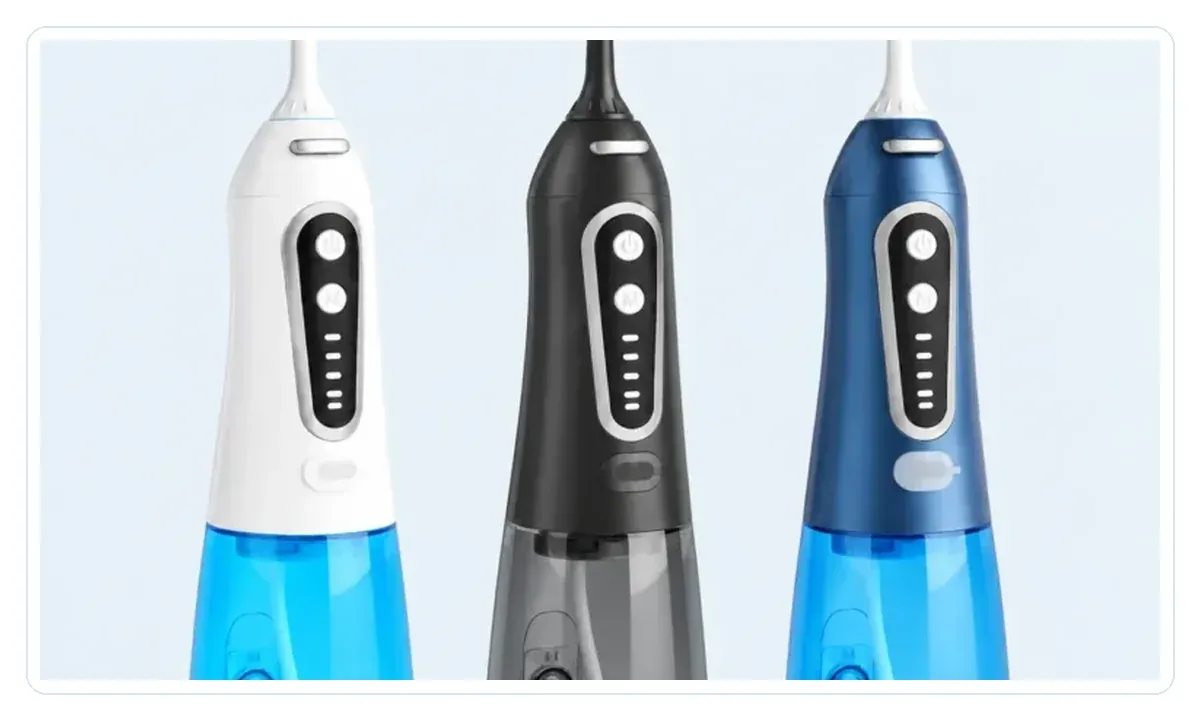
A buyer receives a water flosser sample. It powers on, pumps water, switches modes, charges normally and looks acceptable.
That proves the sample works now.
It does not prove repeated-use reliability, pump stability, seal durability, leak resistance, nozzle-interface durability, port-cover durability, the exact ingress-protection configuration or production consistency.
Before mass production, the critical product claims should be tied to a defined test, an identified sample revision and an agreed acceptance basis.
A water flosser that works once is not the same as a water flosser that has been validated for repeated use and production.
For how to define the product configuration first, see Water Flosser Product Specifications.
These activities support one another, but they answer different questions.
| Activity | Core Question | Typical Purpose | What It Does Not Prove |
|---|---|---|---|
| Functional Verification | Does the feature operate now? | Sample review and basic approval | Long-term durability or compliance |
| Performance Verification | Does the unit meet the agreed output under stated conditions? | Confirming output claims | Repeat-use reliability |
| Reliability Validation | Does the configuration keep working after repeated operation or stress? | Pre-production design confidence | That every production unit is identical |
| Compliance Testing | Does the product meet a defined standard or requirement? | Market or customer documentation | Production consistency or every commercial claim |
| Production QC | Does the manufactured lot match the approved product? | Order-level conformity | Design robustness over product life |
Supplier QC cannot replace reliability validation, and a compliance report cannot replace production QC.
For production-stage inspection, see Incoming, In-Process & Final Inspection for Oral-Care OEM Orders.
Validation evidence has limited value if the tested sample does not represent what will actually be produced.
As far as practical, the validation sample should use the intended:
If a temporary or non-final component is still present, record it explicitly.
Do not silently treat a temporary component as equivalent to the production component.
For reference-sample control, see Golden Sample Approval for Oral-Care OEM Projects.
A test result applies to the product that was actually tested.
The evidence should be traceable to:
If the pump, reservoir seal, nozzle, PCB or another critical component changes after testing, the earlier result may no longer describe the product being ordered.
A passed report for one revision does not automatically validate a changed product revision.
For a broader report-review process, see How to Review Oral-Care Product Test Reports Before OEM Approval.
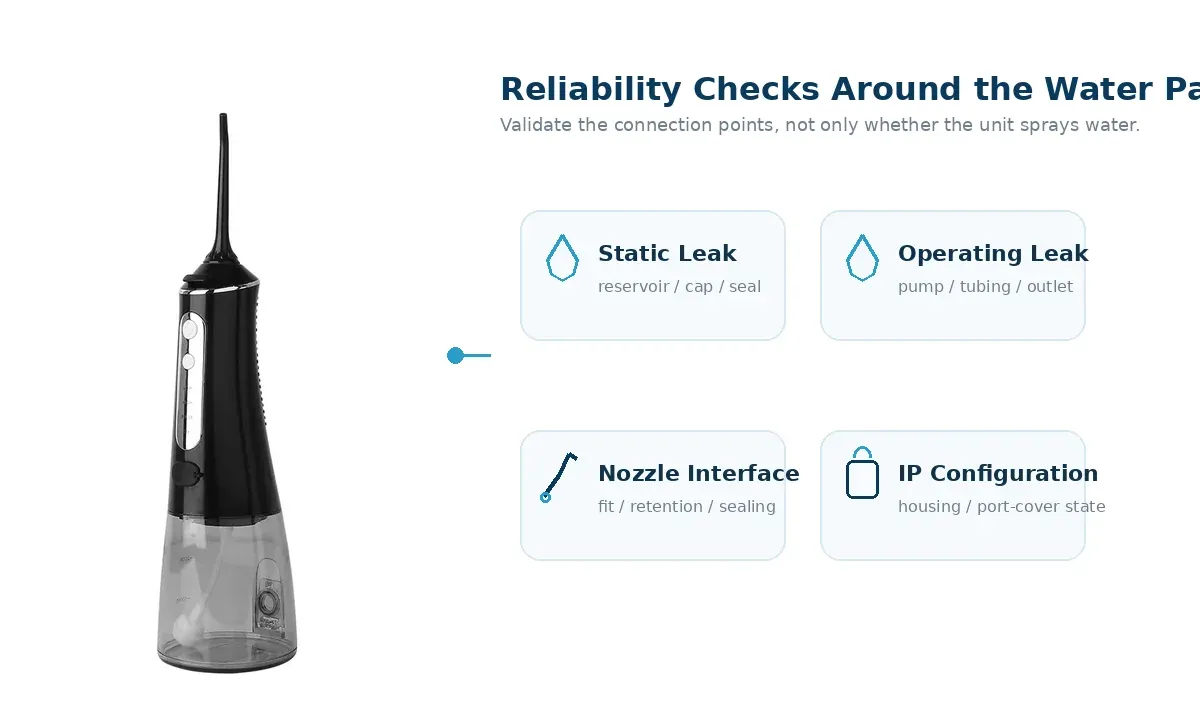
Water output should be separated into several characteristics.
| Output Characteristic | Buyer Question | Conditions to Record |
|---|---|---|
| Pressure | What pressure was measured? | Measurement point, nozzle, mode, reservoir state, battery state, orientation and pressure definition |
| Flow Rate | How much water was delivered over time? | Mode, nozzle, collection interval, reservoir condition and battery state |
| Pulse Frequency | What does the supplier’s pulse figure represent? | Terminology, unit, method and mode |
| Mode Behavior | Do the modes work as approved? | Mode sequence, output distinction, indicators and memory behavior |
A product can meet one parameter and still differ materially in another.
Pressure, flow rate and pulse frequency are different parameters and should not be merged.
Before accepting or comparing a pressure result, ask:
Higher pressure should not automatically be treated as better product quality.
The useful sourcing question is whether the measured result supports the agreed product claim under a defined condition.
A pressure number without its measurement condition has limited sourcing value.
A single reading shows what happened at one point in time.
Output during use may change with:
Where output stability is important, define an observation or measurement over an agreed operating period.
The method and acceptance basis should be agreed before testing so that different samples or suppliers can be compared consistently.
Flow rate describes water volume delivered over time.
It is only useful when the collection interval and product configuration are defined.
Pulse frequency may be described using:
These terms should not automatically be treated as equivalent.
Where either parameter is claimed or controlled, record:
Where relevant, verify that:
Not every mode needs its own quantified pressure target.
That depends on what the project specification and product claims actually require.
The pump and its connected water path are areas where repeated use can reveal problems that a one-time functional check will not show.
Potential failure modes include:
Repeated-operation validation may use:
Continuous running is not automatically representative of intended use.
The test should reflect the actual product and project requirement.
A cycle count is meaningless without the operating condition and post-test acceptance criteria.
Repeated-use testing needs more than a cycle number.
After the agreed reliability test, verify as applicable that:
Reliability testing needs both a stress condition and a post-test acceptance basis.
Both should be agreed before the test begins rather than interpreted only after the results arrive.
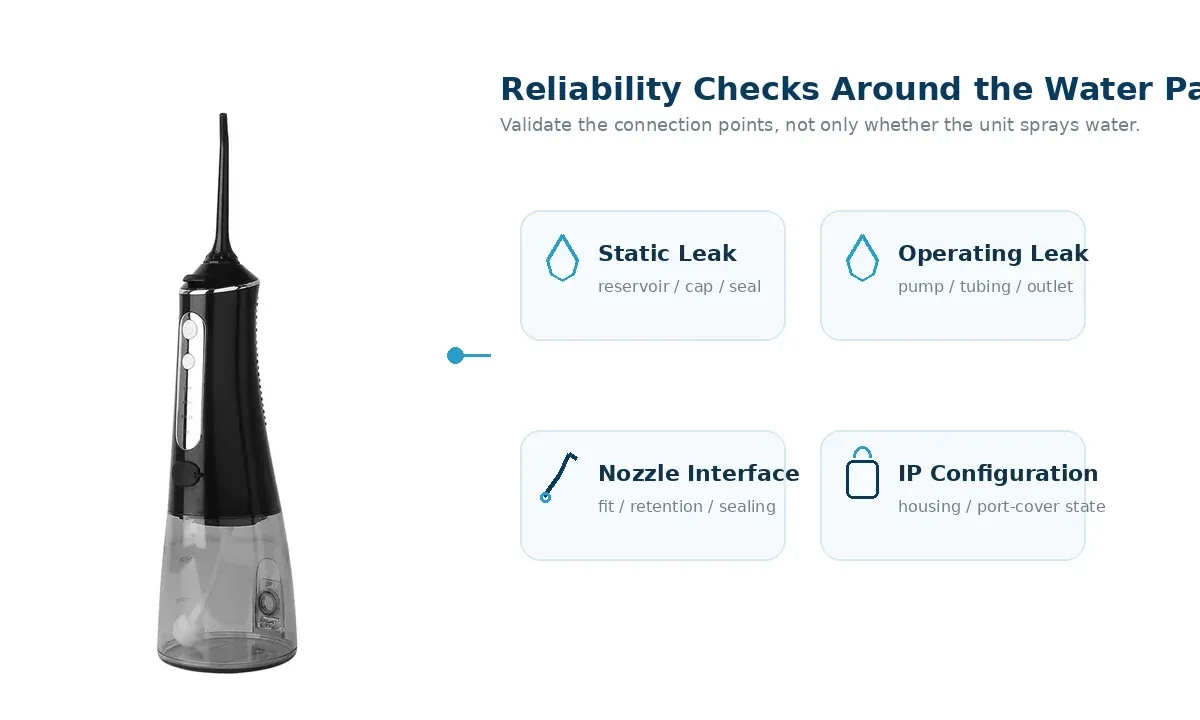
Leakage should not be treated as one generic check.
| Leakage Type | What It Means | Typical Areas to Review |
|---|---|---|
| Static Leakage | Leakage while filled but not pumping | Reservoir seam, cap, valve, tank lock, reservoir-body seal |
| Operating Leakage | Leakage while the pump is operating | Pump joints, tubing, internal seals, outlet, nozzle interface |
A reservoir can pass a static leakage check and still leak once the pump introduces pressure and vibration.
The two conditions should therefore be evaluated separately.
A broad claim such as “leak-proof” has limited value unless the evaluation method behind it is defined.
Internal construction varies by model.
Depending on the product architecture, relevant areas may include:
External inspection alone may not reveal internal leakage.
The validation plan should therefore define how important internal joints and connections are assessed, not only whether water is visible on the outside.
Removable, sliding and collapsible reservoirs are handled repeatedly during filling, cleaning and storage.
Repeated handling can affect:
The useful question is whether the reservoir still seals as intended after the agreed repeated handling.
The number of cycles should come from the project validation plan rather than a generic universal number.
The nozzle is both a mechanical interface and part of the water path.
A nozzle can install successfully and still:
Evaluate each function separately:
Retention can be compared against the approved reference sample.
Quantified force testing is project-specific and should only be used where the project defines a numerical requirement.
Nozzles may be installed, removed and rotated repeatedly during normal ownership.
Over time, this can lead to:
Where nozzle durability matters, check fit, retention, removal, rotation and sealing again after the agreed repeated-use condition.
Rotation should only be evaluated where the design actually offers it. A fixed nozzle is also a valid product architecture.
Relevant controls may include:
Repeated-use checks should confirm that the control:
Do not apply a generic button-cycle target.
The test condition should come from the specific validation plan.
A charging-port cover may be part of the enclosure’s sealing configuration.
Where one is used, review:
For charging connectors, review where relevant:
For battery and charging specification control, see Water Flosser Battery & Charging Systems.
Ingress-protection evidence should be tied to the exact product configuration that was tested.
Buyer questions include:
IEC 60529 provides the IP Code framework for enclosure ingress protection.
But an IP rating should not be interpreted more broadly than the configuration and conditions represented by the evidence.
IPX7 is not a generic promise that the product is safe in every wet-use or charging condition.
The product being sold should match the configuration represented by the ingress-protection evidence.
Where product risk justifies it, ingress protection may also be reviewed after relevant repeated use or stress.
Examples may include:
This is not automatically required for every private-label project.
It is most relevant where the claimed water resistance depends on a component that users repeatedly open, close, remove or stress.
The buyer question is:
Does the enclosure still meet the relevant requirement after the feature most likely to affect sealing has been used or stressed?
Additional validation may be appropriate depending on the product architecture, positioning and claims.
Drop / Impact
Possible post-test checks include:
The drop height, orientation, surface and post-test acceptance should come from the project requirement or an applicable test method.
Temperature / Humidity Conditioning
Environmental conditions may affect:
Do not apply generic temperature or humidity ranges without a defined basis.
Noise
Noise may be evaluated either:
If quantified, record the mode, distance and environment.
Not every private-label project needs all of these tests.
Depending on the product and target market, relevant technical references may include:
These references do not create one universal test package for every water flosser.
Applicability should be confirmed against:
The article should therefore use standards to define the question being evaluated, not as a generic certificate checklist.
Different evidence types serve different purposes.
| Evidence Type | Most Useful For | Buyer Should Check |
|---|---|---|
| Supplier Internal Testing | Engineering development, comparative testing, project-specific endurance and process learning | Method, sample revision, acceptance basis and recorded result |
| Third-Party / Accredited Laboratory Testing | Standardized tests, customer requirements, market documentation and independent evidence | Lab identity, accreditation scope, standard edition, product identity and configuration |
| Physical Sample Review | Appearance, ergonomics, basic function, fit, UI and accessory configuration | Should not be treated as long-term reliability or compliance evidence |
Third-party testing is not automatically the best evidence for every requirement.
A well-documented supplier endurance test can be useful for a project-specific reliability requirement when the method, sample identity, acceptance basis and results are clear.
A useful report should identify as appropriate:
For output, leakage, runtime or similar measurable characteristics, the actual result can be more useful than a simple “PASS.”
A bare “PASS” without method or sample identity has limited value for production approval.
A failed test is not necessarily a reason to abandon a project.
It is useful information if the problem is closed properly.
Ask:
A failed validation is not closed simply because a different replacement sample later passes.
The failure, corrective action and retest should all be traceable to the revision being released for production.
Components may change during development or between repeat orders.
Examples include:
Each relevant change should trigger a validation-impact review.
Ask:
For example:
A purely cosmetic change may have little or no reliability impact.
Risk-based revalidation means identifying which prior evidence a change may invalidate, not automatically repeating every historical test.
For engineering-change control, see BOM & Engineering Change Control.
Reliability validation demonstrates that a defined configuration can survive agreed repeated use or stress.
Production QC confirms that manufactured units and batches conform to that approved configuration.
Routine production checks may include:
Destructive endurance, drop or ingress tests are not normally performed on every unit.
A sample consumed or damaged during destructive testing should also not become the approved reference sample.
Not every project requires the same depth of testing.
| Essential for Most Projects | Project-Specific / Claim-Dependent |
|---|---|
| Basic power-on and pumping | Quantified pressure target |
| Mode operation | Quantified flow target |
| Static reservoir leakage | Pulse-frequency measurement |
| Operating leakage | Extended pump cycling |
| Nozzle fit, retention and removal | Exact nozzle-retention force |
| Charging function | Exact noise requirement |
| Structural and visual condition | Defined drop-test condition |
| Approved-revision traceability | Temperature / humidity conditioning |
| Evidence for explicit product claims | Port-cover cycle target |
| IP evidence if an IP claim is made | Extended battery / charging life validation |
This is a practical buyer framework, not an industry-standard test list.
The final validation scope should reflect the product, its claims, the target market and project risk.
Before mass production, review the project in several groups.
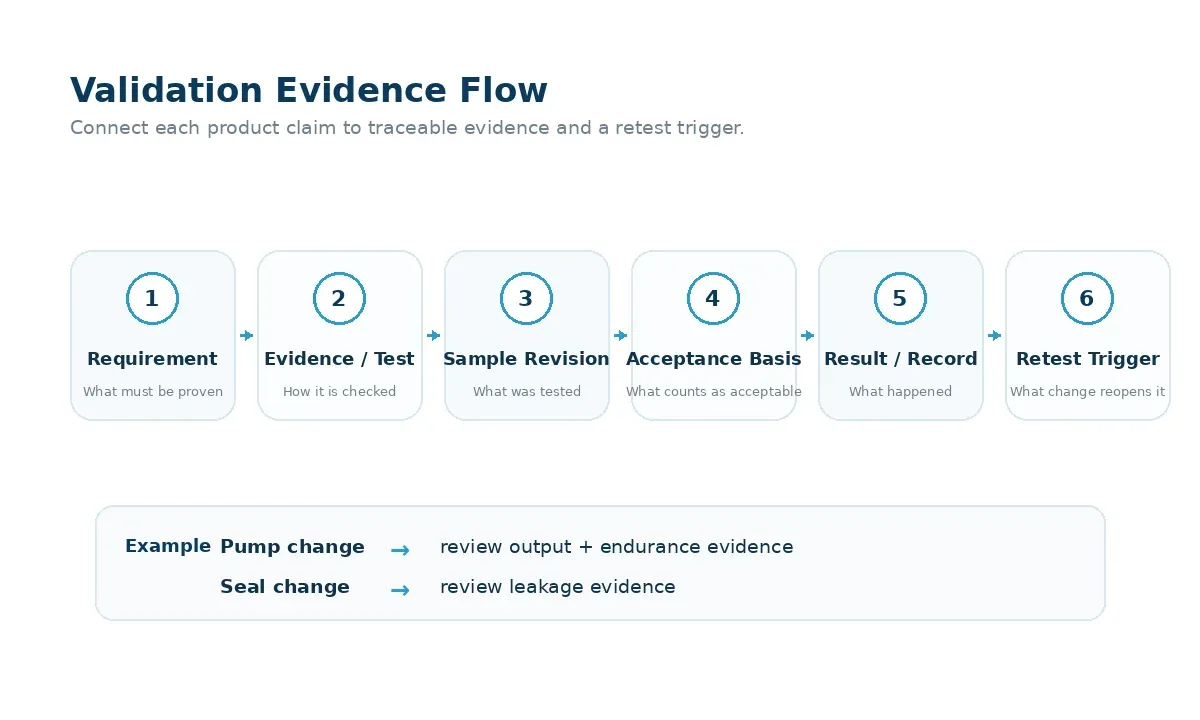
A validation matrix connects each requirement with its evidence, the exact tested revision and the change that would reopen the requirement.
| Requirement | Evidence / Test | Sample Revision | Acceptance Basis | Result / Record | Retest Trigger |
|---|---|---|---|---|---|
| Pressure Claim | Pressure measurement under defined configuration | Agreed test protocol and claim basis | Pump, valve, nozzle, PCB / firmware or water-path change | ||
| Flow-Rate Claim | Collected volume over defined interval | Agreed specification | Pump, water path, nozzle or mode-control change | ||
| Pulse Claim | Defined pulse measurement method | Agreed terminology and protocol | Pump, PCB or firmware change | ||
| Mode Behavior | Mode sequence and indicator check | Approved sample behavior | PCB, firmware or control change | ||
| Pump Reliability | Repeated-operation protocol | Agreed operating condition and post-test acceptance | Pump, motor, valve, seal or PCB-control change | ||
| Static Reservoir Leakage | Filled, non-operating check | Defined project requirement | Reservoir, cap, seal, valve or housing change | ||
| Operating Leakage | Leakage check during pumping | Defined project requirement | Pump, tubing, joint, seal or nozzle change | ||
| Nozzle Fit / Removal | Install, seat and remove, repeated where applicable | Approved sample behavior | Nozzle mold, material, interface or release change | ||
| Nozzle Retention | Retention assessment or force test if specified | Agreed qualitative or quantitative basis | Interface, material, mold or seal change | ||
| Nozzle Rotation | Rotation check after use, where applicable | Approved sample behavior | Rotation mechanism or nozzle change | ||
| Button / Control Durability | Repeated actuation as project-defined | Agreed test protocol | Button, housing, PCB or firmware change | ||
| Port-Cover Durability | Repeated opening / closing and closure-fit review | Defined project requirement | Cover material, hinge, housing or port change | ||
| Charging Function | Charging, connector and indicator review | Approved charging behavior | Battery, PCB, connector, cable or adapter change | ||
| IP Claim | Ingress test on exact configuration | Applicable standard and claimed rating | Port cover, housing, seal, port or reservoir change | ||
| Drop / Handling, if Required | Project- or standard-defined impact test | Defined post-test acceptance | Housing, reservoir, nozzle, port cover or internal mount change | ||
| Noise, if Required | Reference comparison or defined dB(A) test | Approved sample or agreed method | Pump, mounting, housing or water-path change |
Leave the Sample Revision and Result / Record columns to be completed from actual project records.
Do not fill missing acceptance values with assumptions.
Before authorizing production, buyers should be able to answer:
For the broader sourcing route, see the Water Flosser Sourcing Guide.
Before approving a water flosser for mass production, connect every critical product claim to a defined test, a traceable sample revision and an agreed acceptance basis.
Functional testing confirms that a feature works at the time of the check. The product powers on, pumps water, changes modes or charges.
Reliability validation checks whether a defined product configuration continues to function after agreed repeated operation or stress and whether it still meets the defined post-test requirements.
A product can pass its basic functional checks while pump, seal or nozzle durability remains unverified.
No.
One working sample demonstrates initial function. It does not establish repeated-use reliability, long-term leak resistance, nozzle durability, the tested ingress-protection configuration or consistency across production.
Before mass production, buyers should review validation evidence tied to a production-intent revision and defined acceptance criteria.
Compare them only when the test conditions are sufficiently aligned.
For pressure, record the measurement point, nozzle, mode, reservoir state, battery state, orientation and the definition of the pressure value.
For flow, record the mode, nozzle and collection interval.
Pressure and flow are separate parameters, so two suppliers’ figures may not be directly comparable if their methods differ.
Review both the operating condition and the post-test acceptance basis.
The operating condition may include cycling pattern, rest intervals, mode, reservoir refilling and battery state.
After the test, confirm that the pump still starts, output remains acceptable, leakage or abnormal noise has not developed and other related controls still work.
A cycle number alone says little without this context.
Static leakage occurs while the product is filled but the pump is not running.
Typical areas include the reservoir seam, cap, valve and tank lock.
Operating leakage occurs during pumping and may appear at pump joints, tubing, seals, outlet or nozzle interface.
A product can pass one condition and fail the other, so both should be evaluated separately.
Check whether the nozzle seats correctly, stays secure during operation, releases through its intended mechanism and rotates as designed where rotation is offered.
Also check whether the interface remains sealed during pumping.
Where repeated-use durability matters, repeat these checks after installation, removal or rotation cycling.
No.
An IP rating applies to a defined product configuration under specified test conditions.
The ingress-protection evidence may depend on details such as the charging-port cover being closed.
It should not be interpreted as permission to charge a wet product or as proof that every wet-use condition is covered.
Changes to the pump, motor, valves, seals, tubing, reservoir, nozzle, nozzle interface, housing, port cover, PCB, firmware, battery or charging connector can affect previously validated requirements.
They should trigger a validation-impact review.
The purpose is to identify which previous evidence remains valid and which tests need repeating. Not every change requires full retesting.