Start Your Electric Toothbrush Project
Tell us your product requirements and target market. We will review the details and reply with the relevant next steps.

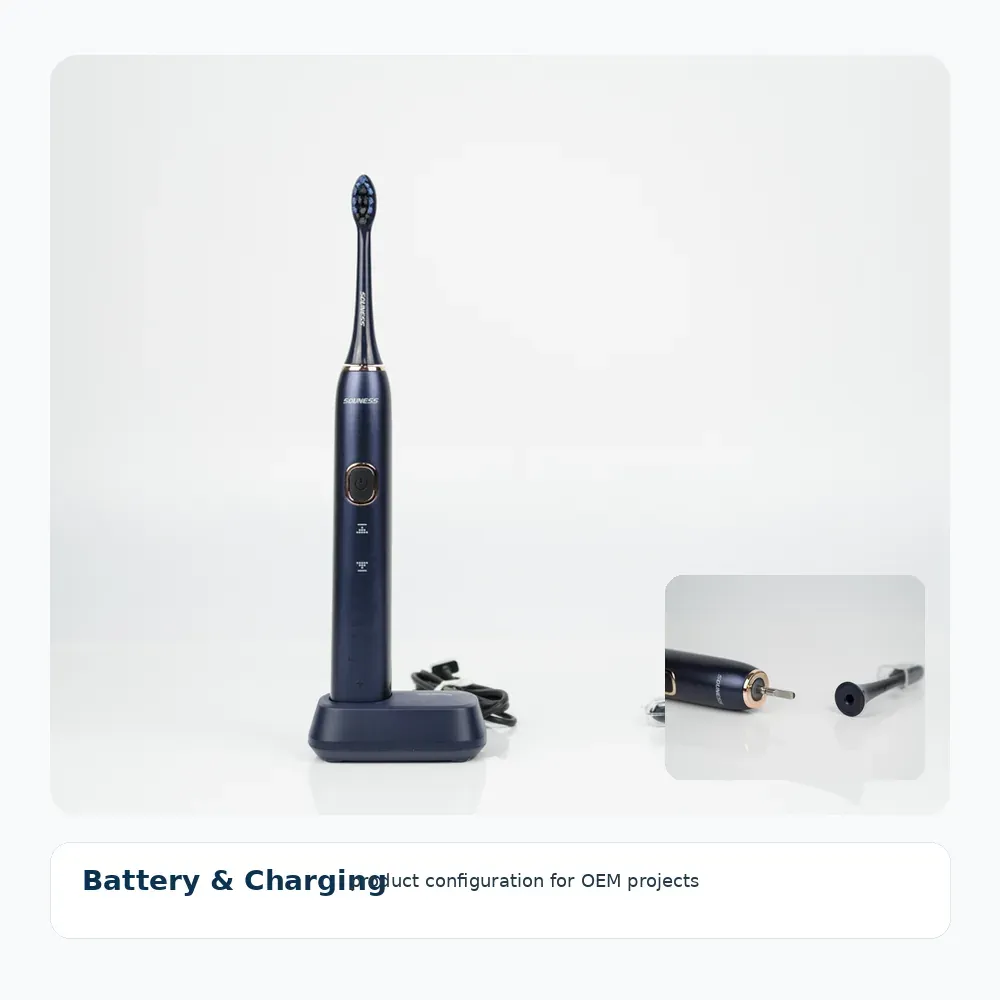
Battery and charging decisions belong in the product configuration stage, not after an electric toothbrush platform has already been approved.
Battery chemistry, capacity, charging method and runtime expectations can affect handle design, weight, sealing, accessories, packaging claims, testing and documentation. A specification that says only “800 mAh lithium battery, USB-C charging” still leaves important product decisions undefined.
For OEM and private-label projects, the goal is to define the battery and charging configuration clearly enough that quotations, samples and mass production are based on the same product.
Battery and charging are often shown as two short fields in an RFQ. In practice, they connect several parts of the product.
The battery supports the motor and electronics load. That affects runtime. The charging method influences housing and sealing design. The charging base, cable or adapter becomes part of the accessory configuration. Runtime and charging performance may later appear on packaging or product listings.
A change to one part of this system can affect several others.
Battery and charging should therefore be reviewed together with the product platform rather than added after the main product decisions have been made.
How the battery and charging system fits into the wider platform decision is covered in the Electric Toothbrush Platform Selection Guide.
Electric toothbrush platforms may use several battery types, depending on the product architecture and positioning.
Common configurations include:
No chemistry is automatically the best choice for every project.
Lithium-based batteries can support compact rechargeable designs, but they also require appropriate charging and protection electronics and relevant transport documentation.
NiMH platforms use a different charging architecture and may remain suitable for established product designs.
Replaceable-cell products remove the internal charging system but create a different product and accessory strategy.
For the buyer, the first question should therefore be:
What battery chemistry is this platform designed around?
Capacity comparisons become more useful only after the underlying battery and platform architecture are understood.
A higher mAh number does not automatically mean a longer or better-performing toothbrush.
Runtime depends on both stored energy and product consumption.
Factors may include:
Two toothbrushes with similar battery capacities can therefore produce different operating times.
Runtime can also be expressed in different ways:
“Days of use” is convenient for marketing, but it depends on assumptions.
A claim such as “30-day runtime” should be tied to conditions such as:
Buyers do not need to create the test method themselves. They should ask the supplier how the runtime figure was established.
| Claim or Specification | What the Buyer Should Ask |
|---|---|
| Battery capacity | What chemistry, voltage and battery configuration sit behind the mAh figure? |
| Runtime in days | How many sessions per day, how long per session and which operating mode were assumed? |
| Charging time | Which charger or input was used, and how was “full charge” defined? |
| Fast charging | What charging performance is actually being claimed and under which input condition? |
| Standby performance | What functions remain active when the toothbrush is not running? |
The important comparison is not simply mAh versus mAh. It is the complete battery, load and charging configuration.
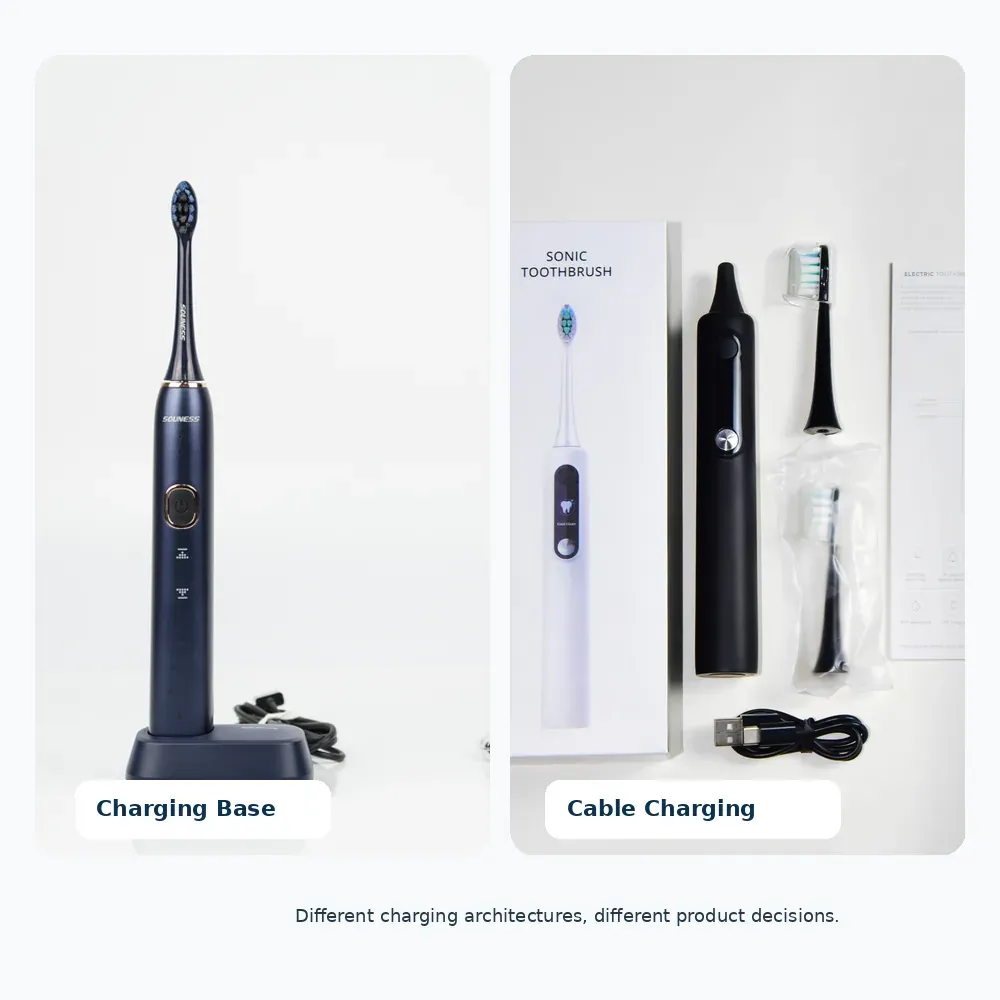
Rechargeable electric toothbrushes can use several charging configurations.
| Charging Configuration | Main Design Implication | Buyer Questions |
|---|---|---|
| Inductive charging base | Handle can avoid an external charging port | Is the base platform-specific? Which regional versions are available? |
| USB-C on the handle | Removes the charging base but introduces an external port | How is the port sealed? What input is required? |
| USB-C on a charging base | Handle may remain sealed while the base carries the port | Is the base shared across models? Which cable is supplied? |
| Proprietary charger or dock | Product depends on a dedicated accessory | Will replacement chargers remain available? |
| Replaceable batteries | No built-in charging system | Which cell format does the platform require? |
Each option affects more than convenience.
Buyers should consider:
There is no universal charging architecture that is correct for every electric toothbrush.
The right choice depends on the target product and market.
“USB-C” describes the connector interface. It does not by itself define the complete charging system.
It should not automatically be interpreted as:
For an OEM project, the supplier should confirm:
These details affect the BOM, accessory configuration, sealing design and packaging.
“USB-C charging” should therefore be treated as the beginning of the specification, not the complete specification.
Inductive charging transfers energy between a transmitting coil in the charging base and a receiving coil inside the toothbrush handle.
Because the handle does not require an exposed charging port or electrical contact, this architecture can support a fully sealed handle design.
That is useful for oral-care products regularly exposed to water.
From a sourcing perspective, however, the charging base creates additional questions:
The charging base should therefore be treated as part of the product system rather than a generic accessory.
Inductive charging does not automatically make a product more reliable or more waterproof. It removes the need for one type of external charging opening, but actual waterproof performance still depends on the complete housing and sealing design.
Rechargeable battery systems also depend on protection and charging electronics.
Depending on the platform, functions may include:
These functions may be implemented inside the battery pack, on the main PCB, or across both.
The practical sourcing point is simple:
Two batteries with the same capacity are not automatically interchangeable.
Other characteristics may also matter, including:
Changing the battery may therefore affect how it works with the existing charging electronics.
OEM buyers do not need to review the circuit design themselves. They should make sure the approved battery is compatible with the approved electronics and that later substitutions are reviewed rather than assumed to be equivalent.
“800 mAh lithium battery” describes some characteristics of a component. It does not uniquely identify the component used in production.
For the approved configuration, useful battery information may include:
This information helps control production consistency.
It also helps buyers understand whether later changes could affect:
The battery does not need to become the subject of a separate engineering project.
It simply needs to be identified clearly enough that the buyer, supplier and approved sample refer to the same configuration.
How the approved configuration is frozen and referenced is covered in Golden Sample Approval for Oral-Care OEM Projects.
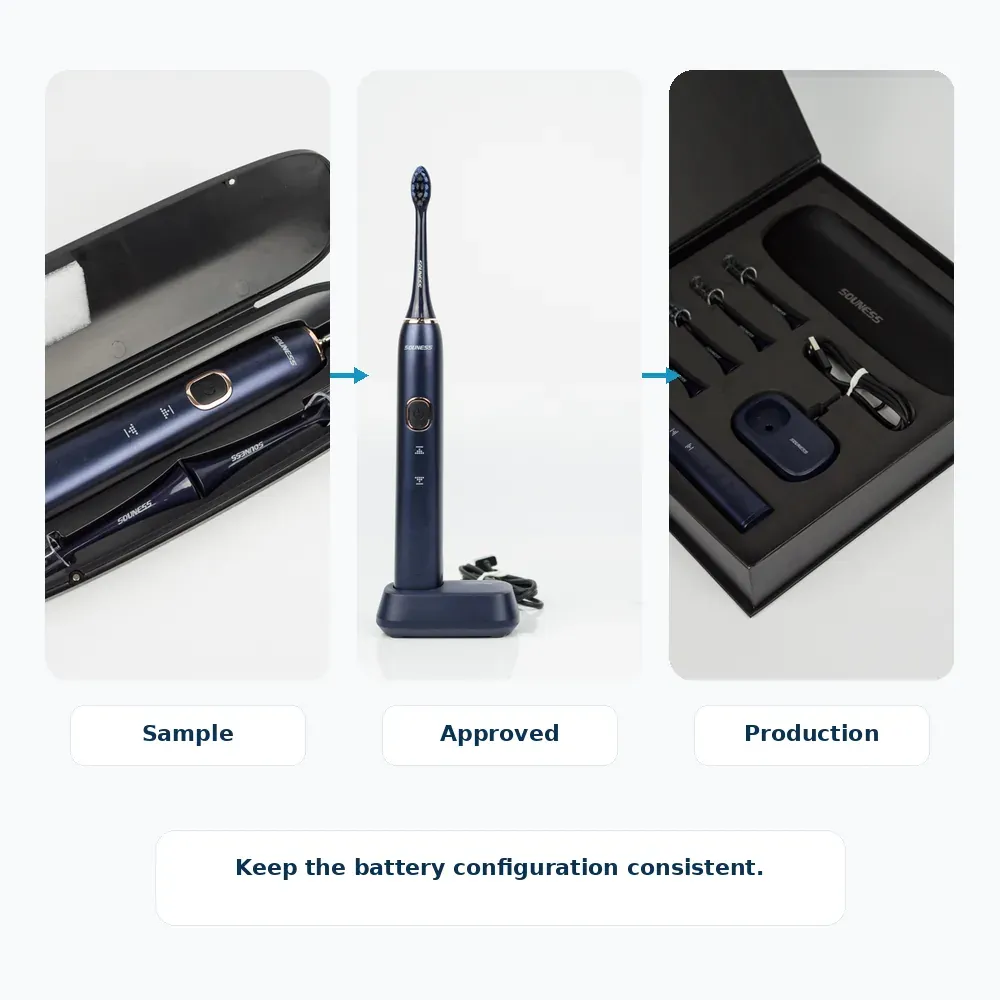
An OEM project may move through several product versions:
Stock sample → Engineering sample → Golden sample → Mass production
The battery inside a stock sample does not automatically define the battery that will be used in production.
Before approving mass production, confirm the agreed battery and charging configuration, including where applicable:
Once these fields are approved, a proposed change to the battery manufacturer or model should be treated as a product configuration change.
That does not mean every battery change automatically requires every previous test to be repeated.
It means the change should trigger a review of:
The required re-verification depends on the actual change.
How battery and charging fields can be verified during production is covered in Incoming, In-Process & Final Inspection for Oral-Care OEM Orders.
Battery and charging should have defined checks within the product validation plan.
Depending on the platform, these may include:
It is useful to separate two stages.
Development testing asks whether the selected battery and charging configuration performs as intended.
This is where longer-duration, cycling or stress-related evaluations may be considered.
Production QC asks whether manufactured units continue to match the validated configuration.
This usually relies on practical functional and process checks rather than repeating the full development validation on every production lot.
Cycle counts, test conditions, sampling plans and acceptance limits should be defined for the actual project rather than copied from generic figures.
Relevant standards and safety requirements may inform the validation program, but battery testing should still be linked to the specific configuration being produced.
The broader testing framework is covered in Electric Toothbrush Reliability Testing: What OEM Buyers Should Verify Before Mass Production.
Charging and sealing cannot be considered completely separately.
With inductive charging, the handle does not need an external charging port.
With USB-C directly on the handle, the charging interface becomes part of the waterproofing design.
Depending on the product, this may involve:
If the USB-C connection is on a charging base instead of the handle, the handle may still use a fully sealed architecture.
The important sourcing question is not whether one design is theoretically better.
It is whether the final charging configuration has been evaluated together with the housing design and whether any claimed ingress-protection performance applies to that exact configuration.
A detailed waterproof-design review belongs in a separate technical topic.
Battery and charging specifications often become marketing claims.
Examples include:
These statements should correspond to the product that will actually be shipped.
A useful control chain is:
Claim → Test condition → Final configuration → Documented result
Problems can occur when a claim is created from an early sample and the product configuration changes later.
For example:
If the product changes, the related runtime or charging claim should be reviewed before the packaging is released.
How packaging claims and artwork are controlled is covered in Oral-Care Packaging Artwork & Label Planning.
Charging accessories also affect SKU planning.
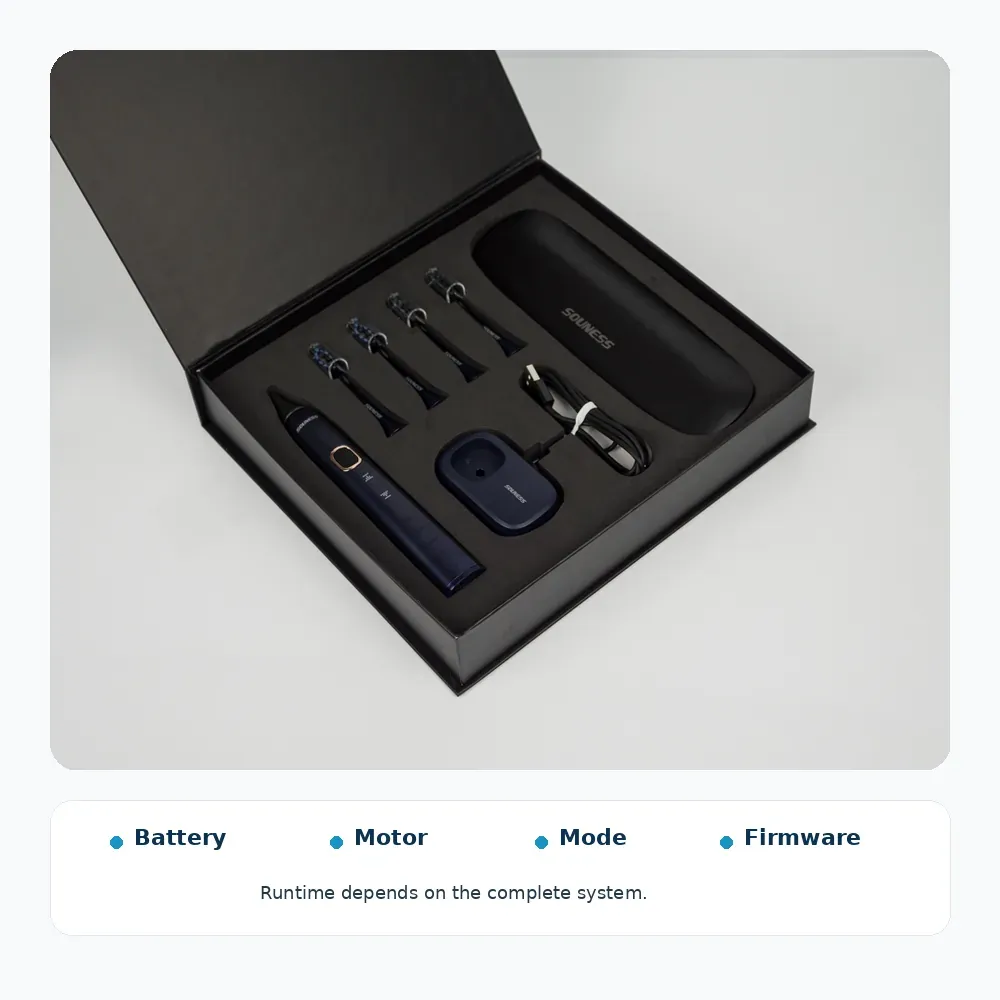
Possible product configurations include:
Each configuration changes:
USB-powered products may simplify some international projects because the toothbrush can be supplied with a cable rather than a market-specific wall adapter.
That does not remove the need to define the electrical input or confirm exactly what will be included in each market.
For inductive systems, the charging base itself may require different regional configurations.
The buyer should therefore define what ships in the box for each target market before final pricing and packaging are approved.
Battery and charging documentation should correspond to the configuration actually used in production.
Depending on the project, relevant records may include:
The most important question is applicability.
If the battery or charging system changes, buyers should check whether existing documentation still corresponds to the revised configuration.
Do not assume that a report associated with an earlier sample or another battery automatically applies.
How to check reports against the shipped configuration is covered in How to Review Oral-Care Product Test Reports Before OEM Approval.
A separate AileCare guide can cover lithium battery transport and UN 38.3 requirements in more detail.
| Field | What to Define |
|---|---|
| Battery chemistry | Lithium-based, NiMH, replaceable cells or other platform configuration |
| Capacity and voltage | Target capacity range and nominal voltage |
| Runtime target | Expected performance with a defined usage basis |
| Charging method | Inductive, USB-C, proprietary system or replaceable cells |
| Charging input | Required input or adapter concept |
| Included accessories | Cable, charging base and adapter configuration |
| Field | What to Confirm |
|---|---|
| Battery identity | Manufacturer and model used in the approved configuration |
| Protection configuration | Battery-pack and/or PCB protection arrangement |
| Charging-time target | Verified on the intended configuration |
| Runtime test basis | Condition supporting any commercial claim |
| Regional accessory plan | Final charger, cable and adapter SKUs |
| Documentation | Relevant battery, charger and product records |
| Change control | Process for reviewing battery or charger substitutions |
| Common Mistake | Better Approach |
|---|---|
| Comparing platforms only by mAh | Compare chemistry, system consumption and runtime basis |
| Treating “USB-C” as a complete specification | Define port location, input and included accessories |
| Assuming USB-C means fast charging | Define the actual charging performance separately |
| Not identifying the approved battery | Record manufacturer and model before production |
| Allowing unreviewed substitutions | Treat battery changes as configuration changes |
| Approving runtime claims from an early sample | Validate claims against the production configuration |
| Changing the battery after documentation review | Re-check applicable testing and documentation |
| Leaving cable or adapter contents undefined | Define box contents by target market |
| Not comparing sample and production configuration | Include battery/charging fields in production control |
| Ignoring replacement charger availability | Confirm future charger or base supply where relevant |
Before releasing an electric toothbrush for mass production, the buyer should be able to answer:
If these points are controlled, battery and charging become part of the approved product specification rather than an assumption hidden inside the supplier’s BOM.
For an OEM or private-label electric toothbrush project, AileCare can review your target market, runtime expectations, charging preference and accessory configuration together with the selected product platform before samples are finalized.
For the overall sourcing workflow, see How to Source Electric Toothbrushes for Private Label & OEM Projects.
No. Battery capacity is only one factor affecting runtime.
Motor consumption, brushing mode, electronics efficiency, standby consumption and smart functions can all affect operating time. Higher capacity may also influence space, weight and cost depending on the cell and platform.
OEM buyers should compare runtime under defined test conditions rather than using mAh as the only performance indicator.
Confirm whether the USB-C port is on the handle or charging base, the required charging input, whether the interface is power-only, whether any additional charging protocol is supported, and which cable or adapter is included.
If the port is located on the handle, the sealing design should also be confirmed.
“USB-C charging” alone does not fully define the charging configuration.
Not universally.
Inductive charging can support a sealed handle because it does not require an external charging port. However, it also adds a charging base that may be platform-specific.
USB-C can reduce dependence on a dedicated charging base, but a handle-mounted port becomes part of the sealing and durability design.
The correct choice depends on the product and market requirements.
For a controlled OEM project, identifying the approved battery manufacturer and model is useful.
It helps maintain consistency between samples, mass production and repeat orders and makes later component changes easier to review.
The level of battery detail required depends on the project, but “lithium battery, 800 mAh” alone may not be enough to control the production configuration.
A proposed replacement should be reviewed before it is accepted.
Two batteries with similar headline specifications may still differ in dimensions, charging characteristics, protection configuration or other characteristics.
The buyer and supplier should determine whether the change affects performance, safety, testing, documentation or commercial claims before using the replacement in production.
First define the conditions behind the claim.
That may include the number of sessions per day, brushing duration, operating mode and whether smart functions are active.
The runtime should then be evaluated using units that represent the intended production configuration. The same test basis should be retained so the marketing claim and shipped product remain aligned.