Start Your Electric Toothbrush Project
Tell us your product requirements and target market. We will review the details and reply with the relevant next steps.

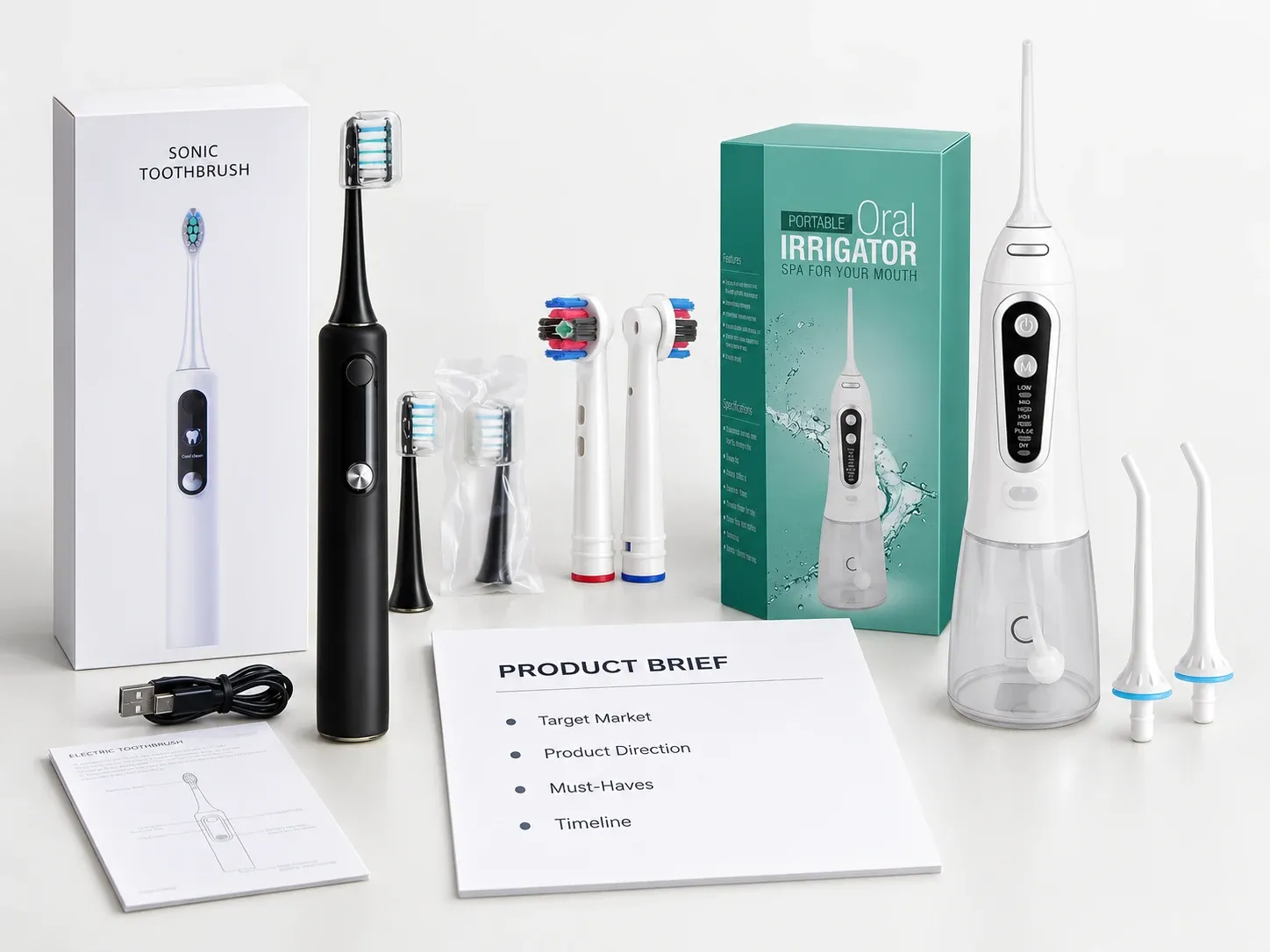
Before asking an OEM supplier for a quotation, prepare a product brief that defines the commercial goal, target market and sales channel, product direction, priorities, reference products, bundle expectations, timeline, and unresolved questions.
A product brief for an OEM supplier does not need to be a final technical specification. It should give suppliers enough context to identify relevant product options, explain assumptions, and prepare more comparable proposals.
“Send me your best price” does not define a project.
Without a clear product direction, market, accessory bundle, and customization scope, different suppliers may quote against different assumptions. One may price a standard platform, another may include extra accessories, and another may assume custom packaging.
The resulting prices are difficult to compare.
A clearer brief does not guarantee a lower price. It reduces ambiguity, makes supplier assumptions easier to identify, and helps suppliers propose configurations that are more relevant to the project.
The goal at this stage is not maximum technical detail. It is enough commercial and product direction to support a useful first supplier discussion.
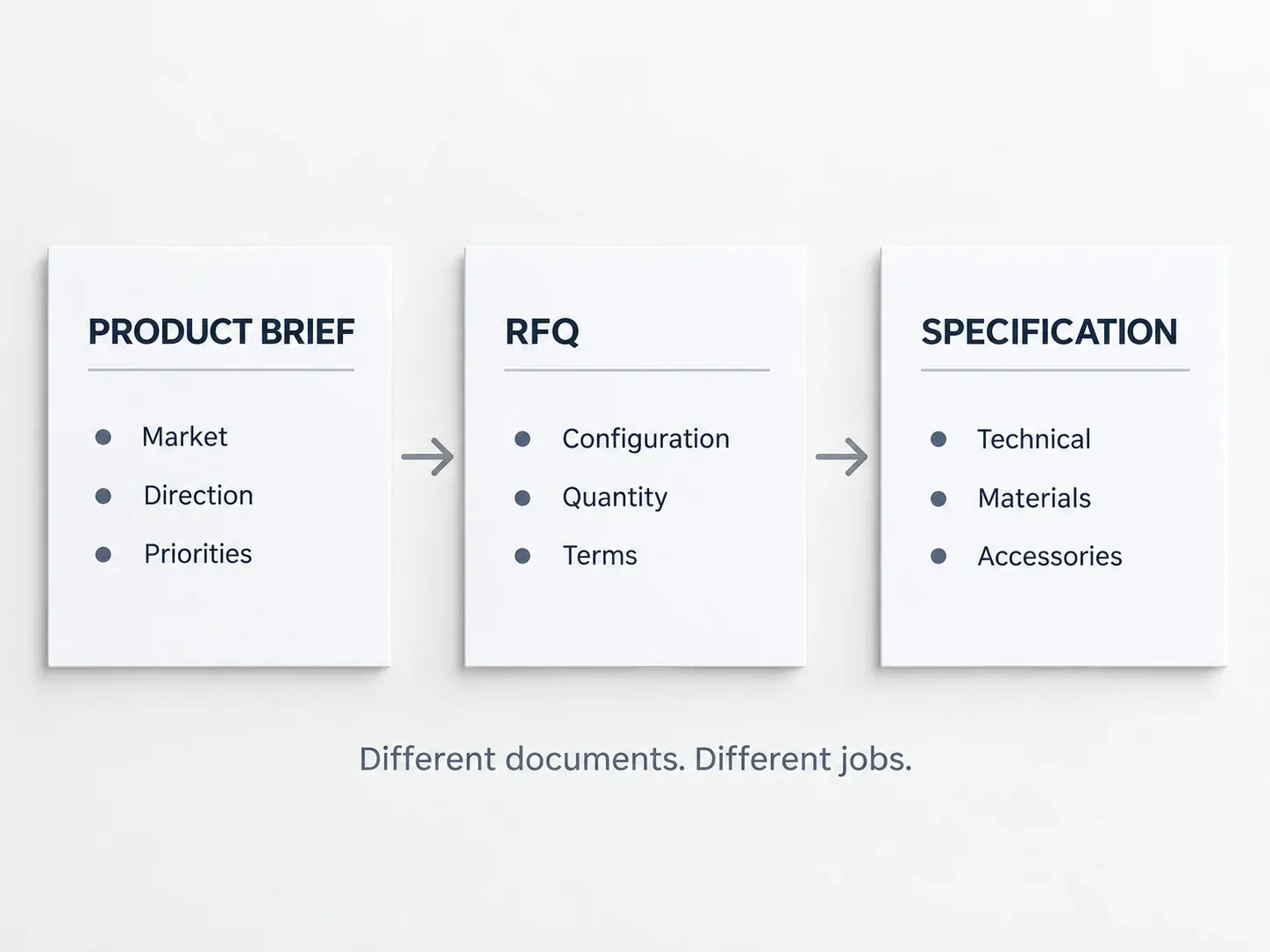
These documents support different stages of an OEM project.
| Document | Main Purpose | Typical Stage | What Belongs in It |
|---|---|---|---|
| Product brief | Explain the commercial goal, market, product direction, priorities and open questions | Before the first meaningful supplier discussion | Objective, market, channel, positioning, references, must-haves, preferences, timeline and open questions |
| Product specification | Define controlled technical, functional, material and configuration requirements | Platform comparison, sampling and approval | Product configuration, performance requirements, charging, materials, accessories and other controlled fields |
| RFQ | Request pricing and commercial terms against defined requirements | After the project direction is sufficiently clear | Configuration, quantities, delivery context, commercial terms and quotation assumptions |
The product brief normally comes first.
It supports the initial supplier discussion and platform matching. Once the configuration becomes clearer, the buyer can issue a more focused RFQ and progressively refine the product specification.
They are connected documents, but they are not interchangeable.
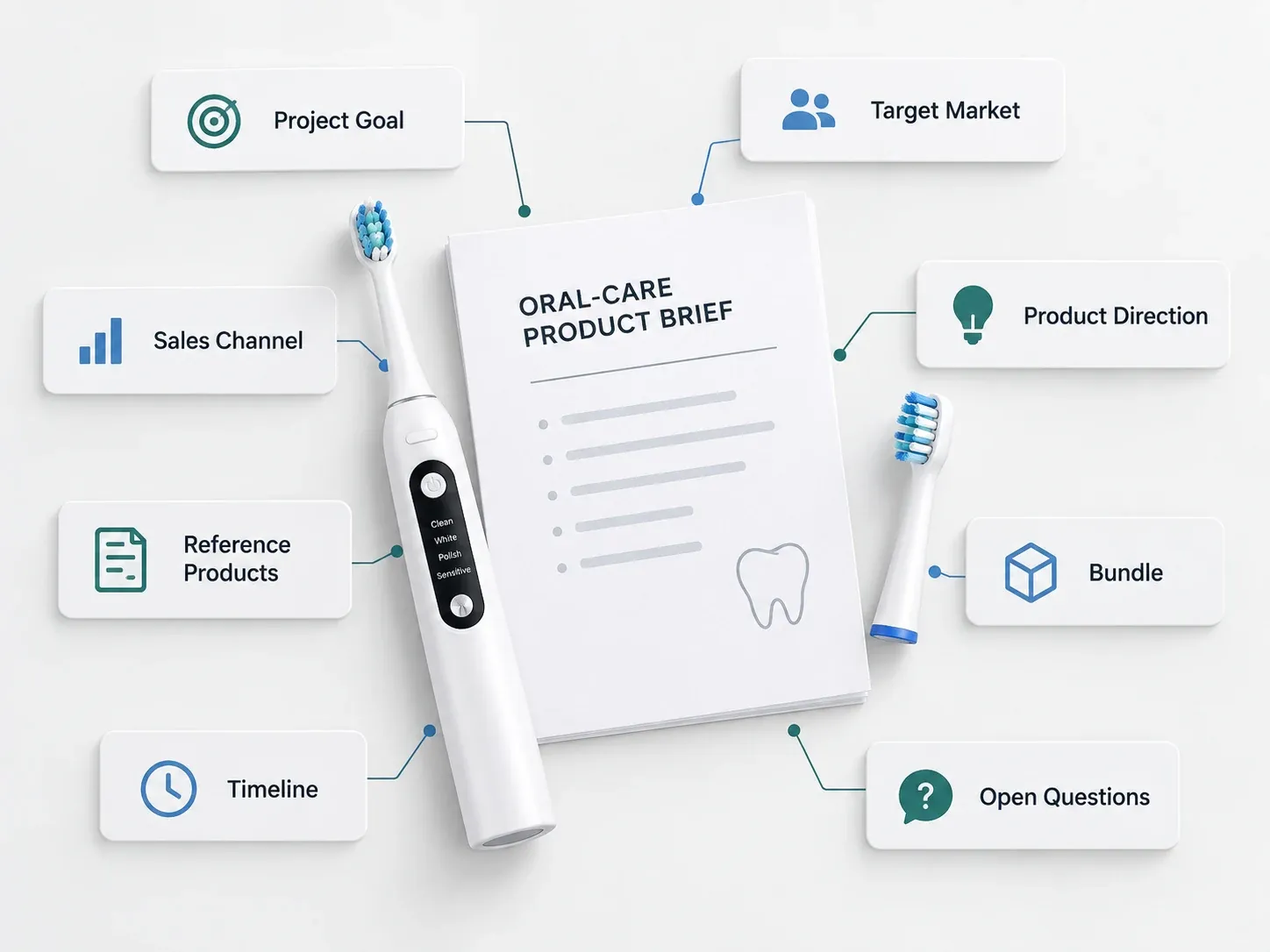
A useful brief should answer five basic questions:
The following areas provide enough structure for most early oral-care OEM discussions.
| Brief Area | What the Buyer Should Define | Why It Matters |
|---|---|---|
| Project objective | Product family and the purpose of the launch, range or program | Gives the supplier commercial context rather than only a product name |
| Target market and channel | Destination market and whether the product is for retail, e-commerce, distribution, subscription or mixed channels | Market and channel can affect configuration, documentation, language and packaging direction |
| Product category and user segment | Electric toothbrush, replacement brush head, water flosser or set; adult, kids, family, travel or another intended segment | Helps suppliers screen appropriate product platforms |
| Positioning | Intended market level and, where useful, retail price tier | Terms such as “premium” are subjective without additional context |
| Reference products | What each reference is intended to communicate and how the new project should differ | Prevents suppliers from treating a reference photo as a complete specification |
| Must-haves, preferences and open questions | Which requirements are fixed, negotiable or still open for supplier input | Makes proposals easier to compare |
| Platform direction | Existing platform, modified platform or custom-development exploration | Sets expectations for the likely project route |
| Customization and brand status | Logo, color, finish, packaging direction, accessory changes and whether brand assets are ready | Separates branding work from engineering-dependent changes |
| Accessories and bundle | Included heads or nozzles, charging components, case, caps, manual and other bundle items | Prevents quotations from using different included contents |
| Order pattern and timeline | Expected initial-order direction, repeat-order potential, launch objective and known timing constraints | Gives suppliers the commercial context needed to discuss suitable options |
| Documentation assumptions and intended claims | Destination-market expectations and any claims that may later require supporting evidence | Identifies issues that may affect later product, documentation or packaging review |
| Supplier proposal request | The specific areas where supplier recommendations are wanted | Tells the supplier where to propose alternatives instead of guessing |
There is no universal rule.
A buyer may share the intended positioning, retail price tier or target product-cost direction when that helps suppliers screen suitable platforms.
Whether to disclose a specific cost target depends on the negotiation strategy and how mature the project is.
Give the supplier an honest view of the expected initial order and repeat-order direction.
If a quantity range is already known, include it. If it is still being evaluated, state that clearly.
MOQ and customization requirements vary by product, platform and supplier, so the early brief should provide commercial context rather than invent a volume target.
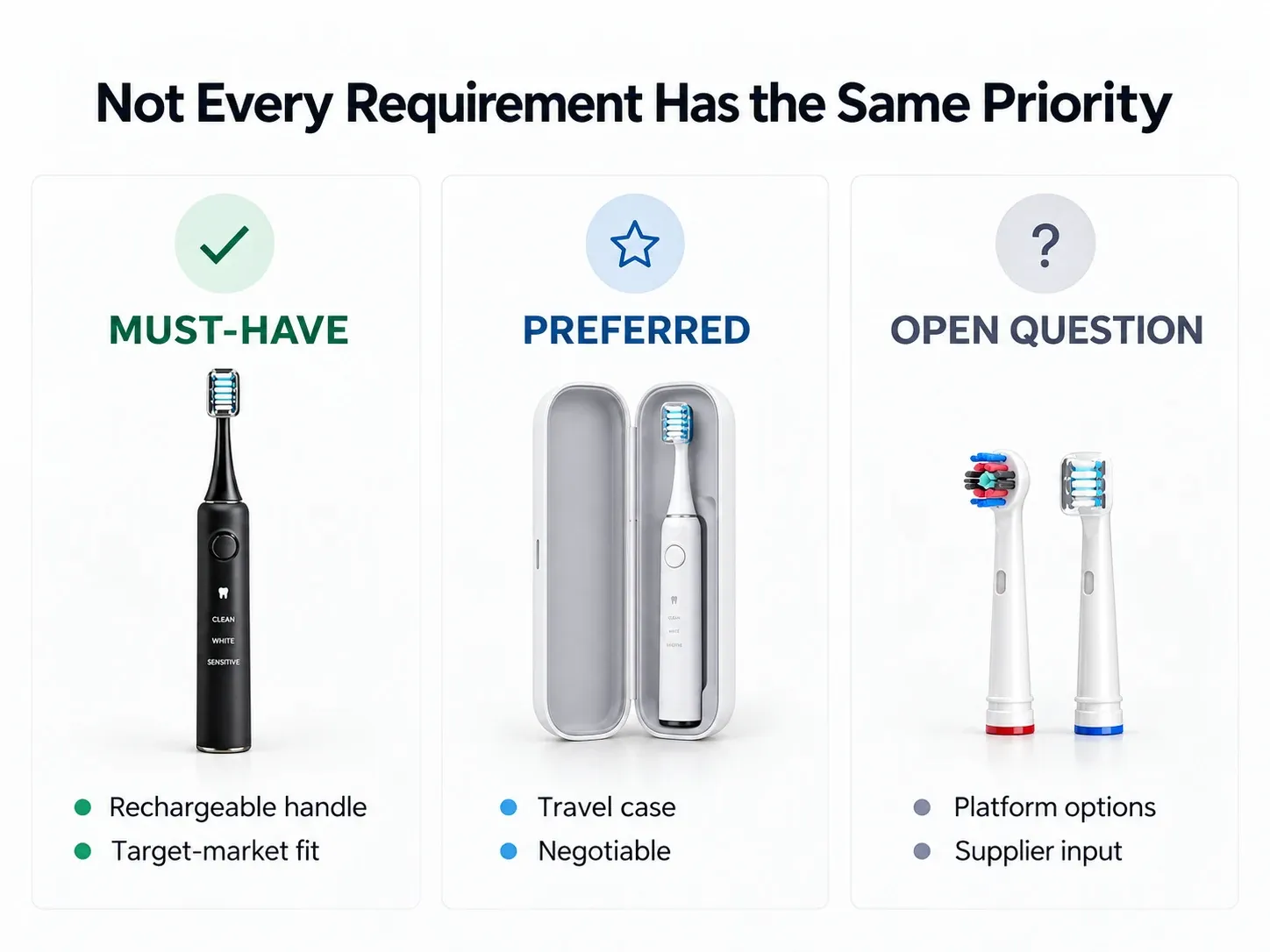
This is one of the most important parts of a useful product brief.
A condition that determines whether a proposed product platform is relevant.
Example:
Rechargeable handle suitable for the intended market.
A feature that is desirable but may be traded against cost, timing, platform availability or project complexity.
Example:
Travel case preferred if it fits the intended positioning.
An area where the buyer wants the supplier to propose feasible options.
Example:
Please propose suitable existing platforms and explain the main accessory differences.
If every feature is marked as mandatory, otherwise suitable platforms may be excluded because of relatively minor differences.
If nothing is prioritized, each supplier may make different assumptions and effectively quote a different product.
Separating these three categories gives suppliers clearer decision boundaries.
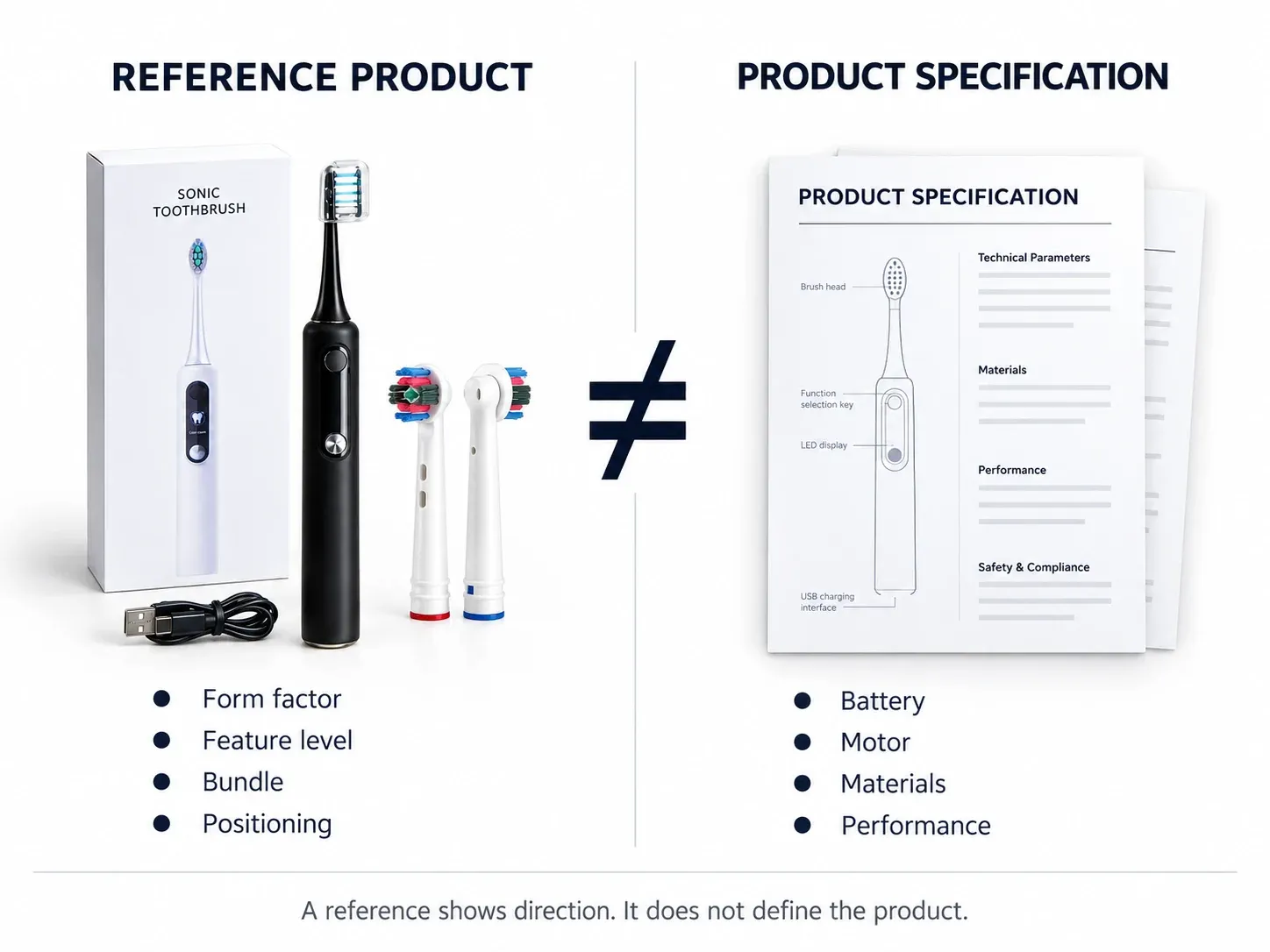
Reference products are useful when they communicate visible direction.
They can help explain:
But a reference product does not automatically define what is inside it.
A competitor product does not establish the required motor architecture, battery configuration, brush-head interface, materials, durability, production controls, market documentation or evidence behind its claims.
“Same as this Amazon bestseller” is therefore not enough.
A better instruction is:
Reference product X is useful for the form factor and bundle concept, but our project differs in target market, charging direction and accessory configuration.
State clearly what the reference is intended to communicate and what should be different.
Reference products should be used for direction rather than as instructions to reproduce another brand’s protected artwork, design or claims. Intellectual-property questions should be reviewed separately where relevant.
A productive supplier discussion depends on a clear boundary between commercial decisions and supplier recommendations.
The buyer owns decisions such as:
These decisions determine what type of product the business actually needs.
The supplier can then help with areas such as:
The supplier can propose ways to execute the project. The buyer still needs to define the commercial direction the product is meant to serve.
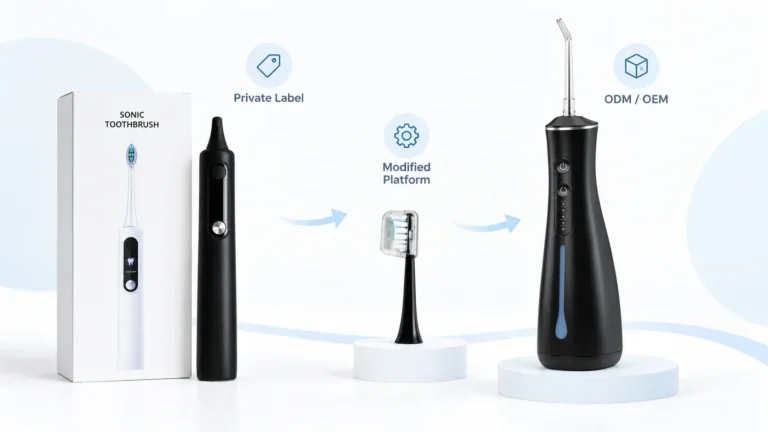
The same brief structure can support different development routes, but the emphasis changes.
For the development-route decision itself, see OEM vs ODM for Oral-Care Products.
Focus on:
Also clarify which elements the buyer expects to change and which may remain standard.
Add:
This helps the supplier distinguish a practical platform modification from a broader custom-development request.
Provide more context around:
For a custom project, suppliers need to understand not only what the buyer wants changed, but why the change matters to the intended market or product strategy.
Different oral-care categories require different information at the brief stage.
State the intended user, platform direction, target market, brush-head ecosystem direction, charging and accessory expectations, and which features are required versus optional.
The technical fields behind these choices are covered separately in the Electric Toothbrush Product Specifications guide.
The brief establishes direction. The specification controls the detailed requirements later.
The main starting point is the intended handle platform and compatibility boundary.
Also define:
The later verification process is covered in the Replacement Brush Head Sourcing Checklist.
State the intended product direction, such as:
Also define the target market, sales channel, nozzle or accessory bundle and broad positioning.
Detailed sourcing and product-verification considerations belong in the Water Flosser Sourcing Guide.
Define the anchor product and exactly what belongs in the set.
Also explain whether the offer is intended as a:
The commercial purpose matters. Otherwise, a “set” can become an undefined collection of accessories that different suppliers interpret differently.
A good early brief defines direction without locking every technical decision too soon.
Unless the buyer already has a justified requirement, the first brief does not normally need to finalize:
These issues are not being ignored.
They can be refined after the available platforms, project scope and market requirements are better understood.
For example:
USB-C charging preferred; open to suitable alternatives depending on the selected platform and sealing design.
This communicates the buyer’s direction without creating an unnecessary technical constraint before the product platform has been reviewed.
| Weak Approach | Why It Creates Problems | Better Approach |
|---|---|---|
| Asking only for “best price” | Suppliers may price different configurations | Define the product goal, market, channel and main priorities first |
| Sending only a reference photo | The supplier has to guess what matters in the reference | Explain which attributes should guide the proposal and what should differ |
| Marking every feature as mandatory | Reduces room for practical platform alternatives | Separate must-haves from preferences |
| Providing no target market | Market-dependent assumptions remain unclear | State the intended destination market early |
| Saying only “premium” | The positioning is too subjective | Add channel, user segment and price-positioning context |
| Hiding or overstating expected quantity | Makes commercial discussions less useful | Give a realistic initial-order and repeat-order direction |
| Giving a launch date without project dependencies | Makes schedule feasibility difficult to assess | Explain both the desired launch window and what is still unresolved |
| Finalizing packaging before the product platform | Product dimensions or bundle changes may force packaging rework | Define packaging direction first and finalize structure later |
| Changing core requirements after sampling begins | Makes samples difficult to compare consistently | Maintain a dated brief and record major requirement changes |
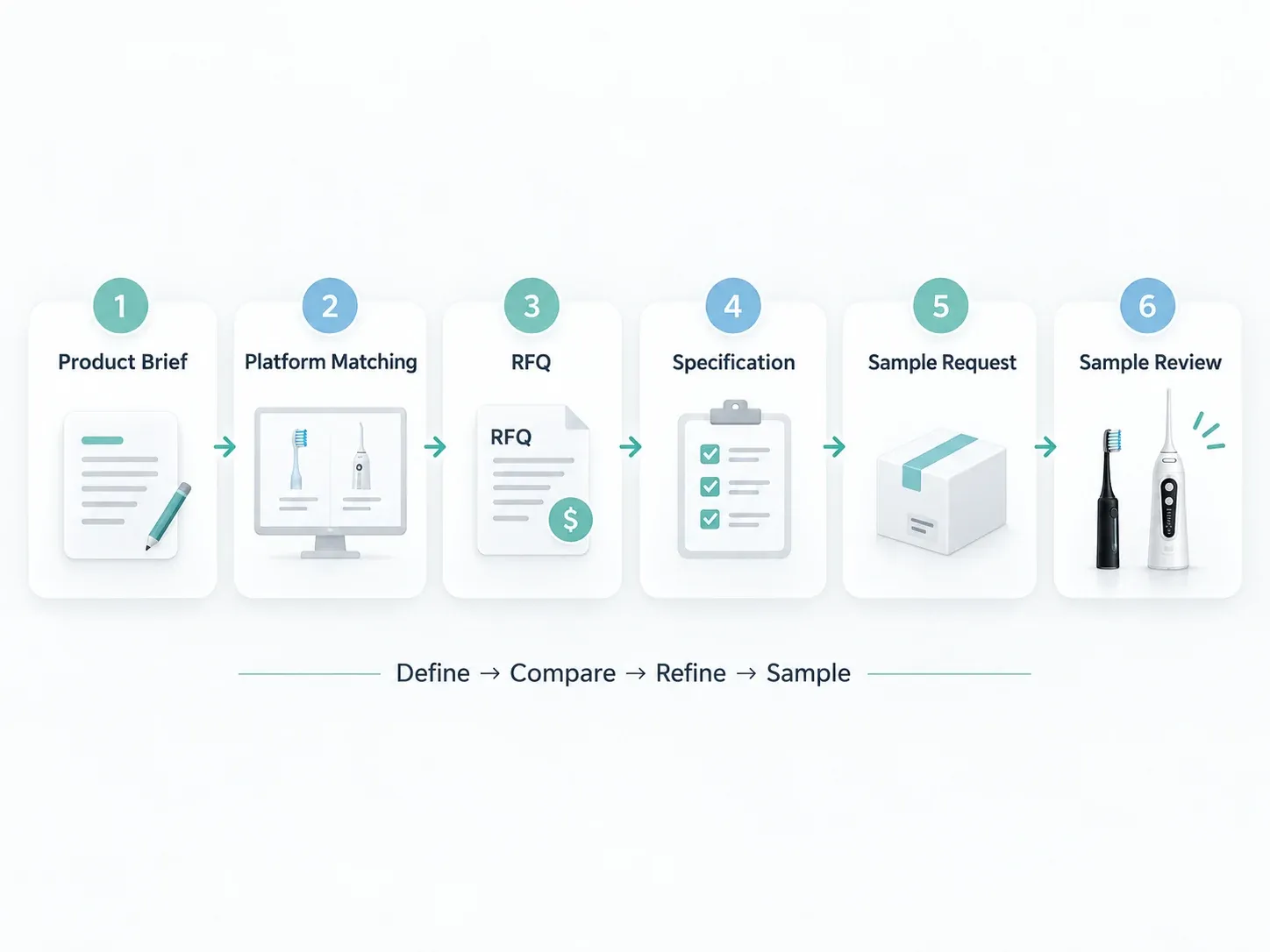
A practical oral-care OEM project usually becomes more controlled in stages.
The product brief is the bridge into this process.
It does not replace the RFQ, product specification or sample-approval process. Each document answers a different project question.
This guide explains the decisions that should be made before contacting suppliers.
Once those decisions are clear, use the Product Brief Template in AileCare Project Resources to organize the information into a working document for a live sourcing or OEM project.
A product brief explains the commercial objective, target market, product direction, priorities and open questions.
An RFQ asks suppliers to provide pricing and commercial terms against sufficiently defined requirements. The product brief normally comes earlier and helps create a clearer basis for the later RFQ.
Provide the product category, intended user, target market and channel, product positioning, useful reference products, must-have requirements, preferences, expected accessory bundle, order direction, timeline and any areas where supplier recommendations are needed.
The goal is to give the supplier enough context to understand what should be quoted.
Be specific about the commercial direction, market, channel, positioning and priorities.
Technical requirements should be detailed where they are genuinely fixed, but component-level decisions can remain open when they depend on the final product platform.
It depends on the project and negotiation strategy.
Sharing the intended positioning or retail tier can help suppliers screen suitable platforms. A specific target cost may also be useful in some projects, but it is not a universal requirement.
At minimum, the platform direction, key configuration, must-have requirements, accessory bundle and main evaluation criteria should be sufficiently clear.
Otherwise, different samples may represent different project assumptions and become difficult to compare.
Explain exactly what the reference is intended to communicate, such as form factor, feature level, accessory bundle or positioning.
Also state what should be different in your project. Do not treat the reference product as proof of its internal construction, production quality, market documentation or claims support.
Before requesting a project review, organize your target market and channel, product direction, priorities, reference products, bundle expectations, expected order pattern and timeline.
A clearer brief gives both sides a better basis for discussing feasible product options and preparing comparable quotations.