Start Your Electric Toothbrush Project
Tell us your product requirements and target market. We will review the details and reply with the relevant next steps.
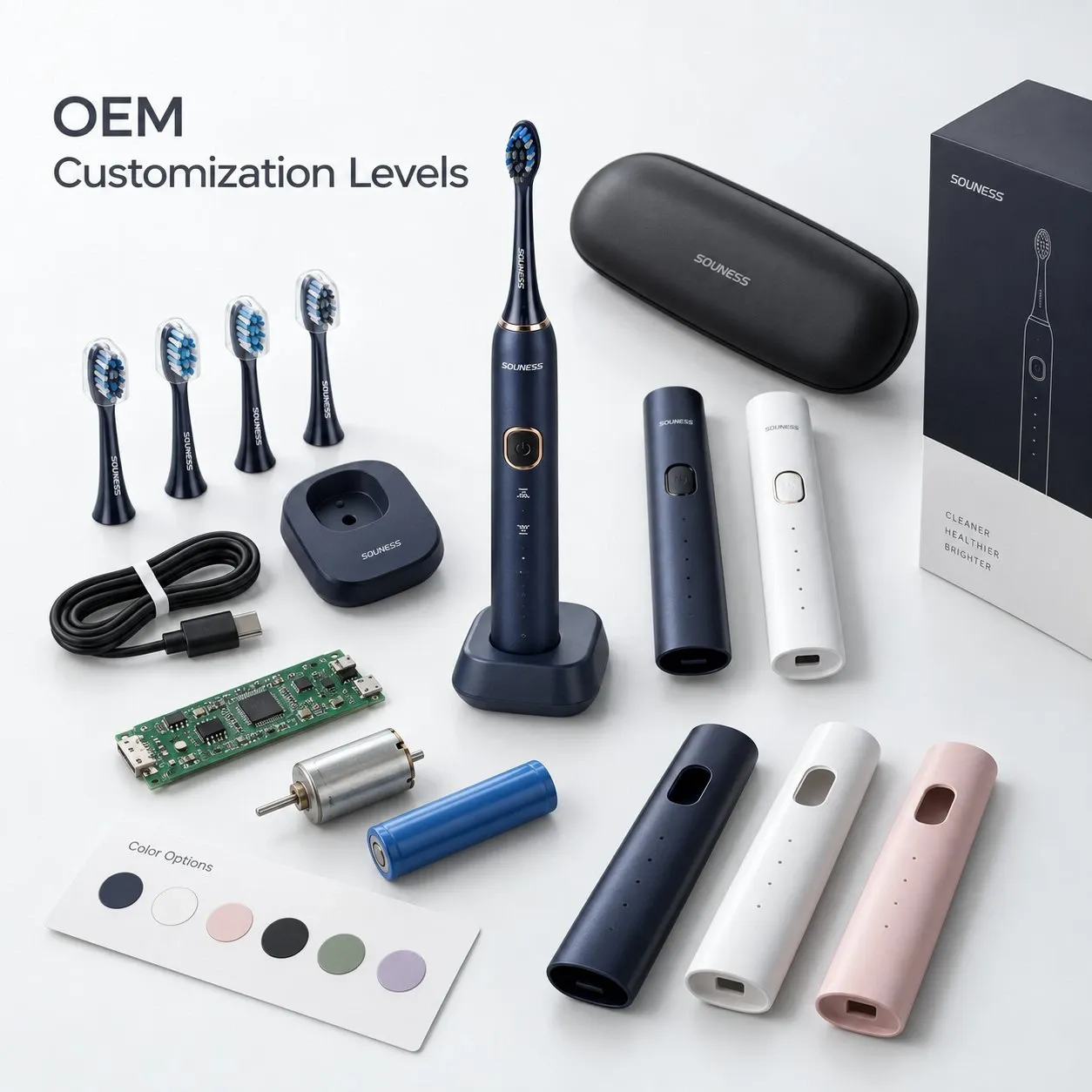
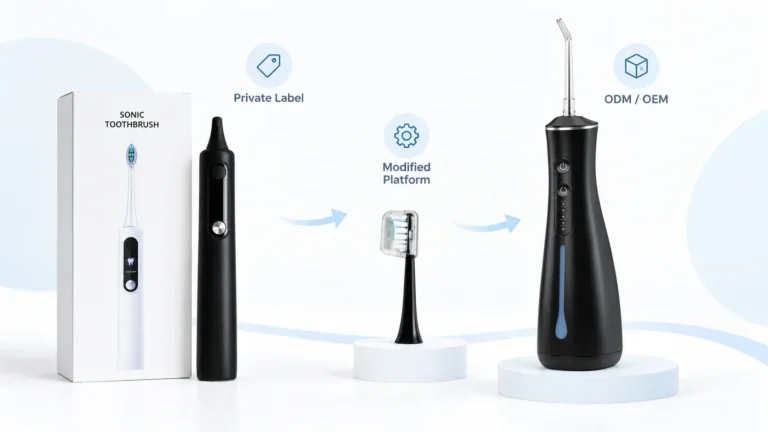
“Custom electric toothbrush” can describe very different projects.
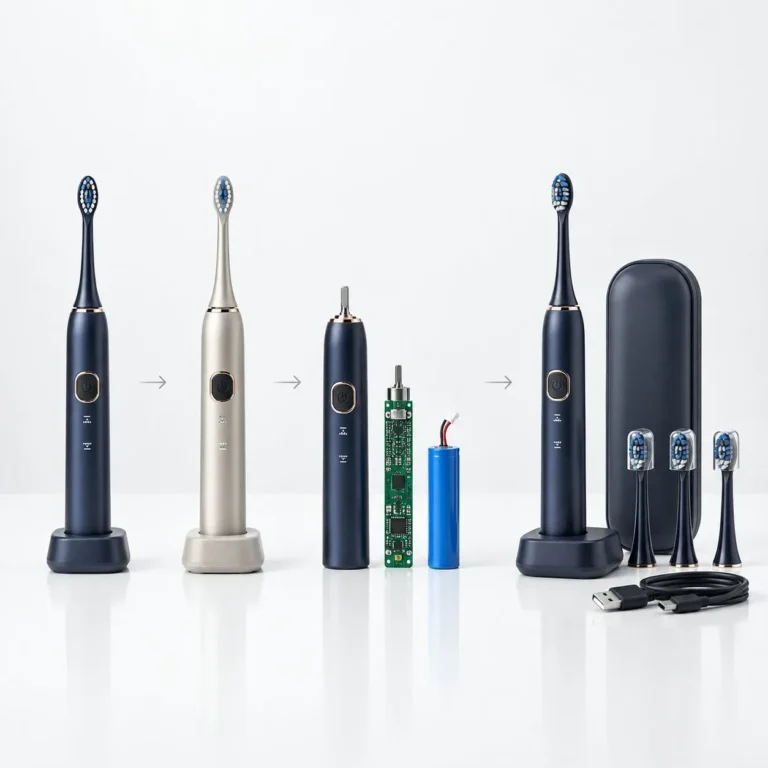
Changing a logo, color or package is one type of customization. Changing firmware behavior is another. A different battery, pressure sensor, charging port, PCB, handle shape or brush-head interface can move the project into deeper engineering, mold modification or new tooling.
Before requesting a quotation, the buyer should first classify the customization depth: what stays standard, what changes, and whether the request affects electronics, mechanics or tooling.
That distinction makes supplier quotations, samples and development plans much easier to compare.
A practical way to classify OEM customization is to use five levels.
This is a buyer-oriented sourcing framework, not an official industry classification.
| Level | Customization Type | Typical Changes | Tooling Impact |
|---|---|---|---|
| 1 | Branding & Packaging | Logo, manual, artwork, barcode, existing color option | Normally no product-tooling change |
| 2 | Cosmetic / Existing Components | Custom color, finish, decorative trim, supported accessories and brush-head cosmetic options | Usually no new main tooling if the platform supports the request |
| 3 | Firmware / Supported Functions | Mode order, timer, pacer, memory, LED logic, supported intensity behavior | Normally no mold change if hardware remains unchanged |
| 4 | Component / PCB / Structural Modification | Battery, charger, display, sensor, PCB revision, motor driver, selected structural parts | Tooling may or may not be required |
| 5 | New Tooling / Full ODM Development | New housing, button position, neck/interface, internal mounts, charging-port opening or proprietary head interface | Mold modification or new tooling is likely |
Each level changes the engineering scope, sample path and validation work.
The important point is not the number assigned to the level.
It is whether the buyer and supplier agree on which parts of the existing platform remain unchanged and which parts require development.
The lowest-complexity private-label changes normally affect branding rather than product architecture.
Examples include:
Common marking methods may include:
The appropriate method depends on the housing material, surface texture, decoration area and intended finish.
Branding normally does not require a product-architecture change.
However, buyers should still confirm whether the requested:
is suitable for the selected decoration process.
A curved, textured or coated surface may require a process trial even when the existing tooling remains unchanged.
The packaging system behind these changes is covered in the Oral-Care Packaging Guide for OEM Projects.
“Custom color” can mean several different things.
This is normally the simplest route because the color and process already exist on the platform.
If the product geometry stays unchanged, a different molded color may still use the existing mold.
The main work shifts to:
Examples may include:
These can introduce additional process and durability considerations even when the geometry remains unchanged.
Some platforms may use separate:
that can be changed without modifying the main housing.
This is platform-specific.
A decorative ring that is removable on one toothbrush may be molded directly into the housing on another.
The useful buyer question is:
Which visible parts are independent components, and which are part of the main molded housing?
For color approval, physical samples are more reliable than screen colors alone.
Accessory bundles often provide useful differentiation without changing the toothbrush handle.
Possible changes include:
But:
Same toothbrush + different accessories does not necessarily mean the same SKU configuration.
An accessory change may affect:
If an electrical accessory such as a charger or adapter changes, relevant documentation may also need review.
The toothbrush itself may remain unchanged while its commercial configuration changes substantially.
Brush-head customization should be divided into two categories.
Possible examples include:
These may remain within an existing brush-head tool and interface.
Deeper changes may include:
These may require:
The key question is:
Does the request stay within the existing brush-head tool and interface?
If yes, the customization may remain relatively contained.
If not, the project has moved from cosmetic customization into mechanical product development.
Changing brush-head compatibility is much more significant than changing bristle color.
A new compatibility system can affect:
Changing bristle color is cosmetic.
Changing which head fits the handle is product architecture.
This should therefore be reviewed at the platform level rather than treated as a simple accessory request.
The brush-head ecosystem question belongs at platform level, covered in the Electric Toothbrush Platform Selection Guide.
Firmware can change a significant amount of product behavior without changing the housing.
Possible firmware-level changes include:
But firmware-only customization is possible only when the existing hardware already supports the requested behavior.
Relevant dependencies may include:
A factory offering an existing toothbrush platform should therefore confirm whether the required function is already supported by the electronics.
Do not assume that every supplier can rewrite firmware on every model.
The electronics architecture behind these dependencies is covered in Electric Toothbrush Motor, PCB & Firmware.
“Add one more brushing mode” sounds simple, but it does not define the function.
The buyer should specify:
Once these are defined, the actual customization depth becomes easier to determine.
If the existing electronics already support the required motor behavior and user interface, the change may remain firmware-level.
If it requires:
then the request may move into PCB or broader electronics development.
A pressure sensor, motion sensor or IMU is not simply a software option.
A sensor feature may involve:
Sensor
→ Mechanical Integration
→ PCB Input
→ MCU
→ Firmware
→ User Feedback
→ Validation
Before requesting a sensor feature, buyers should ask:
If the required hardware does not already exist, the project may involve mechanical, PCB and firmware development together.
Some interface changes may stay within the existing platform.
Examples include:
These may remain relatively simple if the required hardware already exists.
A different level of development may be required for:
A new display position can affect:
The buyer question should be:
Is the requested visual interface already physically supported by the platform?
Battery and charging changes can look simple in an RFQ but affect several parts of the product.
Buyers may request:
These requests may affect:
A larger battery does not automatically fit inside an existing handle.
Different charging requests can represent completely different levels of work.
| Request | Possible Customization Depth |
|---|---|
| Different supplied cable | Often accessory-level |
| Different wall adapter | Often accessory-level, with relevant document review |
| Different charging base using the same handle interface | Accessory / charging-platform review |
| USB-C added to charging base | Base electronics may need modification |
| USB-C added directly to handle | May affect PCB, housing, sealing and tooling |
The exact result depends on the existing platform.
[Internal link: Electric Toothbrush Battery & Charging Systems]
Requests such as:
should not be treated as simple numeric adjustments.
Final behavior may depend on:
Some characteristics may be adjustable within the current platform.
Others are fundamental to the platform architecture.
The useful sourcing question is:
Can the requested behavior be achieved within the existing motor and mechanical platform, or does the architecture need to change?
A higher headline vibration frequency alone should not be treated as proof of better product performance.
A PCB revision may become necessary when the buyer requests:
A PCB change does not automatically mean the external housing mold must change.
If the revised board:
then the external mold may remain unchanged.
However, PCB changes usually increase:
For RFQs, it is more useful to distinguish:
Standard PCB
vs
Revised PCB
vs
New PCB Architecture
than to ask simply for “custom electronics.”
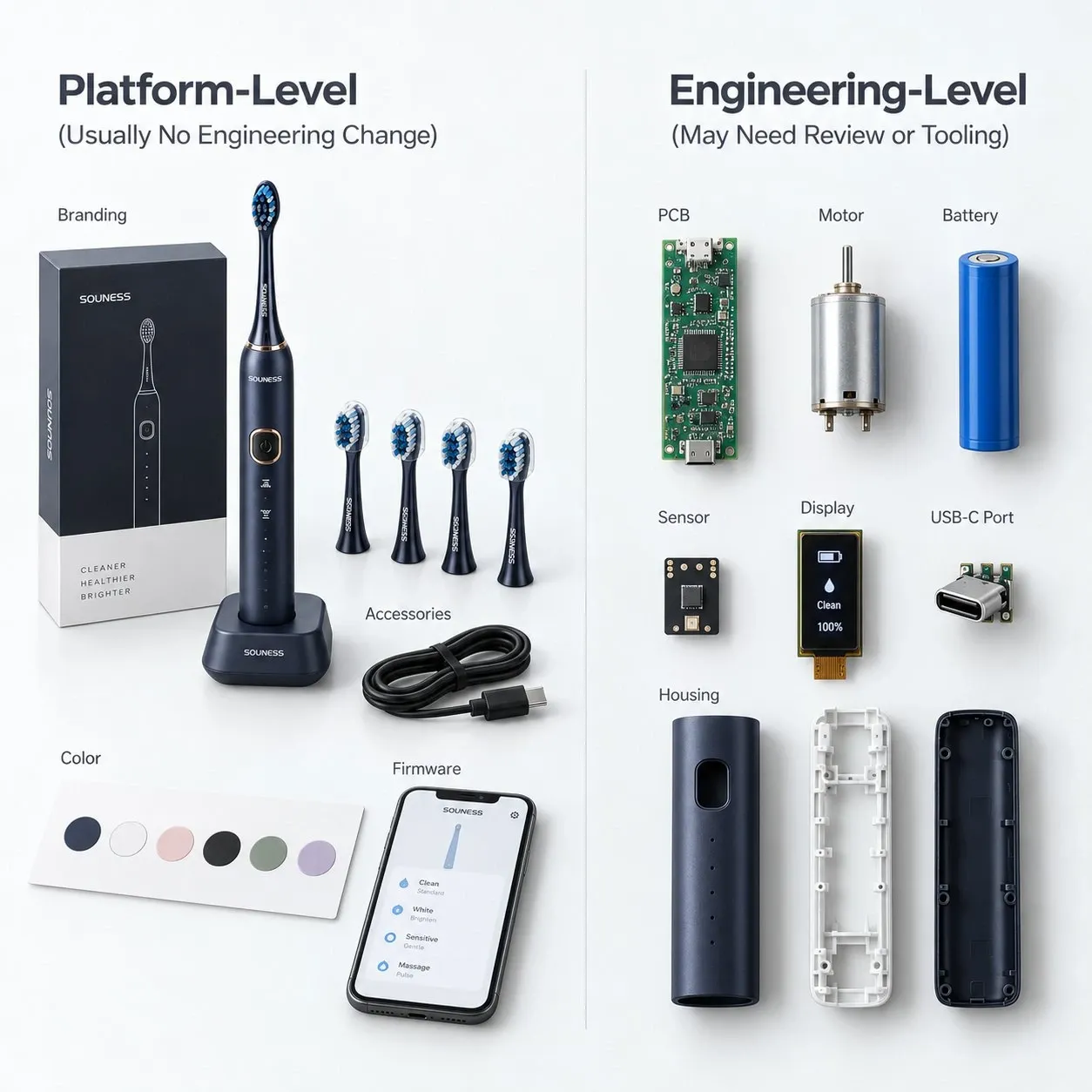
An existing housing can still allow meaningful differentiation.
Depending on the platform, possible changes may include:
None of these options should be assumed to exist on every platform.
The actual flexibility depends on how the original product was designed.
The most useful supplier question is:
Which visible parts are separate components, and which are molded into the main housing?
That answer often defines how far cosmetic differentiation can go without modifying the main tool.
Changes that alter molded geometry may require mold modification or new tooling.
Examples include:
The word may is important.
Not every geometry change requires a completely new mold.
A localized feature may sometimes be changed through an insert or controlled mold modification.
At the same time, a change that looks minor externally may require broader tool work if it affects:
The correct answer depends on the actual part and actual tooling.
Tooling changes exist on a spectrum.
| Tooling Option | What It Means |
|---|---|
| Existing Mold Unchanged | Product geometry remains unchanged; differentiation comes from color, decoration or supported options |
| Insert Change | A localized interchangeable mold feature is changed where the tool design allows it |
| Mold Modification | Existing tooling is machined or altered to revise a feature |
| New Cavity / Component Tool | A new tool is produced for one changed part |
| New Mold | New production tooling is created for substantially changed geometry |
Which option is feasible depends on:
The buyer does not need to judge the mold design personally.
Instead, ask the supplier:
Which tooling option does this change require, and why?
Who owns and controls the tool is its own commercial question, covered in Public Mold vs Private Tooling for Private Label Oral-Care Projects.
Keeping the external housing avoids one type of redesign, but the internal volume remains fixed.
Buyers may want to add:
All of these need space for:
This is one of the main constraints of semi-custom development.
An existing platform can reduce development depth, but it also limits how much new hardware can be added without changing the mechanical design.
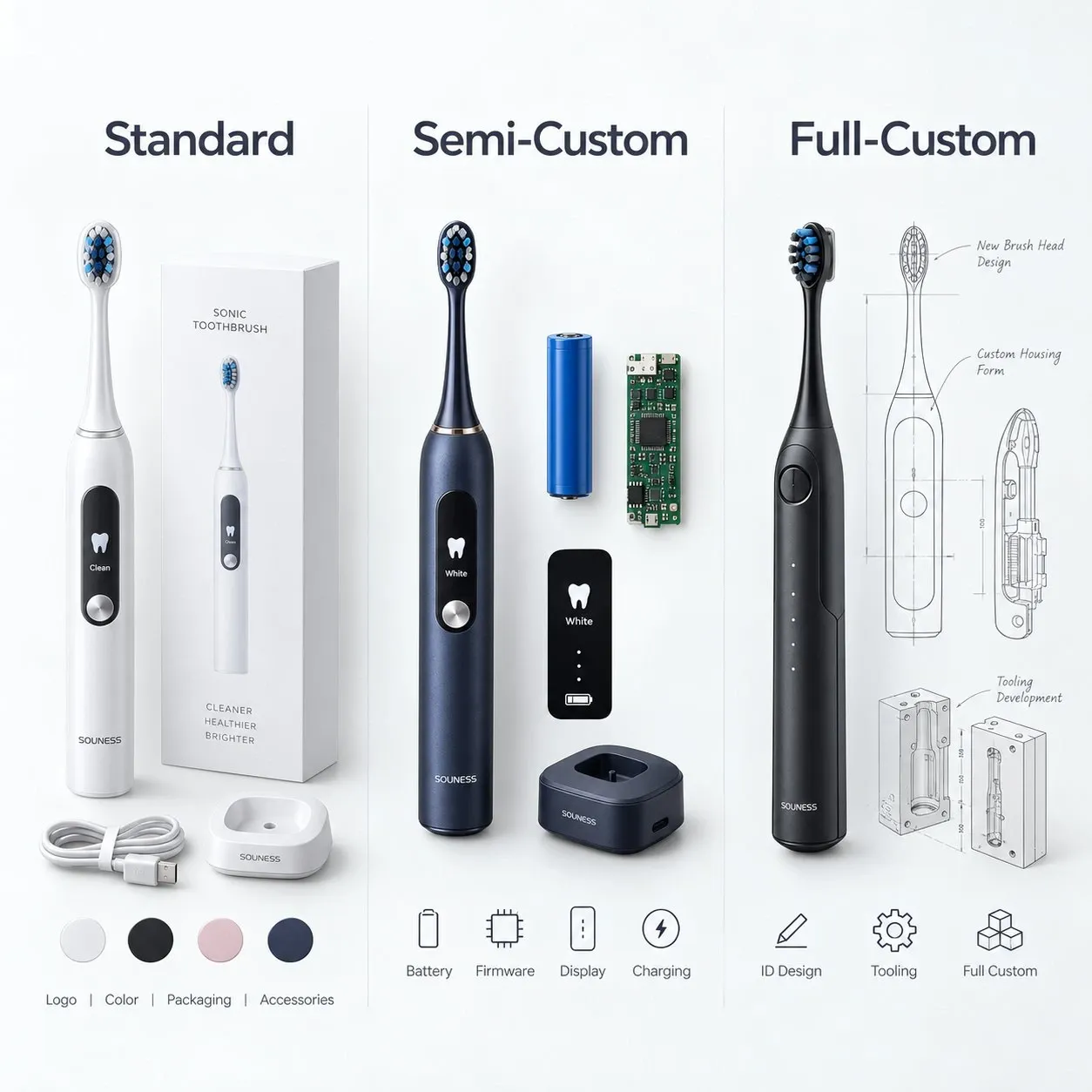
The five customization levels can also be grouped into three broader development routes.
This is a practical sourcing distinction, not an official classification.
| Platform Type | What It Means | Typical Customization |
|---|---|---|
| Standard Platform | Existing housing, electronics and mechanical architecture | Logo, color, packaging, manual, accessories |
| Semi-Custom Platform | Existing mechanical platform retained with selected engineering changes | Firmware, battery options, display, selected PCB changes, charging options, selected exterior parts |
| Full-Custom Platform | New or substantially changed mechanical/electronic architecture | New housing, interface, internal structure, charging concept, motor system or proprietary design |
This distinction helps prevent two common mistakes:
Which development route fits which project commercially is covered in OEM vs ODM for Oral-Care Products.
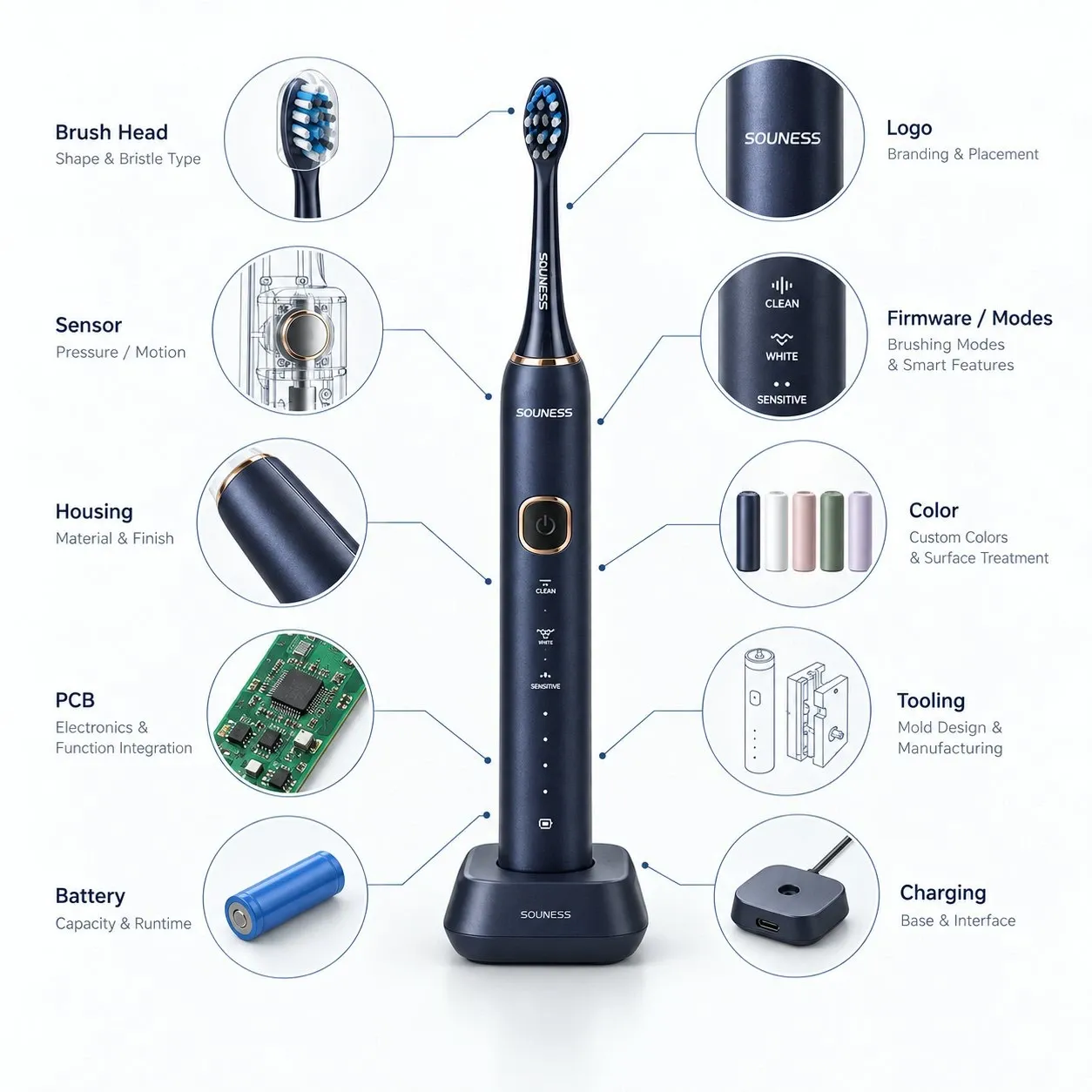
One requested change can affect several other parts of the product.
| Requested Change | What Else May Need Review |
|---|---|
| Logo | Surface, decoration process, wear and adhesion |
| Custom Color | Resin or coating, color match between components, cosmetic approval |
| New Brushing Mode | Firmware, driver capability, timer, UI behavior, validation |
| Pressure Sensor | Sensor, mechanical integration, PCB input, MCU, firmware, user feedback |
| New Display | PCB, power use, housing window, mounting, tooling |
| USB-C on Handle | PCB, housing opening, sealing, internal space, tooling review |
| Larger Battery | Internal space, charging system, thermal behavior, documentation |
| New Charging Base | Charging compatibility, accessories, packaging and documentation |
| Higher Intensity | Motor, driver, firmware, mechanical system, power and noise |
| New Brush-Head Interface | Shaft, retention, tooling, compatibility and reliability |
| New Handle Shape | Industrial design, mechanical design, mold modification or new tooling |
| New Brush-Head Geometry | Head tooling, tufting layout, interface fit and validation |
This table identifies possible dependencies.
It does not mean every request automatically requires every item listed.
The supplier should confirm which dependencies actually apply to the selected platform.
Customization depth changes what needs to be checked.
| Customization Depth | Typical Review Focus |
|---|---|
| Branding / Packaging | Cosmetic quality, marking durability, correct content and claims |
| Color / Finish | Appearance, adhesion, wear and consistency where relevant |
| Firmware | Mode behavior, sequence, timer and UI |
| Component | Fit, function, compatibility and targeted reliability |
| PCB / Electronics | Function, power/charging behavior, firmware and relevant documentation |
| Structural / Tooling | Fit, assembly, sealing, durability, manufacturability and production consistency |
There is no single validation program for every customization.
The required review depends on what actually changed.
Customization affects records as well as hardware.
Depending on the depth of the change, buyers may need to update:
A logo change may affect only a few records.
A new sensor, charging port or brush-head interface may affect several at once.
An externally similar toothbrush should not automatically be assumed to be the same approved configuration.
How those records and changes are controlled is covered in BOM & Engineering Change Control for Electric Toothbrush OEM Projects.
Before sending an RFQ, ask:
These answers define the actual development scope behind the quotation.
A supplier cannot quote an undefined customization project accurately.
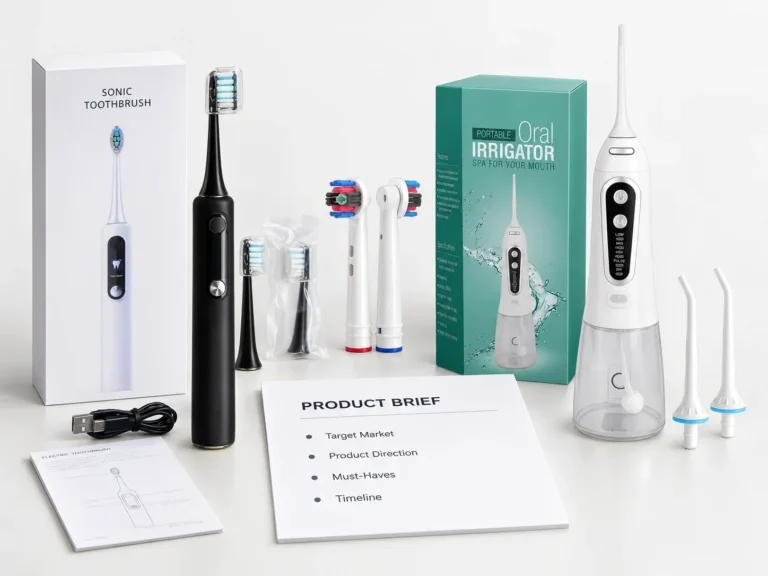
A short brief can include:
| Field | Buyer Input |
|---|---|
| Existing Platform / Model | Supplier platform under consideration |
| Target Market | Countries, customer program and accessory requirements |
| Target Positioning | Entry, mid-range, premium or feature-led |
| Must-Change Items | Non-negotiable requirements |
| Nice-to-Have Items | Features that can be removed if development becomes too deep |
| Future-Version Items | Ideas that can move to a later version |
| Logo | Location and decoration requirement |
| Color / Finish | Reference color and visible parts to match |
| Functions | Modes, timer, indicators and memory behavior |
| Sensors / Smart Features | Required function and intended feedback |
| Battery / Charging | Existing system acceptable or requested changes |
| Brush Heads | Appearance and compatibility requirements |
| Accessories | Heads, case, cable, adapter, base, stand or manual |
| Housing | Existing shape acceptable or structural differentiation required |
| Tooling Willingness | Existing platform only, modification acceptable or full-custom possible |
| Packaging | Retail package, bundle and market variants |
| Target Launch Timing | Helps organize sample and engineering review |
The most important distinction is:
Must Have
vs
Optional
vs
Future Version
This prevents every idea from being engineered into the first product version.
| Common Mistake | Better Approach |
|---|---|
| Treating a logo change and full redesign as the same “OEM customization” | Classify the customization depth first |
| Requesting a new handle shape while expecting public-mold economics | Decide whether tooling is acceptable |
| Assuming firmware can create hardware that does not exist | Confirm sensor, driver, LED and MCU capability first |
| Requesting a pressure sensor without PCB review | Review sensor, mechanics, PCB, firmware and UI together |
| Requesting a larger battery without checking space | Confirm internal fit and charging architecture |
| Adding USB-C without considering sealing | Review housing, PCB, sealing and tooling implications |
| Changing brush-head compatibility without reviewing the interface | Treat it as mechanical-system development |
| Assuming every cosmetic change needs a new mold | Check existing colors, finishing processes and separate components |
| Assuming every geometry change needs a completely new mold | Ask whether an insert or mold modification is feasible |
| Approving only external appearance | Record internal configuration and revision as well |
| Requesting “custom functions” without defining behavior | Write a clear function specification |
Before requesting development or approving quotation, the buyer should know:
Once these questions are answered, “custom toothbrush” becomes a defined product-development scope rather than a vague sourcing request.
If you are evaluating an existing electric toothbrush platform for an OEM or private-label project, separate the requirements into branding, cosmetic, firmware, component, PCB and tooling changes before requesting quotations and samples.
Branding, packaging, existing color options, some new resin colors on unchanged geometry, supported finishes, accessory changes and firmware adjustments may often use the existing tooling.
However, feasibility depends on the selected platform.
The key question is whether the product geometry remains unchanged and whether the requested function is already supported by the existing hardware.
Often, yes, when only the color changes and the molded geometry remains the same.
A new resin or masterbatch color may use the existing mold, while painted, metallic or soft-touch finishes may add surface-process and durability considerations.
The buyer should approve a physical color sample because the appearance of resin or coatings can differ from digital references.
Sometimes.
If the existing MCU, motor driver, buttons and indicators already support the required behavior, the change may remain firmware-level.
If the new mode requires different hardware, additional LEDs, unsupported drive behavior or a new user-interface function, PCB or other electronics changes may also be required.
The mode should be defined in terms of behavior, duration, sequence, timer and indication before the supplier evaluates it.
It depends on the existing platform.
If the platform already contains the required sensor hardware and PCB input, the feature may be enabled or adjusted with limited changes.
If the hardware does not exist, the feature may require sensor integration, PCB changes, firmware and mechanical design work.
The supplier should confirm the current platform architecture before development starts.
Possibly, but adding USB-C directly to the handle is more than a cable change.
It may affect the PCB, housing opening, sealing and internal space.
Depending on the existing housing design, mold modification or new tooling may also be required.
USB-C added to a separate charging base is a different customization request and may leave the toothbrush handle unchanged.
Changes to bristle color, protective caps, branding or existing supported bristle options may remain within the current brush-head platform.
Changes to molded head geometry, tufting-hole arrangement, neck geometry, retention features or the handle interface may require tooling changes.
Compatibility changes should be treated as mechanical-system development rather than simple cosmetic customization.
A standard platform keeps the existing housing, electronics and mechanical architecture and mainly changes branding, color, packaging or accessories.
A semi-custom platform keeps the core mechanical platform while modifying selected firmware, components, charging, battery, display or PCB functions.
A full-custom project substantially changes the product architecture, such as the housing, interface, internal structure or motor system, and is more likely to involve dedicated tooling.