Start Your Electric Toothbrush Project
Tell us your product requirements and target market. We will review the details and reply with the relevant next steps.

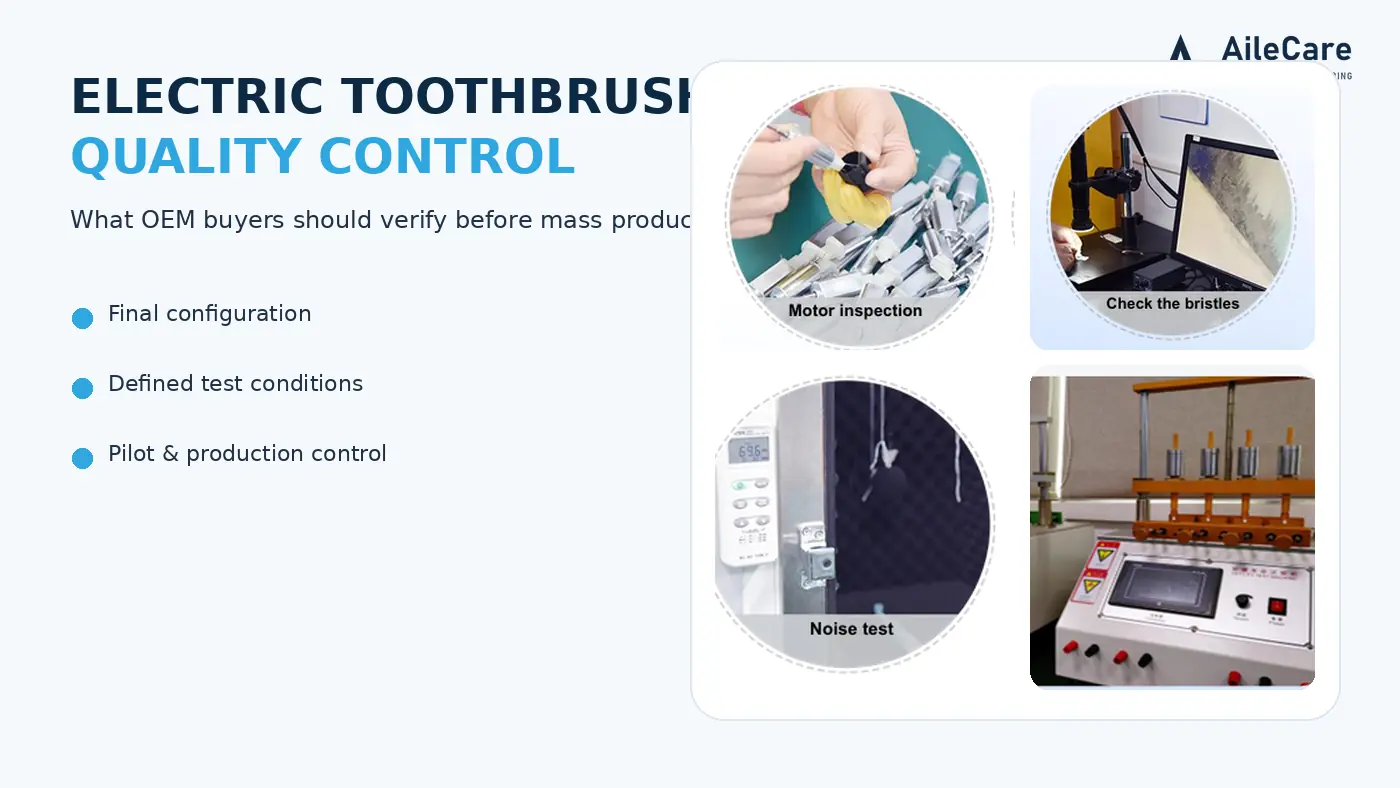
Before approving mass production, an OEM buyer should verify three things.
First, the tested unit should match the final production configuration — including the handle, brush head, battery, charger, firmware, materials, and other critical components intended for shipment.
Second, each test result should be linked to a defined method, test conditions, and pre-agreed acceptance criteria.
Third, production-intent tooling, processes, fixtures, and quality controls should demonstrate that the validated design can be reproduced consistently.
Certification reports, reliability tests, pilot runs, and routine production inspections answer different questions. Effective electric toothbrush quality control requires understanding what each type of evidence actually proves.
When a supplier says an electric toothbrush has “passed testing,” the first question should be:
What type of testing?
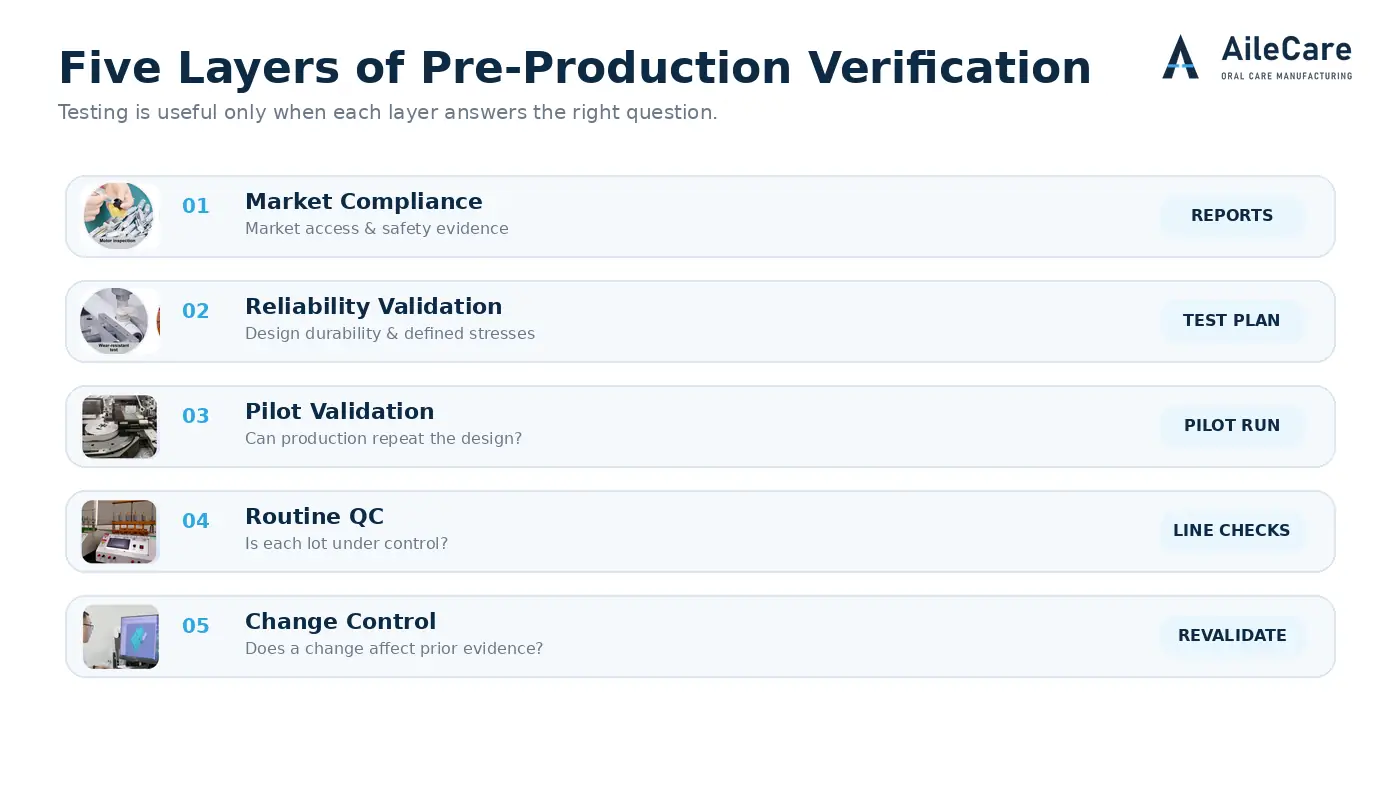
Five categories of evidence are commonly relevant to an OEM project.
Main question:
Can this final product configuration meet the applicable safety and market-access requirements for the intended destination?
Typical evidence may include third-party reports, declarations, technical documentation, battery documents, and market-specific conformity records.
This does not automatically prove long-term product reliability or stable mass-production execution.
Main question:
Can the design continue to function through the agreed operating stresses and product requirements?
Evidence may include design-verification plans, internal reliability reports, endurance tests, and failure-analysis records.
A successful engineering test does not by itself prove that mass production will reproduce the same result consistently.
Main question:
Can the manufacturing process repeatedly build the validated design?
This may include pilot-run records, first-article inspection, production-tooling verification, fixtures, work instructions, and process controls.
Main question:
Is current production output being controlled?
This can include visual inspection, basic functional checks, dimensional inspection, charging checks, packaging inspection, and other agreed line or lot controls.
Main question:
Has anything changed that could affect earlier test evidence?
A new battery, charger, PCB, firmware revision, seal material, brush head, supplier, or tooling change may require an impact assessment and, where necessary, relevant retesting.
These five areas should not be treated as interchangeable.
An IPX7 result is not the same as long-term waterproof reliability.
UN 38.3 does not demonstrate complete finished-product safety.
An outgoing inspection does not replace an endurance test.
And a prototype that passed reliability testing does not prove production consistency.
A test report is most useful when the tested configuration can be linked clearly to the product that will actually be manufactured.
Before relying on a result, identify what was tested:
Changes after testing are a common point where equivalence can break.
For example, substituting a battery cell, changing the adapter, revising a seal supplier, updating firmware, or modifying a housing tool can affect characteristics previously evaluated.
That does not mean every change requires full retesting.
The appropriate approach is to assess whether the change affects previously validated characteristics and repeat the relevant evaluation where necessary.
What buyers should avoid is relying on an old report without confirming that it still represents the released production configuration.
Tooling changes are a common source of configuration drift. For how tooling decisions affect an OEM project, see: Public Mold vs Private Tooling for Private Label Oral-Care Projects.
A useful reliability plan is more than a list of test names.
Each test should be defined well enough that the result can support a production decision.
What characteristic or risk is being evaluated?
Which exact product revision, BOM, battery, charger, firmware, and brush head are included?
Is the test based on an ISO, IEC, ISTA, regulatory method, or an agreed internal procedure?
What temperature, load, mode, orientation, exposure, or other conditions apply?
Which units were tested, and how much evidence does the sample provide?
What constitutes a pass or failure?
This should be agreed before the test rather than decided after seeing the result.
Was the test performed during engineering development, design validation, production validation, qualification, pilot production, or routine QC?
Was the test performed by the supplier, an internal laboratory, the buyer, or an independent third party?
Will the result include a report, summary table, photographs, failure record, or other evidence?
Which future product or process changes require reassessment?
The key principle is simple:
A test without defined conditions and acceptance criteria is difficult to use as a production-approval decision.
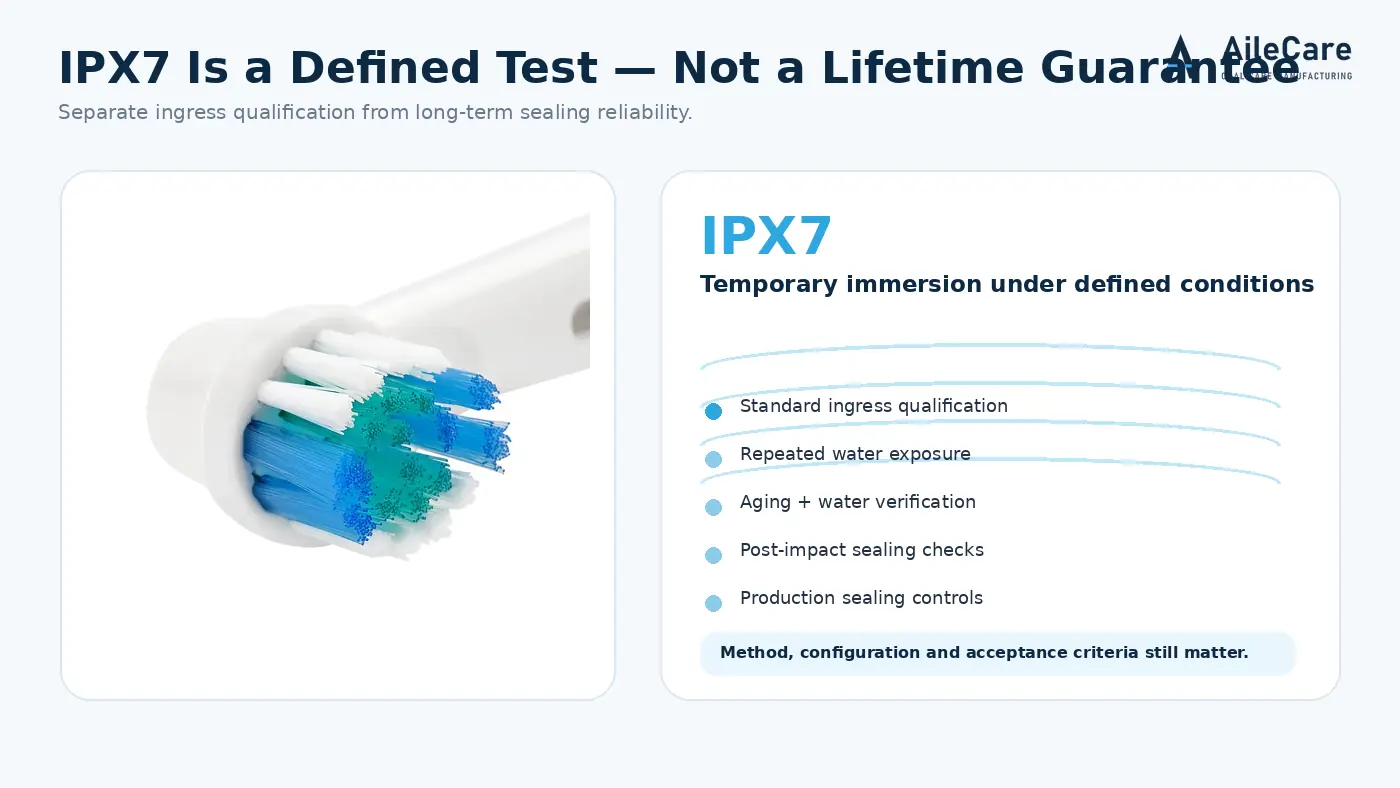
IPX7 is an ingress-protection classification under IEC 60529.
For a typical toothbrush-sized enclosure, it is commonly summarized as a temporary-immersion test for 30 minutes with the enclosure positioned according to the standard’s defined immersion conditions. It should not be interpreted as unlimited underwater durability. (ISO)
IPX7 alone does not demonstrate:
It also does not eliminate production variation.
Sealing can be affected by factors such as:
A stronger waterproof-reliability strategy can therefore include several layers.
One layer may be formal ingress qualification on production-intent samples.
Additional project-defined reliability work may include repeated water exposure, aging followed by ingress checks, or post-impact waterproof verification.
Production processes may also include controls designed to detect sealing variation.
The exact frequency and method depend on the product, factory process, and agreed quality plan.
A full IPX7 immersion test should not automatically be assumed to occur on every production unit.
Common reliability risks in an electric toothbrush drive system can include:
For sonic toothbrushes, a project specification may define checks for vibration or cycle rate, unit-to-unit consistency, different operating modes, loaded and unloaded behavior, and performance after endurance testing.
There is no single universal tolerance that should be copied into every electric toothbrush project.
Frequency, amplitude, endurance, current, and other criteria should be linked to the specific product requirement and test method.
Requirements also differ by product platform — you can compare the available electric toothbrush platforms before defining your specification.
A phrase such as “low noise” has limited technical value by itself.
A useful noise result should define factors such as:
Without those conditions, comparing one supplier’s noise value with another can be misleading.
There is no single universal drop height that can be applied to every electric toothbrush project.
A statement such as:
“Passed a 1.5 m drop test”
is incomplete unless the test also defines:
Post-drop checks may include product function, housing damage, brush-head fit, charging, abnormal noise, and sealing where relevant to the project.
Battery evidence should be divided into separate questions.
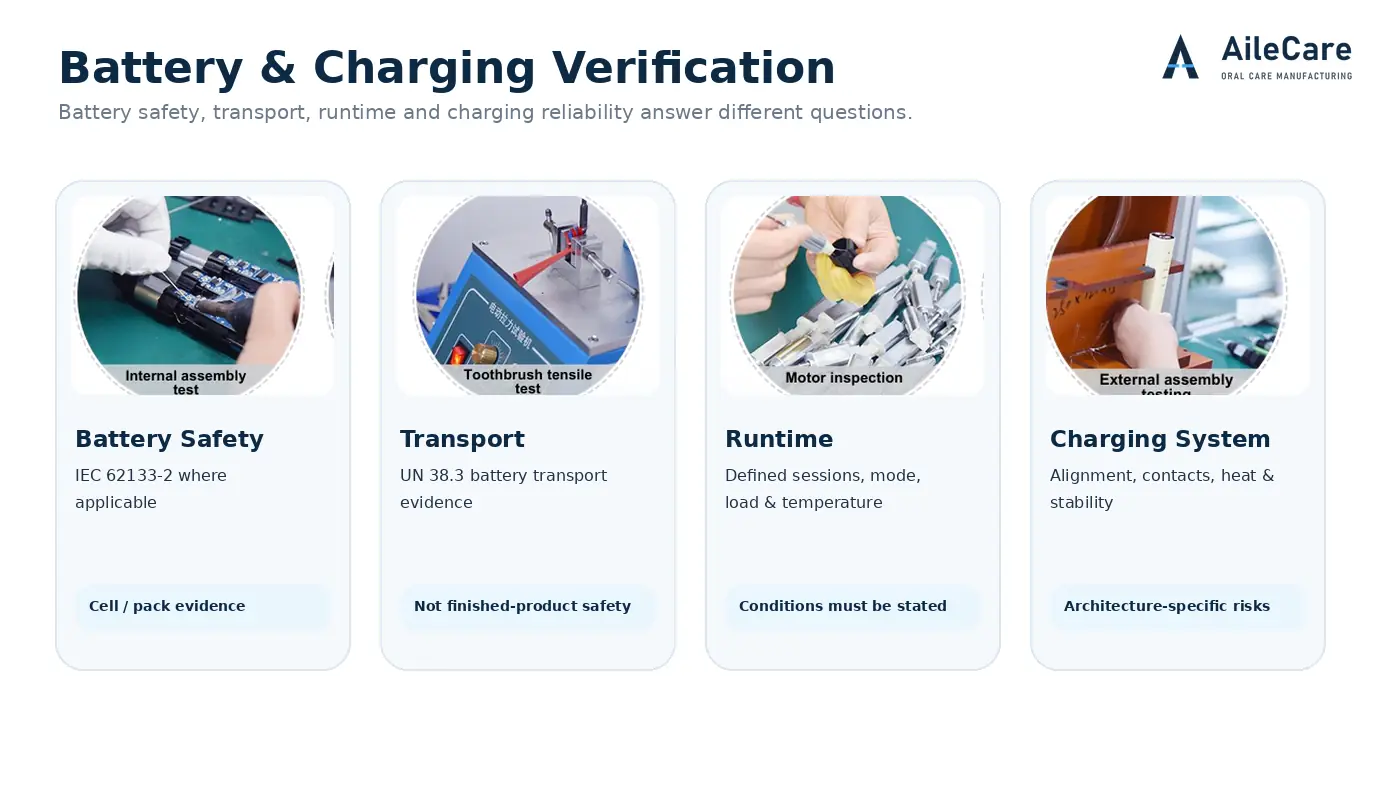
IEC 62133-2 addresses safety requirements and testing for portable sealed secondary lithium cells and batteries under intended use and reasonably foreseeable misuse, where applicable.
It can support battery qualification.
It does not by itself prove finished-product runtime, charging-base durability, motor reliability, or waterproof performance.
UN 38.3 relates to lithium-cell and battery testing for transport.
It is part of the UN Manual of Tests and Criteria and addresses the battery type being transported. It should not be described as a general safety certification for the finished electric toothbrush. (UNECE)
Buyers should confirm that the transport evidence corresponds to the actual battery used in production.
A claim such as “60-day battery life” needs defined test conditions.
Relevant variables may include:
The question is not only:
“How many days does the battery last?”
It is:
“Under what conditions was that result obtained?”
Different charging architectures create different reliability questions.
For an inductive charging system, these may include coil alignment, docking position, charging stability, thermal behavior, and water exposure around the charging base.
For contact or pogo-pin systems, relevant concerns may include contact wear, corrosion, contamination, spring-force consistency, and alignment.
For USB charging, the project may need to consider connector wear, port sealing, cable strain, and adapter compatibility.
Not every risk applies to every product.
The purpose is to identify the actual charging architecture and validate the risks relevant to it.
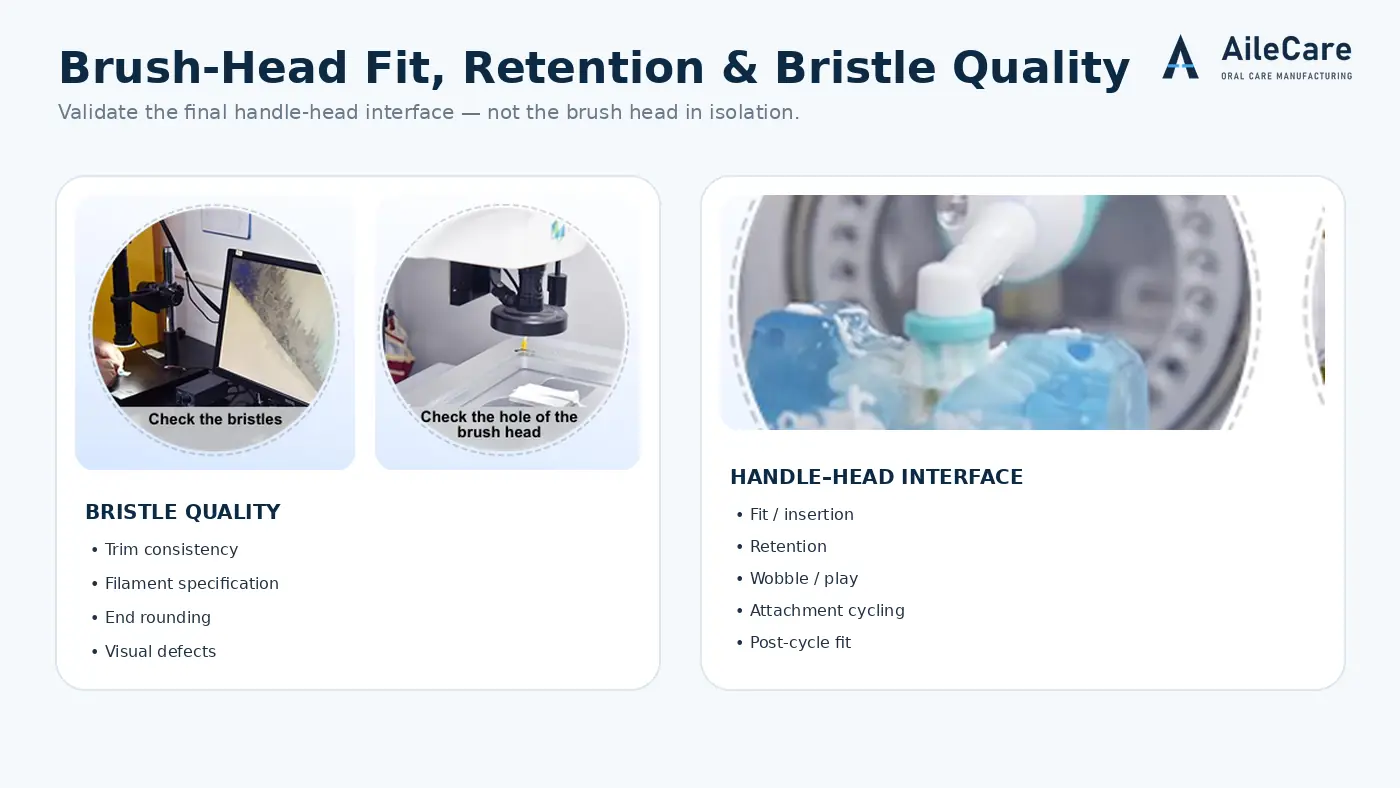
Brush-head quality should be evaluated as part of the complete handle-and-head system.
A brush head may fit correctly when new but become loose, noisy, difficult to remove, or less stable after repeated attachment, vibration, water exposure, or material aging.
Depending on the project, buyers may review:
Testing should use the final intended handle and brush-head interface.
On the bristle side, buyers may also review:
ISO 20127:2025 is the current third edition of the international standard addressing physical properties of powered toothbrushes and requirements intended to promote safety in use. It also includes filament end-rounding provisions for applicable filament types. (ISO)
For a closer look at why end-rounding matters and how it is evaluated, see our guide: What End-Rounding Quality Means for Brush Head Safety.
This does not mean the complete electric toothbrush is “ISO certified.”
Where documentation supports it, more precise wording is:
Tested or evaluated against the applicable ISO 20127 requirements.
Not every product reliability requirement comes from an international toothbrush standard.
Many are project-defined based on product materials, intended use, distribution conditions, and brand quality expectations.
The research did not identify a universal oral-care button-cycle requirement.
A project may therefore define its own relevant checks for:
A cycle count should not be presented as an “industry standard” unless there is a documented basis for doing so.
Electric toothbrush materials may be exposed to:
Possible failure modes include:
The required tests depend on the actual materials and product requirements.
Packaging validation should reflect the real distribution channel.
ISTA distinguishes early screening procedures from general-simulation procedures designed around particular transport environments. For example, the 1-Series is used as integrity screening, while the 3-Series includes general simulations for defined shipping environments such as parcel delivery. (国际安全运输协会)
A product shipped through parcel delivery may therefore require a different packaging-validation approach from a palletized B2B shipment.
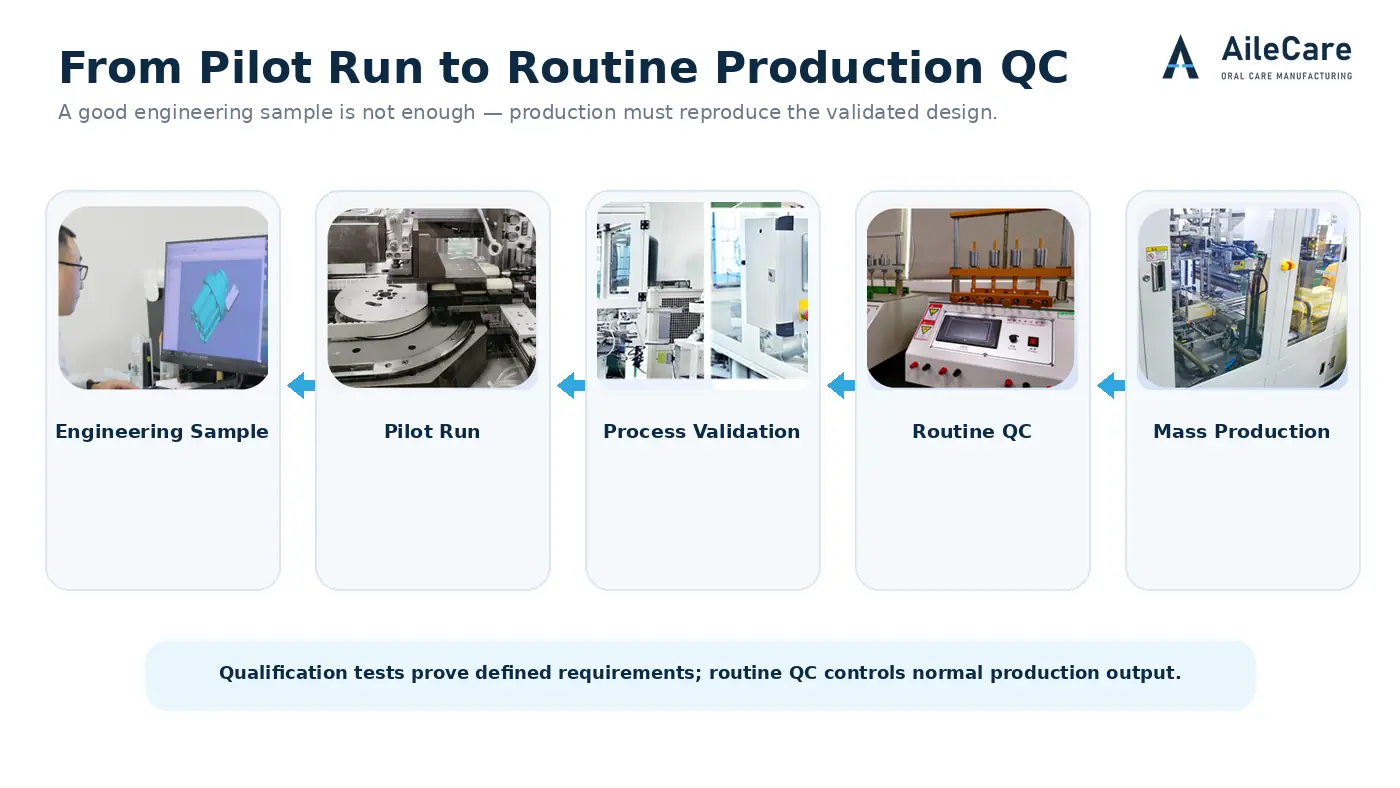
EVT, DVT, and PVT are widely used terms in hardware development, but suppliers do not necessarily define them identically.
They are useful as general shorthand rather than universal formal stages.
Engineering Validation Testing typically focuses on whether the core engineering concept works.
For an electric toothbrush, this may include early motor, charging, electronics, mechanical, and sealing concepts.
Design Validation Testing generally focuses on whether the design meets its defined requirements.
This can include reliability, dimensions, materials, physical performance, and other design-level verification.
Production Validation Testing generally moves toward production-intent tooling, fixtures, work instructions, and manufacturing processes.
A pilot or pre-production run evaluates whether the production system can repeatedly build the intended configuration.
This step matters because a successful engineering sample does not by itself demonstrate:
A pilot run may reveal issues that were not visible in early samples, such as intermittent charging, tolerance variation, welding inconsistency, fixture marks, packaging problems, or test-station variation.
Some tests are primarily used to qualify a design, periodically check a risk, or verify a significant change.
Examples may include:
Routine production checks are usually shorter and designed to control normal manufacturing output.
Depending on the agreed quality plan, these may include:
This division is not universal.
A manufacturer may perform a particular screening test more frequently because of a known product risk or customer requirement.
The important distinction is that a statement such as “every unit is tested” should not automatically be interpreted as every production unit receiving every destructive, environmental, or long-duration reliability test.
Buyers should ask which checks are performed on every unit, which are sampled by lot, and which are qualification, periodic, or change-triggered tests.
For how quality planning and inspection are handled in AileCare projects, see our Quality page.
Depending on the product and project stage, useful evidence may include:
Buyers do not need every proprietary factory process parameter.
The evidence should be sufficient to answer seven questions:
What was tested?
Which configuration was tested?
How was it tested?
What was the acceptance criterion?
What failed?
What changed?
Was the changed configuration retested?
A golden sample is valuable for aligning characteristics that are difficult to communicate using numbers alone.
These may include:
But a physical sample cannot replace written specifications.
It does not fully define:
Before mass production, relevant controlled information should be frozen or formally approved.
Depending on the project, this may include:
The objective is to ensure that the product tested, the product approved, and the product manufactured remain aligned.
A failed reliability test is not necessarily the end of a project.
What matters is how the failure is handled.
A typical problem-solving sequence is:
Failure
→ Containment
→ Root-Cause Investigation
→ Corrective Action
→ Change Impact Assessment
→ Retest
→ Documentation Update
Methods such as 5 Why, fishbone analysis, 8D, or CAPA may be used depending on the organization and issue.
No single method is universally required.
The more important principle is traceability.
“Test failed, then passed” is not enough information for a production decision.
The buyer should understand:
Before releasing an electric toothbrush project to mass production, buyers can ask:
The purpose is not to collect the largest possible stack of reports.
It is to confirm that the evidence represents the product that will actually be manufactured and shipped.
Compliance testing addresses applicable market-access and safety requirements for a specific product configuration and destination market.
Reliability testing evaluates whether the design can continue to perform through defined operating stresses and agreed product requirements.
The two answer different questions. A product may have relevant compliance documentation but still experience poor durability if reliability risks are not adequately validated.
No.
IPX7 is a defined temporary-immersion ingress-protection classification under IEC 60529. It should not be interpreted as proof of unlimited underwater use or long-term sealing performance.
Repeated water exposure, material aging, impact, toothpaste, cleaning chemicals, and production sealing variation may require separate reliability consideration.
ISO 20127:2025 specifies requirements and test methods for physical properties of powered toothbrushes intended to promote safety in use.
The current third edition also addresses filament end rounding for applicable filament designs. It does not replace electrical-safety, EMC, battery, transport, or full product-lifetime validation requirements. (ISO)
No.
UN 38.3 addresses lithium-cell and battery testing associated with transport classification.
It supports the transport of the relevant lithium battery type, but it does not demonstrate finished-product runtime, charging durability, motor reliability, ingress protection, or total electric toothbrush safety compliance. (UNECE)
Not automatically in every case, but it should trigger an impact assessment.
A battery or charger change can affect safety evidence, transport qualification, charging behavior, runtime, thermal performance, or other characteristics.
The relevant tests should be reassessed based on what changed rather than assuming an existing report automatically covers the new configuration.
Engineering samples can demonstrate that a design works under defined test conditions.
A pilot run addresses a different question: whether production-intent tooling, components, fixtures, work instructions, and operators can repeatedly build the intended product.
It can expose manufacturing issues that are difficult to identify from a small number of engineering samples.
Electric toothbrush quality control should not be reduced to a list of certificates or factory test machines.
Before mass-production approval, buyers should confirm that the tested product matches the production configuration, that test conditions and acceptance criteria are defined, and that the production process can reproduce the validated design.
The key question is not simply:
“Has this toothbrush been tested?”
It is:
“What exactly was tested, under what conditions, against which criteria, and does that evidence still represent the product we are about to ship?”
If you are planning an electric toothbrush OEM or private-label project, you can explore all oral-care products and share your project requirements with AileCare for review.