Start Your Electric Toothbrush Project
Tell us your product requirements and target market. We will review the details and reply with the relevant next steps.

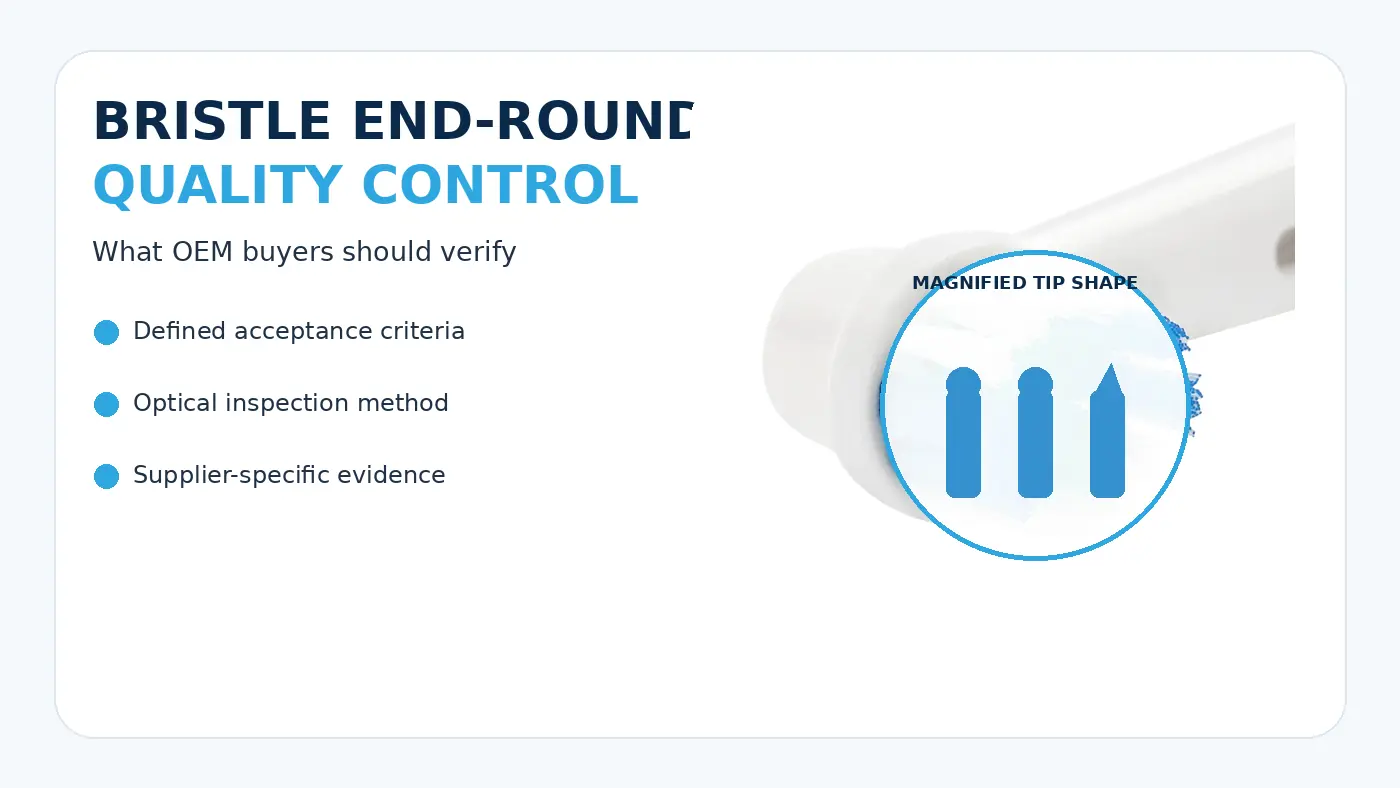
Toothbrush bristle end rounding is the finishing process used to remove sharp or irregular geometries from filament tips after trimming. For standard cut filaments, grinding or polishing helps produce smoother, rounded ends instead of sharp rims, points, or burrs.
For an OEM buyer, end rounding is not just a visual detail. It is a measurable brush-head quality attribute that can be inspected under magnification, defined in a product specification, and checked against relevant standards such as ISO 20127:2025 for powered toothbrushes.
A filament is an individual synthetic fiber that forms part of a toothbrush tuft. Common toothbrush filament materials include polyamide materials such as nylon and polyester materials such as PBT.
During brush-head production, filaments are placed into the head and trimmed to create the required profile. Cutting a cylindrical plastic filament can leave a flat face, sharp rim, angled surface, point, or irregular burr.
End rounding is the finishing step used to remove or reduce these sharp geometries. A properly finished conventional filament tip is generally smooth, rounded, hemispherical, or blunt, without an obvious sharp edge where the tip meets the filament wall.
Poorly finished tips may appear pointed, knife-like, obliquely cut, flat with a sharp rim, or irregular. The distinction matters because filament tips repeatedly contact oral soft tissue during brushing.
Filament-tip geometry is primarily a safety-related quality issue. Research has found that toothbrushes with poorly rounded or sharp filament tips can produce more gingival abrasion than brushes with acceptably finished tips.
A double-blind randomized clinical trial published in 2017 compared toothbrushes with 0% acceptable end rounding, approximately 40–50%, and more than 90%. The brush with 0% acceptable end rounding produced significantly more gingival abrasion than the other two groups.
Importantly, the study did not find a significant difference between the approximately 40–50% group and the greater-than-90% group. This means the research should not be interpreted as proof that 90% is a universally required safety target.
For buyers, the practical conclusion is simpler: uncontrolled filament finishing is a safety-related quality risk, not merely a cosmetic issue.
The available evidence also does not show that sharper filament tips provide a cleaning advantage. End-rounding quality should therefore be evaluated primarily as a safety-related finishing attribute.

For conventional cylindrical nylon or PBT filaments, a typical production sequence is:
Filament placement or tufting → trimming → end finishing → cleaning → inspection
Mechanical grinding or polishing is widely used for standard cut filaments. The filament tips contact an abrasive surface under controlled conditions so that sharp edges are gradually removed and the free ends become smoother.
The result depends on the product design and process settings. Filament material, diameter, trim profile, tuft density, brush-head geometry, abrasive conditions, pressure, and processing time can all affect the final tip shape.
A finishing program optimized for one filament diameter or trim profile will not necessarily produce the same result on another brush-head design.
For this reason, end-rounding quality should be verified for the actual product rather than assumed from a supplier’s general manufacturing capability.
Tapered filaments are produced differently from conventional cylindrical cut filaments.
In many PBT designs, the taper is created through controlled chemical processing, producing a fine attenuated end rather than a conventional flat-cut tip.
Depending on the filament design and production method, additional finishing may involve mechanical, chemical, or thermal processes.
These filament types should therefore not automatically be evaluated using the same conventional end-rounding criteria used for standard cylindrical filaments. More detail on the full production sequence is available on our brush head manufacturing page.
ISO 20127:2025, Dentistry — Physical properties of powered toothbrushes, is an important reference for electric toothbrush and powered brush-head projects.
The standard covers physical properties related to the safety of powered toothbrushes, including brush heads, and specifically addresses filament end rounding.
For applicable filament types, at least 50% of filaments must be free of sharp geometries at the tips.
This requirement does not apply in the same way to filament designs where conventional end rounding is inappropriate or impractical. These include very thin filaments below 0.1 mm and certain tapered, feathered, split-tip, spherical-cap, or non-synthetic filaments.
These exclusions do not mean that special filament designs have no safety requirements. They mean that their geometry should be evaluated using methods appropriate to the specific design rather than automatically applying a conventional end-rounding percentage.
For manual toothbrushes, the corresponding published standard is ISO 20126:2022, Dentistry — Manual toothbrushes — General requirements and test methods.
For OEM buyers, the important point is that the 50% figure is a standards-based minimum for applicable filament types.
It should not be confused with supplier claims that 90% or 100% represents a universal industry requirement. These requirements apply directly to sourcing projects for electric toothbrushes and replacement brush heads.
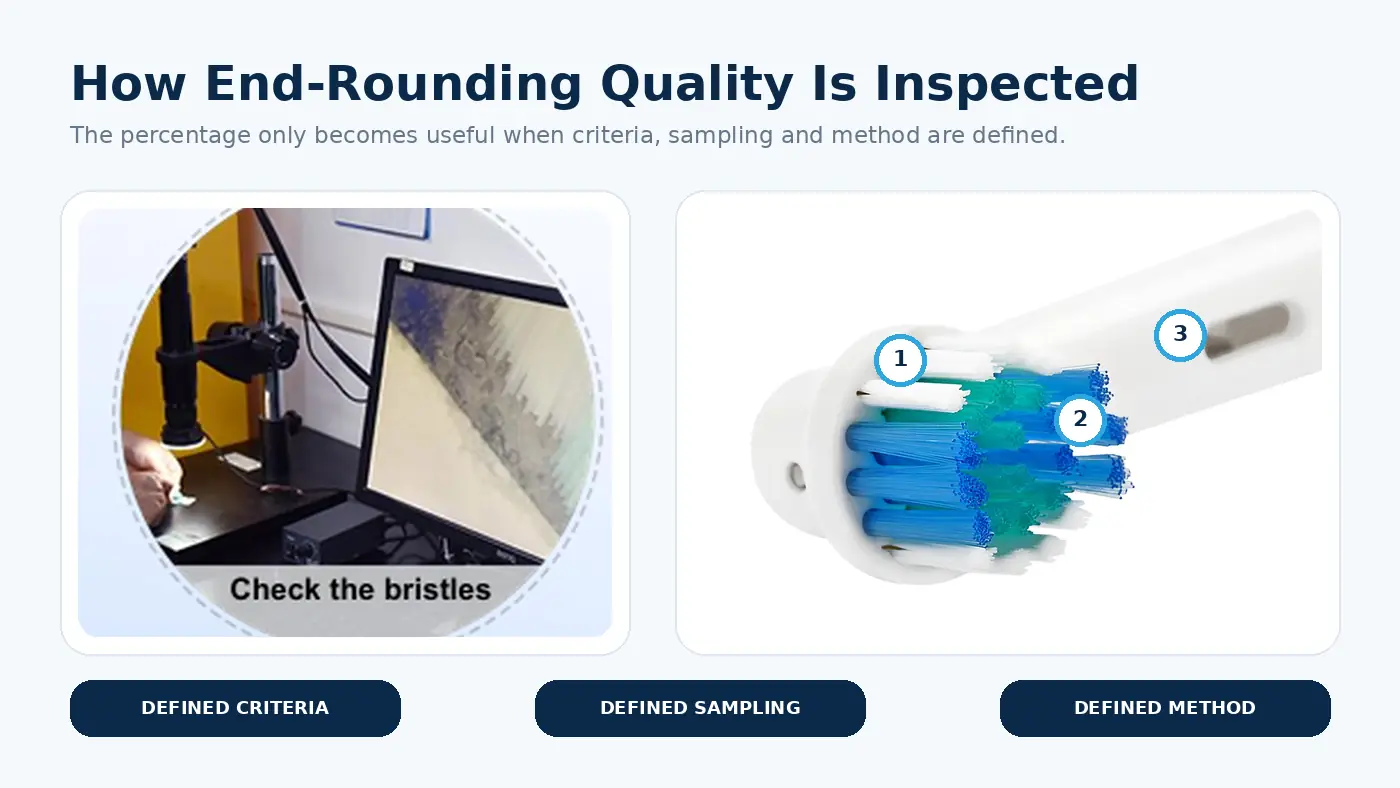
End-rounding quality is normally evaluated through magnified visual inspection.
A stereomicroscope or comparable optical system allows inspectors to distinguish rounded or smooth filament tips from sharp, pointed, oblique, or irregular geometries.
Research and standard-related methods commonly use magnification in approximately the 20× to 90× range, although the exact inspection setup may vary.
Under ISO 20127:2025, filament end-rounding uses a defined sampling procedure. Filaments from selected tufts on randomly selected powered toothbrushes are evaluated, and applicable filament types are assessed according to the standard procedure.
Manufacturers may also use broader internal QC sampling across different areas of a brush head. This can help determine whether finishing quality remains consistent across different trim heights, tuft positions, and filament groups.
This leads to one of the most important sourcing principles:
An end-rounding percentage is only meaningful when the inspection method is defined.
If a supplier states that a brush head has “85% end-rounded bristles,” the buyer should also know:
Without these definitions, two suppliers can report different percentages even when evaluating similar brush heads. This is also the logic behind structured brush head quality control during supplier qualification.
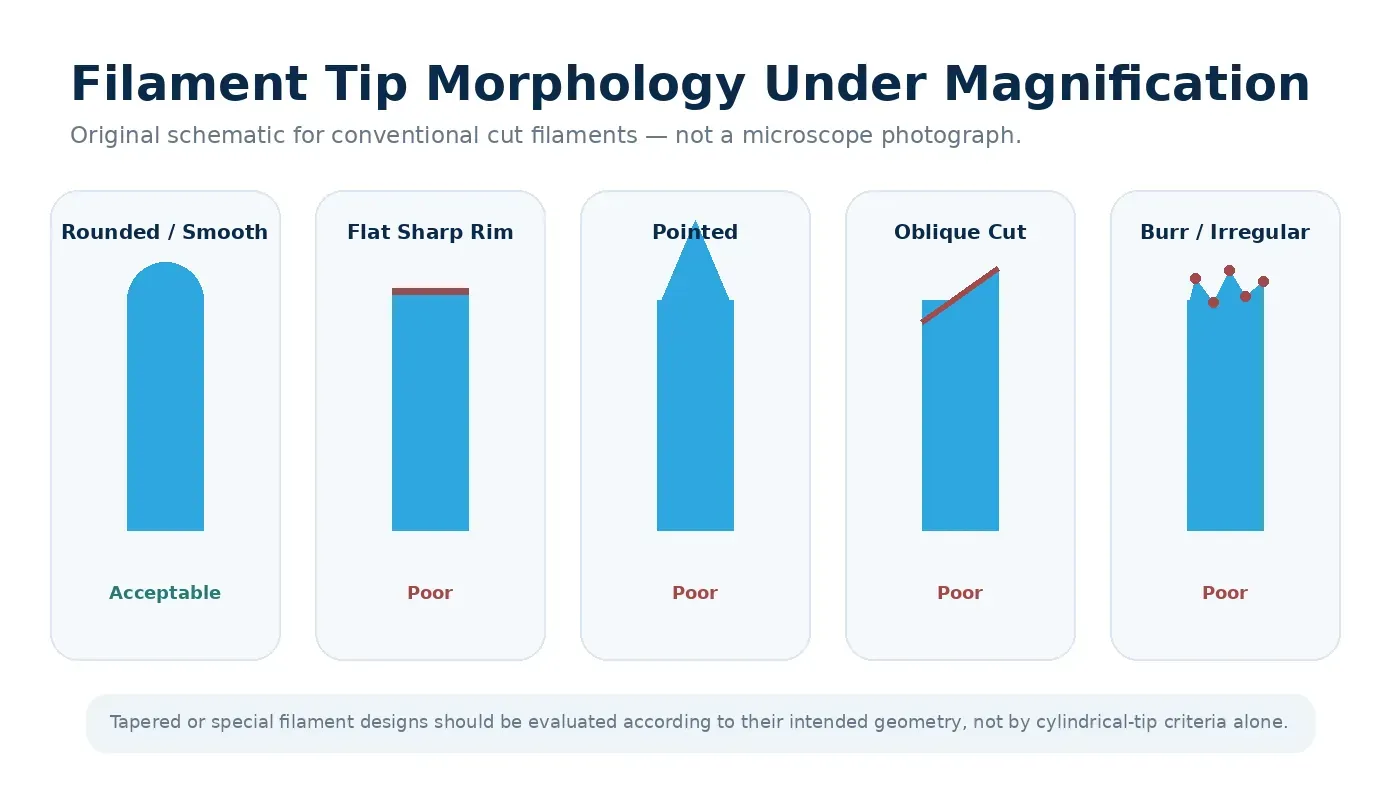
Rounded / smooth
What it looks like:
A hemispherical or blunt end with no obvious sharp rim.
What it may indicate:
Acceptable finishing for a conventional cut filament.
Flat with sharp rim
What it looks like:
A flat cut face with a distinct sharp circular edge.
What it may indicate:
Insufficient end finishing.
Pointed
What it looks like:
The filament tip narrows into a sharp point or spike.
What it may indicate:
An unacceptable sharp geometry for a conventional filament.
Oblique cut
What it looks like:
The tip is cut at an angle, leaving a sharp elliptical edge.
What it may indicate:
Trim geometry that was not adequately corrected during finishing.
Burr / irregular edge
What it looks like:
Ragged or uneven plastic remains around the filament tip.
What it may indicate:
Cutting or finishing inconsistency.
Tapered filaments should not be judged simply because their ends appear narrow or pointed.
A fine attenuated tip can be an intentional design feature. It should be evaluated according to the filament design rather than against cylindrical-filament morphology alone.
Terms such as “ultra-rounded,” “dentist-grade,” and “gum-safe” do not by themselves define a standardized technical requirement.
Percentage claims such as “90% end rounded” or “100% end rounded” can be measurable, but only when the supplier defines the inspection method behind the number.
A meaningful percentage should be supported by:
Without this information, a high percentage is difficult to compare across suppliers.
The ISO requirement of 50% is a standards-based minimum for applicable filament types.
An OEM buyer may specify a stricter internal acceptance level for a particular product. That becomes a buyer-supplier quality specification rather than a universal ISO requirement.
The important point is not simply whether a number is high.
The number must be defined, measurable, and verified using the same method on both sides.
End rounding is an important indicator of filament-finishing control, but it should never be used as the only measure of brush-head quality.
An OEM evaluation should also consider:
For powered toothbrush projects, buyers should treat end rounding as one part of a broader physical-property and reliability specification rather than an isolated marketing feature.
A supplier may produce visually acceptable bristle tips but still have problems with tuft retention, fit, vibration stability, dimensional consistency, or material control.
Brush-head qualification should therefore evaluate the complete construction. These properties are normally verified through product testing and reliability checks at the finished-product level.
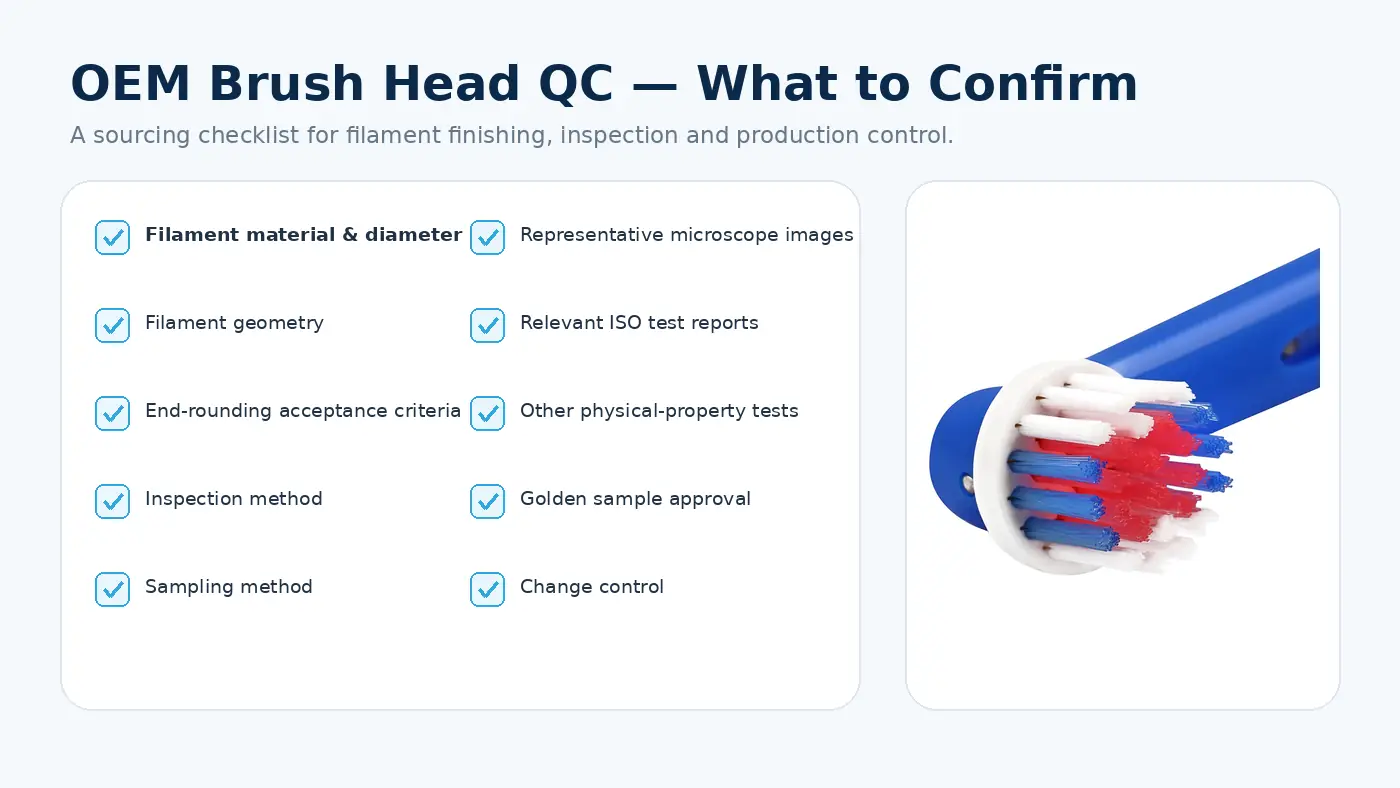
Depending on the project, buyers may request the following information during supplier qualification and before mass production.
Confirm the filament material, diameter, filament type, and other relevant construction details.
This is particularly important when comparing nylon, PBT, tapered, and other filament designs.
Confirm whether the product uses standard cylindrical filaments, tapered filaments, split-tip filaments, or another design.
The filament geometry affects which end-rounding criteria and inspection methods are appropriate.
Ask how the supplier defines an acceptable conventional filament tip.
If a percentage target is agreed for the project, both buyer and supplier should use the same definition.
Confirm how the filament tips are inspected.
This may include the optical system, magnification, classification method, and inspection frequency.
Ask how brush heads, tufts, and filament types are selected for inspection.
A percentage without a defined sampling method is difficult to reproduce.
Depending on the project, buyers may request microscope images from the actual or approved brush-head design.
Generic images from another product are less useful for product qualification.
Where applicable, buyers can request test reports referencing ISO 20127:2025 for powered toothbrushes or ISO 20126:2022 for manual toothbrushes.
The report should correspond to the relevant product or construction rather than an unrelated product family whenever possible.
End rounding should be reviewed together with other relevant physical properties, including tuft retention and other tests appropriate to the brush-head design.
Before mass production, both sides can approve a reference sample covering appearance, filament construction, tip quality, fit, and other agreed specifications.
The approved sample then becomes a practical reference during production. Golden sample approval and pilot runs are part of the sampling to mass production stage.
Filament material, diameter, supplier, brush-head construction, or finishing process should not change without appropriate review.
For private-label projects, change control is especially important when the product has already completed testing or market approval.
Detailed machine settings and complete production records may remain part of the supplier’s internal manufacturing controls.
The buyer’s objective is not to obtain every proprietary process parameter. It is to establish repeatable evidence that the agreed product specification is being controlled.
In an OEM or ODM project, these items belong in the product specification agreed before production starts.
Toothbrush bristle end rounding is the finishing process used to remove sharp geometries from conventional filament tips after trimming.
Grinding or polishing can turn flat or sharp cut ends into smoother, rounded shapes. For OEM projects, the result can be evaluated under magnification and included in brush-head quality specifications.
ISO 20127:2025 for powered toothbrushes and ISO 20126:2022 for manual toothbrushes specify that at least 50% of applicable filaments should be free of sharp tip geometries.
This is a standards-based minimum, not a universal premium-quality target.
A higher project-specific requirement can be agreed between buyer and supplier, but the inspection method and acceptance criteria should be clearly defined.
Yes.
ISO 20127:2025 covers physical properties of powered toothbrushes, including brush heads. Filament end rounding is one of the physical safety-related properties addressed by the standard, making it relevant when specifying electric toothbrushes or replacement brush heads.
Not necessarily.
Certain tapered, feathered, split-tip, spherical-cap, very thin, and non-synthetic filament designs are not evaluated using the same conventional end-rounding percentage.
Their safety and tip geometry still need to be evaluated using methods appropriate to the specific filament design.
Start by asking the supplier for its acceptance criteria, inspection method, sampling method, and the filament specification used in the product.
Depending on the project, buyers may also request representative microscope images and relevant ISO test reports.
Most importantly, any claimed end-rounding percentage should be linked to a clearly defined and repeatable inspection method.