Start Your Electric Toothbrush Project
Tell us your product requirements and target market. We will review the details and reply with the relevant next steps.


Approving the retail box does not automatically approve the shipment configuration.
An oral-care product can have the correct artwork, an approved retail package and a finished packaging sample, yet still arrive with crushed boxes, scuffed surfaces or displaced accessories because the units per carton were never frozen, the pack orientation changed, dividers were removed or the tested carton was not the one actually shipped.
For OEM buyers, the master carton and complete pack-out should therefore be treated as a separate controlled packaging specification before mass production is released for shipment.
A shipment may contain several packaging layers, and each performs a different function.
The retail package presents and protects the individual product.
Inner protection may include sleeves, wraps, pads, trays or dividers used to control movement and surface damage.
An inner carton may group several retail units where case-pack control, SKU separation or additional protection is needed.
The master carton is the main shipping case used for bulk handling, stacking and transport.
Where products move on pallets, palletization adds another controlled layer. For direct-to-consumer fulfillment, an individual parcel shipper may become the actual shipping unit instead.
Approving one retail packaging sample does not automatically approve:
These belong to the production pack-out.
How the retail packaging sample itself is approved is covered in Packaging Sample Approval for Oral-Care OEM Projects.
Master-carton dimensions cannot be determined reliably by multiplying retail-box dimensions by the number of units.
The final pack-out can also depend on:
Too much free space allows units to move, rub and gain momentum during handling.
Too little clearance can deform retail boxes and make packing inconsistent between cartons.
Final carton dimensions also affect logistics.
They influence:
Buyers should therefore confirm measured dimensions and gross weight from the actual production pack-out before final freight booking.
Quotation-stage carton figures should remain estimates until the shipment configuration is finalized.
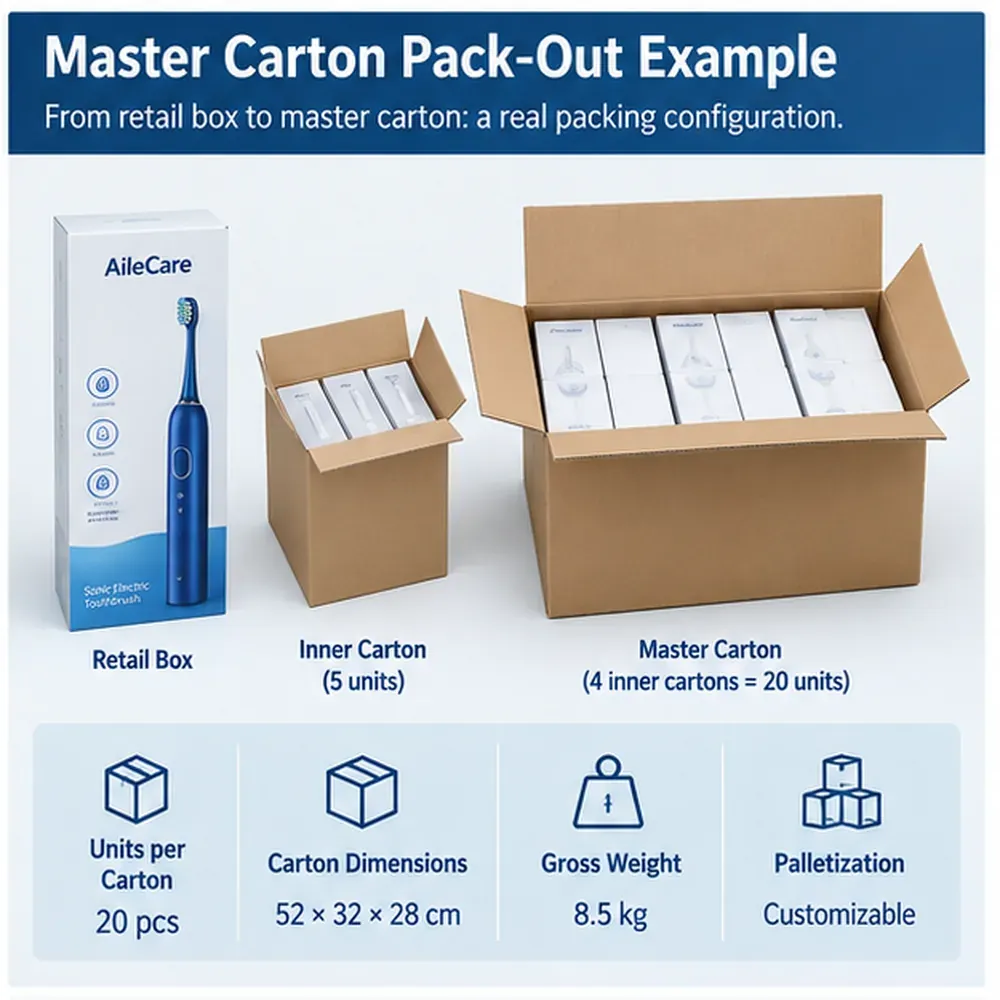
The factory should have a clear pack-out reference for production, and the buyer should be able to review the same configuration.
A practical master-carton specification can include:
| Field | What to Confirm |
|---|---|
| Product / SKU | Finished product and variant covered by this pack-out |
| Packaging Revision | Retail-package version used inside the carton |
| Units per Master Carton | Final approved case-pack quantity |
| Inner Carton Configuration | Quantity and grouping where inner cartons are used |
| Master-Carton Dimensions | Measured external dimensions |
| Net / Gross Weight | Measured from the completed pack-out |
| Product Orientation | How retail units are positioned inside the carton |
| Divider / Cushioning | Pads, partitions, wraps or other internal protection |
| Carton Construction | Agreed wall construction or performance requirement |
| Closure Method | Tape, glue, straps or other approved closure |
| Carton Marks | SKU, quantity, carton sequence and required references |
| Barcode / Logistics Label | Customer-specific case or shipping labels |
| Pallet Configuration | Pattern, layers and wrapping where applicable |
| Approved Pack-Out Reference | Photo set or assembled reference carton |
| Transit-Validation Reference | Applicable test and tested configuration, where used |
The objective is not paperwork for its own sake.
It is to make sure production, inspection and shipment are all referring to the same physical pack-out.
Increasing the number of units per carton may reduce packaging material and handling steps.
But it also increases:
The right case pack depends on factors such as:
There is no universal maximum carton weight for all oral-care shipments.
Carriers, retailers, warehouses and customers may each set their own limits.
A better question than:
“How many units can fit?”
is:
“At this quantity, is the completed carton practical to handle and suitable for the intended distribution route?”
Orientation is part of the packaging configuration.
It affects:
For electric toothbrushes, buyers should consider whether the retail boxes are packed upright or flat and whether the charging base, cable or adapter can move against the handle.
For replacement brush heads, pack orientation may influence small-box bending, protective-cap movement and count control.
For water flossers, the reservoir, nozzle and accessories should remain supported in the intended shipping orientation.
There is no single correct orientation for every product.
The important point is to record the approved orientation and keep production consistent with it.
Internal protection should have a clear purpose.
Possible options include:
These elements can help with:
But more packaging is not automatically better.
Each element should solve a specific risk.
One important principle is:
A stronger outer carton does not solve uncontrolled movement inside the carton.
A shipment works as a system:
Product → Retail Package → Internal Protection → Master Carton → Closure
Weakness at one layer cannot always be fixed by strengthening another.
OEM buyers do not need to become corrugated-box engineers, but a few terms are useful.
Single-wall corrugated board contains one corrugated medium.
Double-wall contains two corrugated media and may be selected where additional compression performance or protection is needed.
The flute describes the corrugated profile and affects properties such as thickness and cushioning.
ECT — Edge Crush Test relates to edgewise compression performance of corrugated board.
Burst strength concerns resistance to rupture or puncture.
BCT — Box Compression Test evaluates compression performance of the finished carton.
These measurements are not interchangeable.
Buyers should avoid copying a flute type, ECT value or board grade from another project.
The required carton depends on:
The useful buyer question is:
What carton construction was selected for this actual pack-out, and what is the basis for that choice?
A carton may appear strong immediately after packing and still perform differently after extended transport or storage.
Real distribution can involve:
Corrugated packaging performance can change with moisture conditions.
This does not mean every ocean shipment needs:
Those decisions depend on the actual route and risk.
Where extended humidity exposure is relevant, buyers can ask the carton supplier or packaging-test provider whether the selected construction remains appropriate for the expected environment.
ASTM D5276 is a recognized method for free-fall drop testing of loaded shipping containers.
Depending on the selected test plan, evaluation may involve impacts on:
The relevant:
depend on the selected procedure and test configuration.
There is no single universal drop height for every oral-care master carton.
A drop test can help assess handling shock.
It does not automatically represent:
So a statement such as:
“The carton passed a drop test.”
should lead to another question:
What configuration and test plan were used?
Transport also involves repeated movement over time.
Vibration can reveal packaging weaknesses that may not appear in a single impact test.
Possible results include:
Recognized test methods such as ASTM D4728 and ASTM D999 address different vibration environments.
OEM buyers do not need to select laboratory parameters themselves.
The buyer’s role is to define the actual product, shipping unit and distribution route, then determine with the supplier or test provider whether vibration validation is appropriate.

ISTA procedures and ASTM D4169 are recognized frameworks used to evaluate packaging against defined distribution hazards.
They are not universal legal requirements for oral-care products.
At a high level:
Transit validation may be worth considering when:
For any test, buyers should ask:
“ISTA tested” alone is incomplete.
The result should be tied to a specific packaging configuration.
Palletized wholesale distribution and direct-to-consumer parcel shipping expose products to different conditions.
Parcel shipments may experience:
The most important buyer question is:
Does the retail box ship directly to the consumer, or is it placed inside a separate parcel shipper?
That answer defines the shipping unit that needs to survive parcel distribution.
A retail box that performs well inside a master carton on a pallet may not be suitable as its own courier parcel.
Marketplace, fulfillment provider and retailer packaging requirements should be treated as customer-specific requirements rather than universal OEM rules.
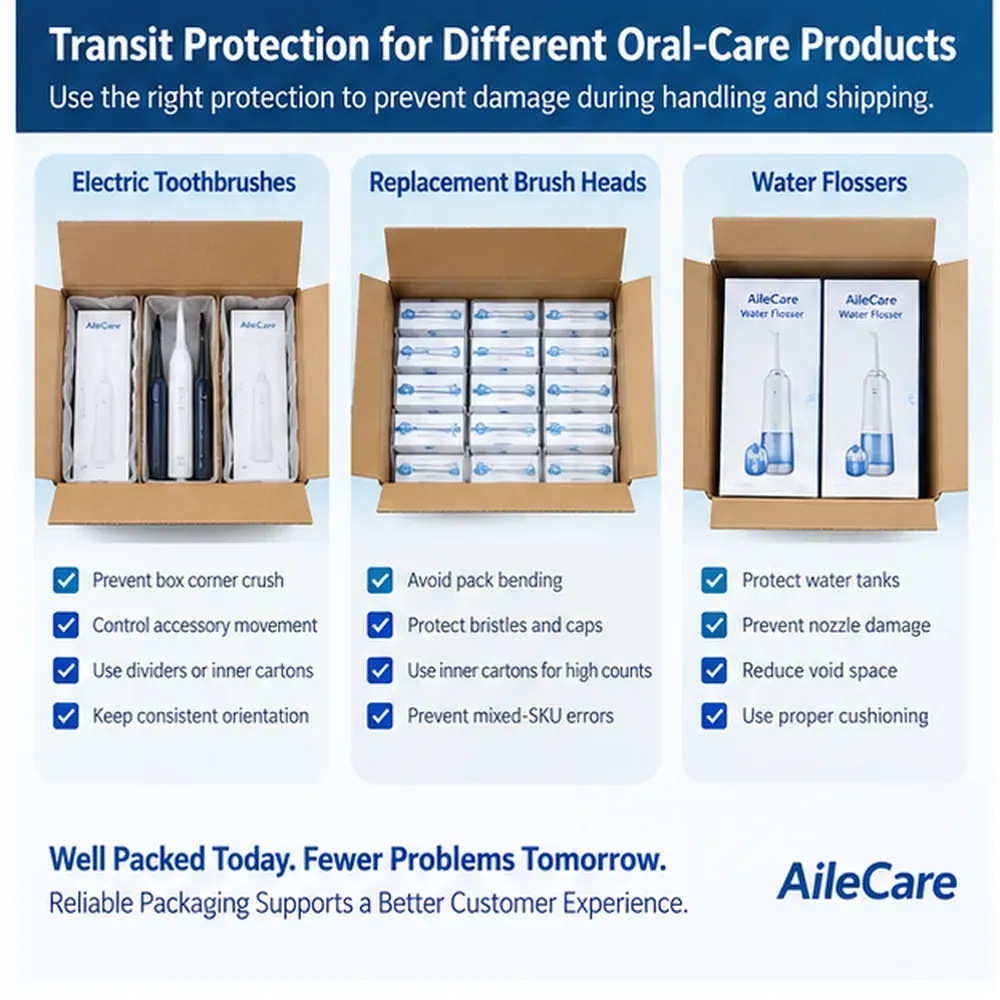
Potential issues include:
Buyer checks should include accessory restraint, product orientation and protection between retail units.
Replacement brush heads are lightweight but may be packed at high counts.
Potential issues include:
Useful controls may include inner cartons, dividers, controlled fill levels and clear SKU identification.
Water flossers may contain larger and more irregular components.
Potential risks include:
The pack-out should support the product and accessories in the orientation they will actually travel.
Premium retail packaging often requires more transit protection, not less.
Examples include:
These finishes can be vulnerable to:
The retail gift box should not automatically be treated as a shipping carton.
Depending on the project, additional protection may include:
The correct solution depends on the packaging design and distribution risk.
Several types of identification may appear in a shipment.
They serve different purposes.
A retail barcode identifies the consumer unit.
A case or carton barcode may identify a homogeneous shipping case where the customer requires it.
A logistics or shipping label supports warehouse and transportation handling.
Common master-carton information may include:
These fields are not universally mandatory.
The required information should be confirmed against:
ISO 780 handling symbols can also be used where relevant to communicate handling or storage instructions.
Examples may include:
They should reflect the actual packaging configuration rather than being added decoratively.
How artwork, claims and label content are planned and controlled is covered in Oral-Care Packaging Artwork & Label Planning.
Pack-out decisions also affect logistics cost.
Master-carton dimensions influence:
A different orientation, divider or carton count can change the logistics profile even if the product itself has not changed.
Final freight calculations should therefore use measured production-carton dimensions and weight, not early quotation estimates.
Pallet planning depends on the final carton dimensions and weight.
Buyer-level fields may include:
There is no universal pallet size or height that applies to every market.
Destination warehouses, retailers, customers and carriers may use different requirements.
For this reason, palletization should normally be finalized after the master-carton pack-out is confirmed.
Retail packaging approval and mass-production pack-out approval serve different purposes.
A production pack-out review can confirm:
A practical production reference can include:
**Pack-Out Specification
This gives production and inspection a clear physical reference.
[Internal link: Packaging Sample Approval for Oral-Care OEM Projects]
Before goods are released, verify the final pack-out against the approved specification:
Where these checks sit in the inspection and release process is covered in Incoming, In-Process & Final Inspection for Oral-Care OEM Orders.
A transit test represents the shipping configuration that was actually tested.
Review may be needed when:
This does not automatically mean full retesting is required.
The question is whether the previous test still represents the new shipping unit and distribution route.
If the change is material, the supplier and buyer can determine whether:
The same applicability logic used for product test reports is covered in How to Review Oral-Care Product Test Reports Before OEM Approval.
| Common Mistake | Better Approach |
|---|---|
| Approving only the retail box | Approve the complete production pack-out separately |
| Leaving units per carton undefined | Freeze the case pack before production |
| Booking freight using estimated dimensions | Use measured production-carton dimensions |
| Not checking gross weight | Weigh the completed pack-out |
| Removing dividers after approval | Review changes to internal protection |
| Changing product orientation | Record and control the approved orientation |
| Assuming a stronger carton fixes internal movement | Control movement through the complete packaging system |
| Relying on one informal drop test | Match validation to the actual distribution hazards |
| Testing for the wrong distribution route | Select validation based on the real shipping channel |
| Ignoring parcel handling | Define the D2C parcel shipping unit separately |
| Treating a premium gift box as transit-ready | Add protection appropriate to the retail finish |
| Testing one pack-out and shipping another | Keep transit evidence tied to the approved configuration |
Before shipment, the buyer should be able to identify the following fields.
| Field | Record |
|---|---|
| Product / SKU | Finished product and variant |
| Packaging Revision | Retail-package version |
| Retail-Box Dimensions | Approved unit-package dimensions |
| Units per Inner Carton | Where inner cartons are used |
| Inner Cartons per Master Carton | Grouping configuration |
| Units per Master Carton | Frozen case-pack quantity |
| Master-Carton Dimensions | Measured external dimensions |
| Net / Gross Weight | Measured completed-carton weight |
| Product Orientation | Approved pack pattern |
| Divider / Cushioning | Internal protection arrangement |
| Carton Construction | Agreed construction or performance requirement |
| Closure | Approved closure method |
| Carton Marks | Required outer-carton information |
| Barcode / Labels | Case and logistics-label requirements |
| Pallet Configuration | Pattern, layers and protection where applicable |
| Approved Pack-Out Reference | Photo set or reference carton |
| Transit-Validation Reference | Applicable test and tested configuration |
A shipment pack-out does not need to become a complicated engineering document.
It simply needs to be specific enough that the buyer, supplier and inspector can confirm that the same packaging configuration is being produced and shipped.
If you are preparing an oral-care OEM order for shipment, confirm the final units per carton, measured master-carton dimensions and gross weight, pack orientation, internal protection, carton marks and distribution route before the shipment configuration is released.
For buyers still at the supplier-selection stage, the overall workflow is covered in How to Source Electric Toothbrushes for Private Label & OEM Projects.
The retail box is the individual product package used for presentation and unit-level protection.
An inner carton may group several retail units for organization, SKU control or additional protection.
The master carton is the main shipping case used for bulk handling, stacking and transport.
Not every project requires every packaging layer, so the actual configuration should be defined by function rather than terminology alone.
A practical specification should identify the product and packaging revision, units per carton, dimensions, net and gross weight, product orientation, internal protection, carton construction, closure, marks and labels.
Where relevant, it can also record inner-carton configuration, palletization, an approved pack-out photo and the transit-validation reference.
The specification should describe the complete shipping configuration rather than only the outer box.
Consider the complete shipping system rather than maximizing the number that physically fits.
Important factors include unit weight, retail-box strength, master-carton construction, manual handling, stack load, pallet layout, distribution route and customer case-pack requirements.
Carrier or warehouse weight limits should be checked against the actual destination rather than treated as universal export rules.
Because the shipment contains more than retail boxes.
Orientation, manufacturing tolerances, inner cartons, dividers, pads, wraps, accessories, cushioning clearance and corrugated-board thickness can all change the final dimensions.
For freight booking and pallet planning, buyers should therefore use measurements from the actual approved pack-out rather than early calculations.
Not automatically.
ISTA procedures are recognized packaging-testing frameworks, not universal requirements for electric toothbrush shipments.
Testing may be useful when the packaging is unproven, the product or retail finish is relatively vulnerable, the distribution route is demanding, previous damage has occurred or a customer specifically requests it.
Any result should be tied to the exact pack-out that was tested.
ASTM D4169 is a recognized framework for evaluating shipping units against distribution hazards through defined test sequences.
Depending on the selected distribution cycle, those hazards may include handling, vibration, compression and environmental conditioning.
It can be useful when a project requires structured transit validation, but it is not automatically required for every oral-care shipment.
Often it does, depending on the design and distribution route.
Premium finishes such as matte lamination, coated paper, foil stamping and rigid corners can be sensitive to rubbing, scuffing and compression.
Protective wraps, sleeves, dividers, pads or an inner carton may therefore be appropriate.
The final decision should be based on the complete pack-out rather than assuming the retail gift box itself is suitable for transport.