Start Your Electric Toothbrush Project
Tell us your product requirements and target market. We will review the details and reply with the relevant next steps.

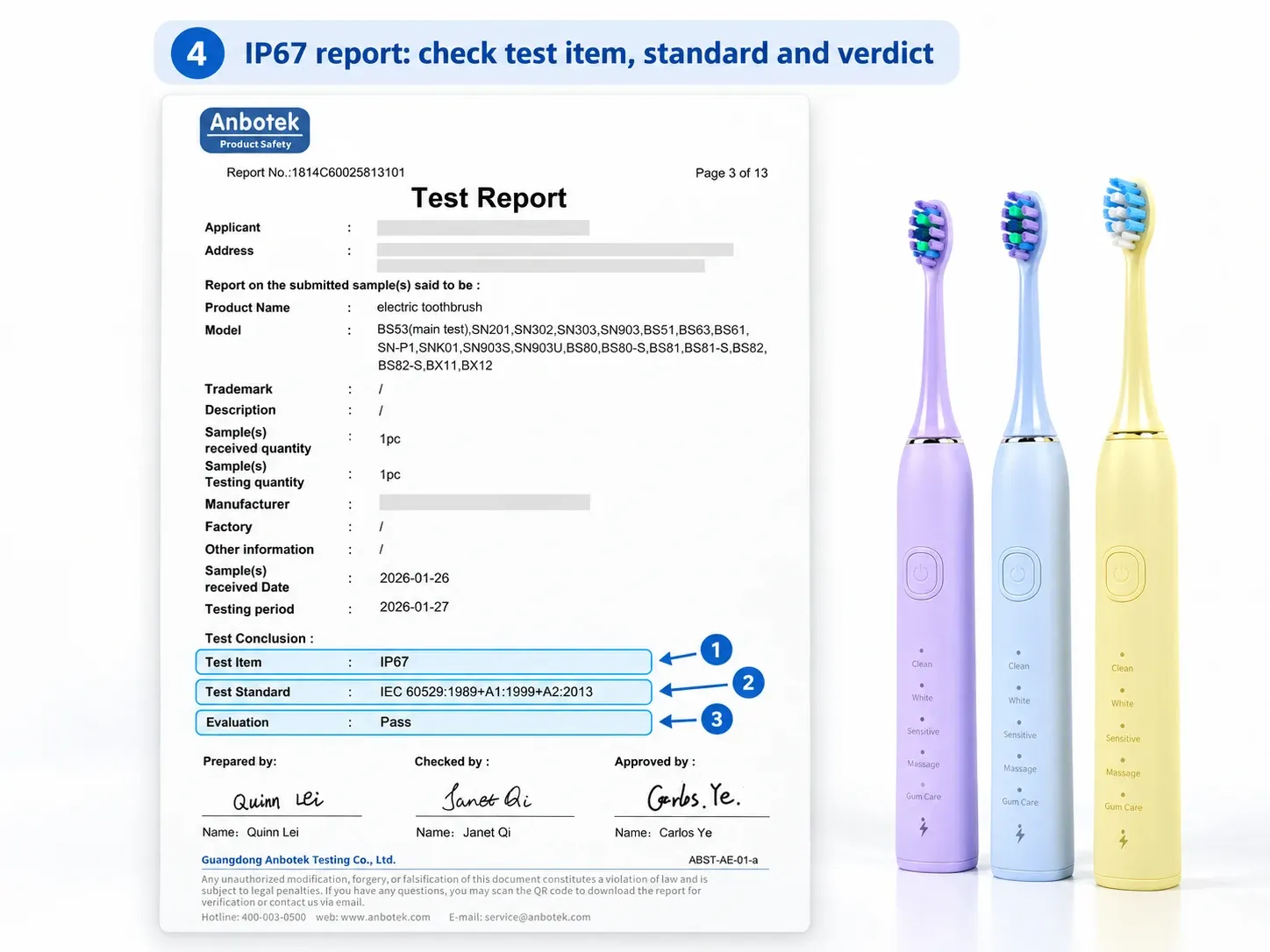
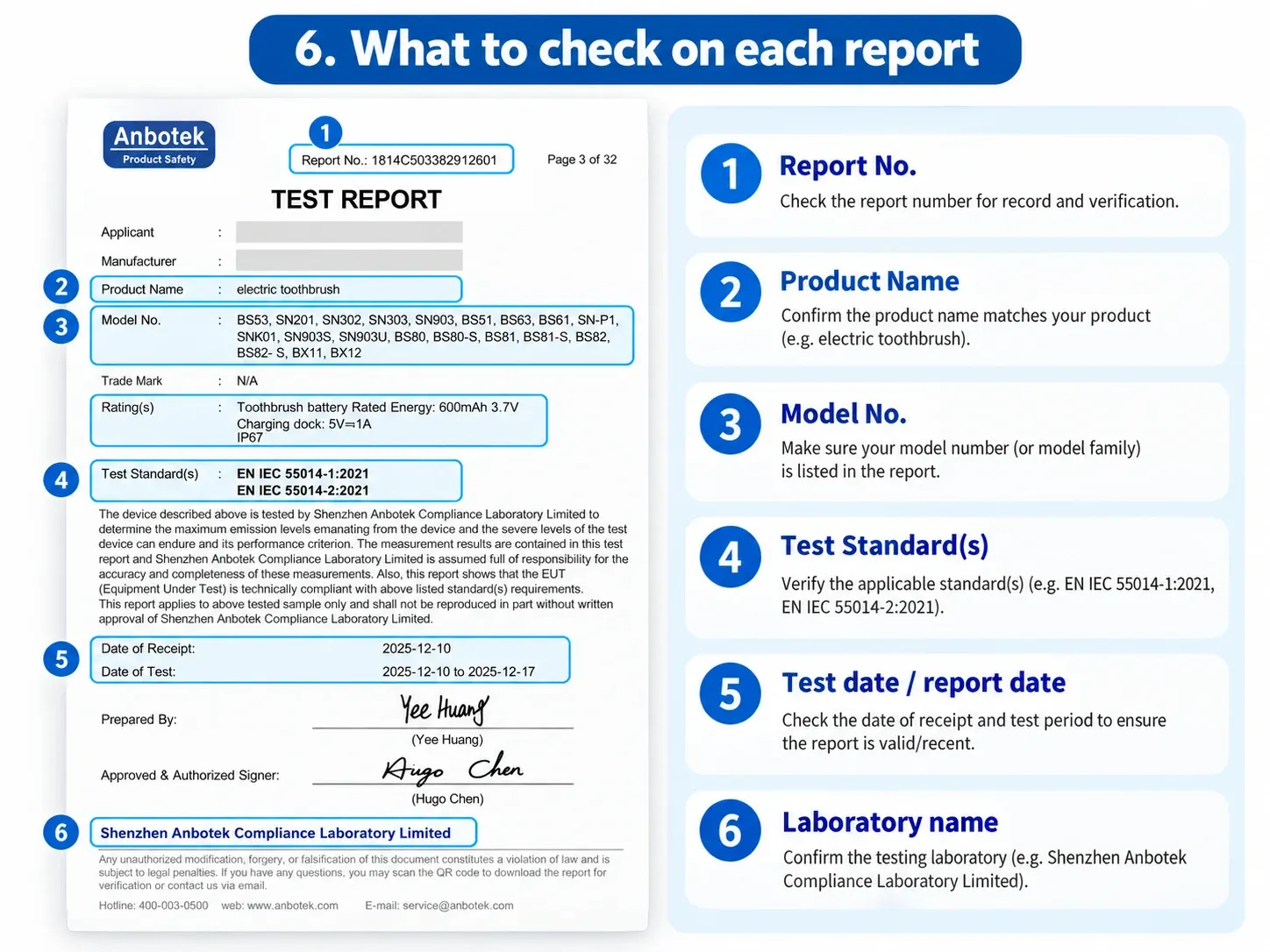
When a buyer asks an electric toothbrush supplier “do you have CE and FCC?”, the useful answer is not yes or no. It is a set of test reports, each issued against a named standard, each listing the models it covers. This guide explains what a typical report set for a rechargeable sonic or oscillating toothbrush contains, what each report does and does not prove, and what to check before you accept it for your own private-label model.
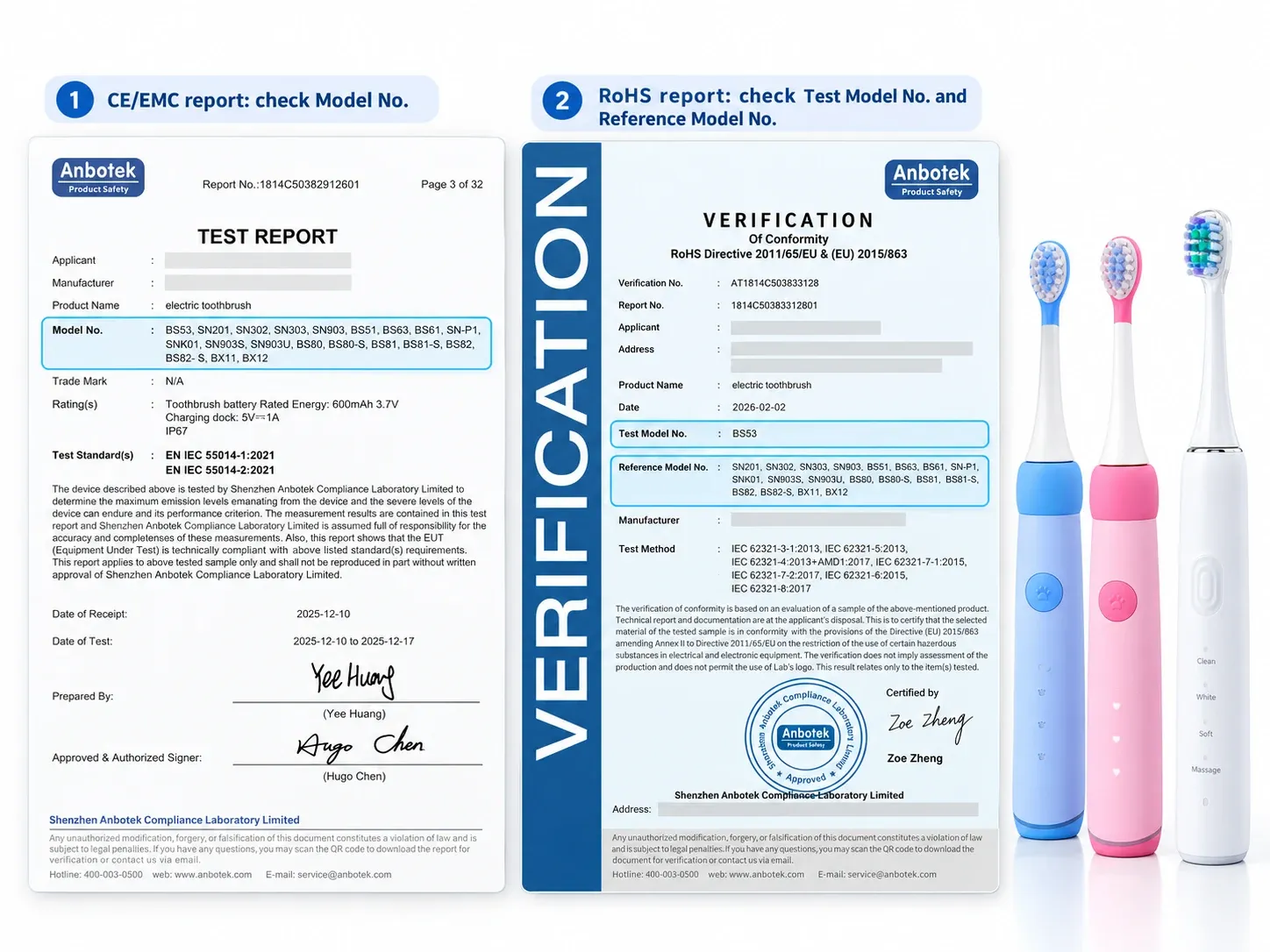
A test report may identify one main test model and a number of additional or reference models. Those additional models are covered only to the extent stated in that specific report. The basis for grouping models can differ by test: EMC focuses on characteristics relevant to electromagnetic emissions and immunity, IP testing depends heavily on enclosure and sealing construction, while RoHS depends on the materials and components assessed.
This is why buyers should check the model list on each report, rather than assuming that a model appearing on one report is automatically covered by all of the others.
Changes limited to branding or appearance may not affect EMC or ingress-protection results when the tested construction remains unchanged. However, changes to pigments, coatings, inks or materials can affect chemical-compliance evidence such as RoHS. Confirm coverage report by report.
Ask for the full report, not a one-page certificate. The certificate summarises; the report shows the standard, the test dates, the model list and the results.
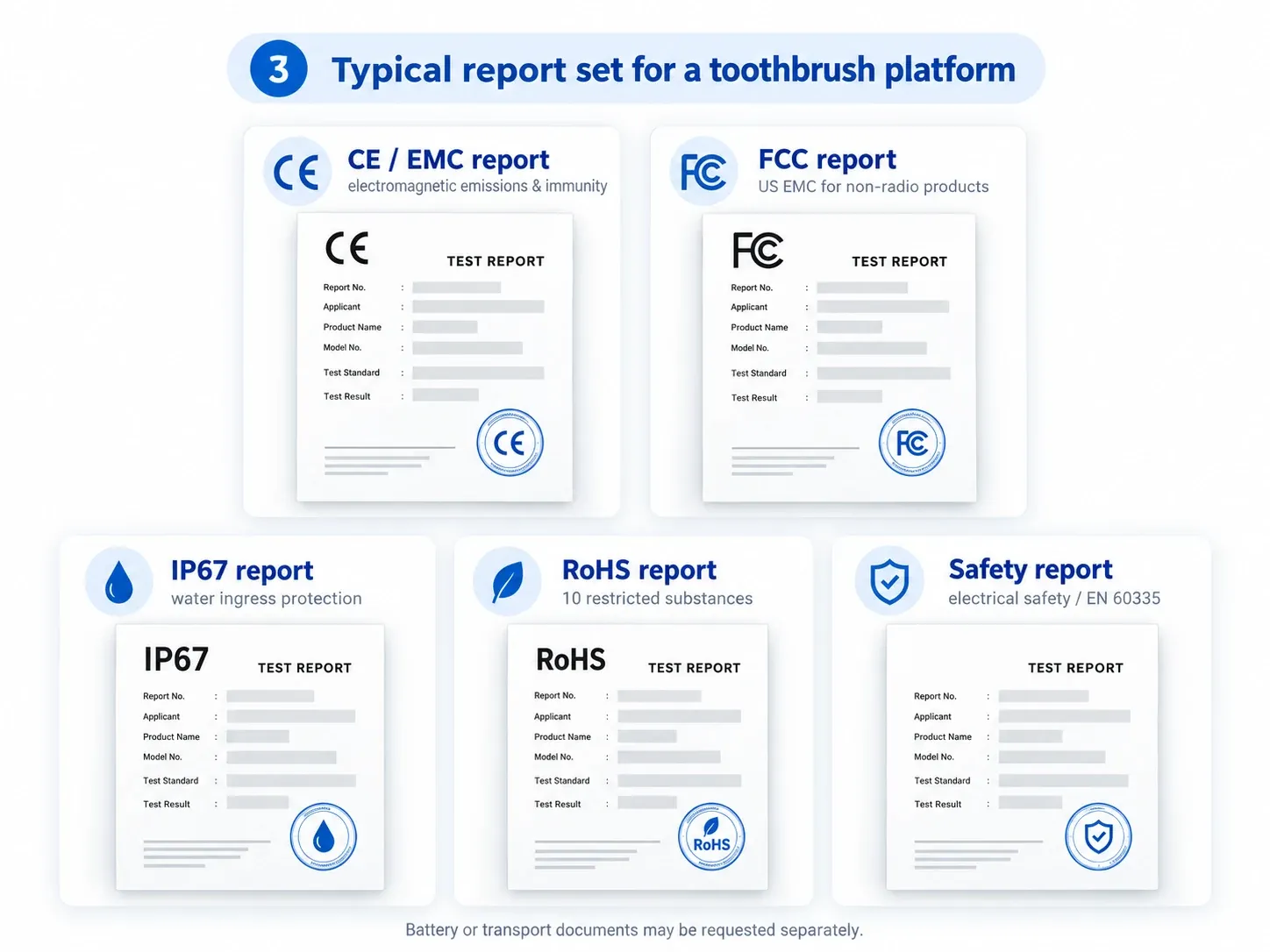
EN IEC 55014-1 covers electromagnetic emissions from household appliances and similar electrical equipment; EN IEC 55014-2 covers immunity. Together they are the harmonised standards used for the CE EMC Directive for this product category. The report records conducted and radiated disturbance, electrostatic discharge and radio-frequency field immunity. A current report cites the 2021 editions.
A non-radio rechargeable toothbrush containing digital electronic circuitry may be subject to FCC Part 15 Subpart B as an unintentional radiator. Compliance is declared by a responsible party located in the United States through a Supplier’s Declaration of Conformity (SDoC), supported by a test report to ANSI C63.4. The report does not carry an FCC ID; models with Bluetooth or other radio transmitters follow a separate certification route.
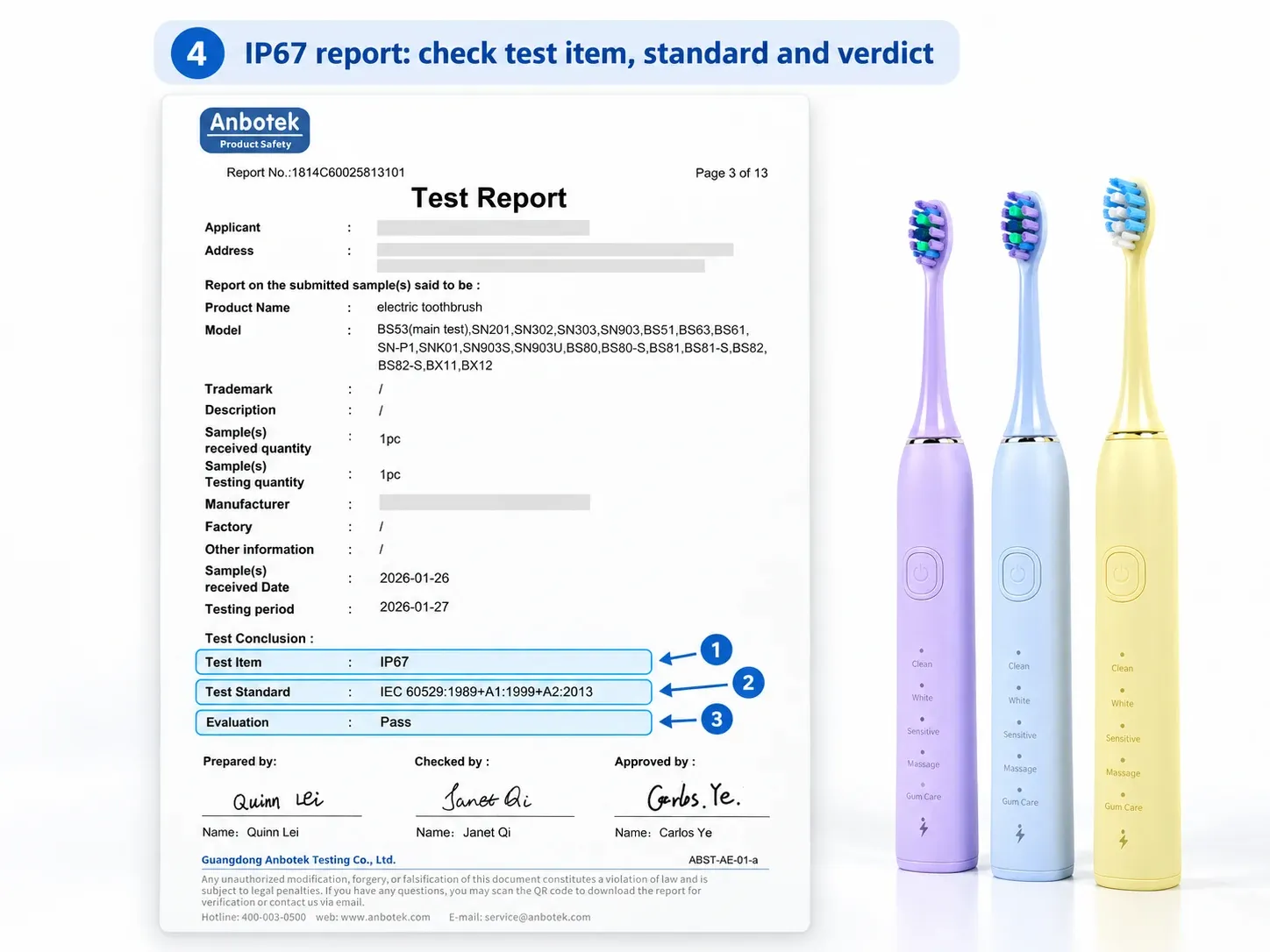
IPX7 means the enclosure withstands temporary immersion to one metre for thirty minutes under IEC 60529. The report states the clause tested (protection against water, second characteristic numeral) and the result. IPX7 is an immersion test rating, not a general guarantee against every type of water exposure, and “waterproof” without an IP rating and a standard reference is a marketing claim rather than a specification.
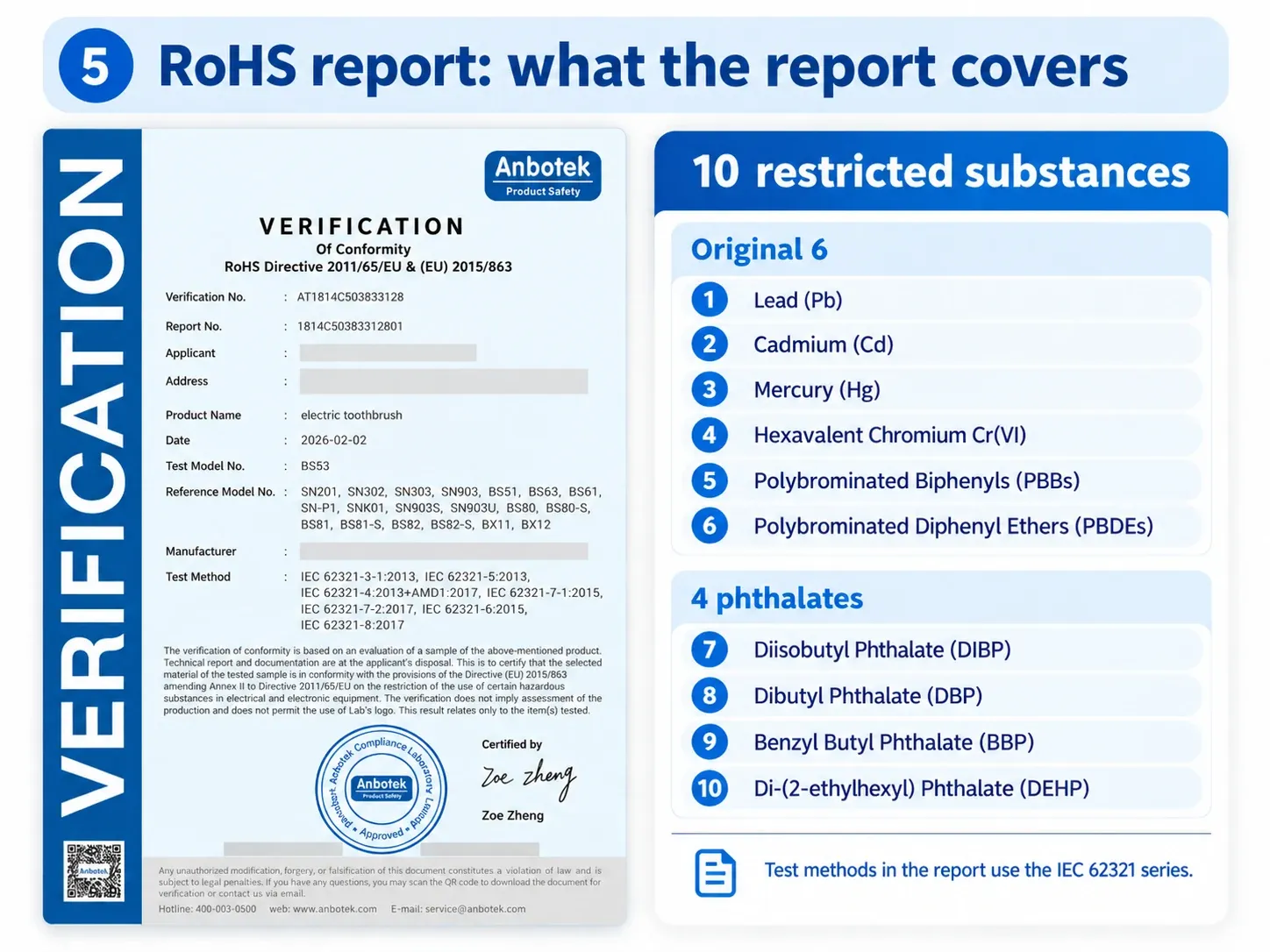
The RoHS report lists the ten restricted substances — lead, cadmium, mercury, hexavalent chromium, PBB, PBDE and four phthalates (DIBP, DBP, BBP, DEHP) — tested in the selected materials of the sample. Check that the report names the amendment (EU) 2015/863, which added the phthalates. A report covering only the original six substances does not, by itself, demonstrate coverage of the current ten-substance Annex II list.
WEEE is not demonstrated by a laboratory test report. EU requirements include the crossed-out wheeled-bin marking and producer registration, reporting and waste-management obligations in the relevant Member State. Buyers should therefore distinguish WEEE documentation and registration arrangements from product test reports.
IEC 60335-2-52 covers the safety of electric oral-hygiene appliances, including toothbrushes. For a non-radio 5 V DC toothbrush handle, the EU Low Voltage Directive does not apply solely on the basis of the handle voltage, because the LVD starts at 75 V DC. This does not remove other product-safety obligations, and buyers may still request safety testing to the relevant EN/IEC standard. For toothbrushes incorporating Bluetooth or another radio transmitter, the EU Radio Equipment Directive applies; its safety requirements incorporate the LVD safety objectives without applying the LVD voltage limits.
The China safety reports in an existing supplier file set may cite earlier editions such as GB 4706.1-2005 and GB 4706.59-2008 (the latter adopted from IEC 60335-2-52). Buyers should check the exact edition printed on the report: these editions were replaced on 1 August 2026 by GB/T 4706.1-2024 and GB/T 4706.59-2024. A legacy report shows what was tested at the time; it should not automatically be presented as evidence against the current Chinese editions.
Electric toothbrushes are listed by Japan’s METI as non-specified electrical appliances under the Electrical Appliances and Materials Safety Act. PSE compliance is not established by a single “PSE certificate”: the applicable technical requirements, supplier/importer procedures, self-inspection and required marking must be satisfied. If a supplier provides a Japan-specific EMC or safety test report, check the exact standard and model list rather than treating the report alone as proof of complete PSE compliance.
In the United States, a powered toothbrush is a medical device classified under 21 CFR 872.6865 (product code JEQ) as a Class I device. It is generally exempt from premarket notification, so a 510(k) is not normally required, subject to the exemption limitations in 21 CFR 872.9: for example, a new intended use or a fundamentally different technology can remove the exemption. Exemption from 510(k) is not exemption from FDA requirements. The manufacturing establishment must register with FDA and list the device, foreign establishments must designate a U.S. agent, and the device is not exempt from quality-system (GMP) requirements. Ask the supplier for the establishment’s current FDA registration and confirm that the device listing covers the product being shipped.
In the United States, a powered toothbrush is a medical device under 21 CFR 872.6865 (product code JEQ). It is Class I and exempt from 510(k) premarket notification, subject to the limitations in 21 CFR 872.9. Exemption from 510(k) does not mean exemption from FDA requirements: the manufacturer must register the establishment and list the device with FDA, and the device remains subject to FDA’s quality system requirements.
Before shipping to the US, confirm who will hold the establishment registration and device listing for your product, and that the model, function claims and labelling stay within the Class I powered toothbrush classification. Added functions or therapeutic claims can move a product outside this classification.
For a step-by-step method, see how to review oral-care product test reports before OEM approval.
Does a CE EMC report mean the product is “CE certified”?
CE marking follows a conformity assessment, technical documentation and an EU Declaration of Conformity, which are the manufacturer’s responsibility; an importer has verification duties, and a private-label seller placing the product on the market under its own name or trademark may take on manufacturer responsibilities. An EMC test report supports the EMC part of that assessment; RoHS and, where applicable, safety reports support the rest.
Can I use the supplier’s FCC report for my own brand?
The supplier’s test report can support the SDoC, but the U.S.-based responsible party must issue and maintain the required compliance information.
My private-label model has a different colour and logo. Is it still covered?
Often yes for EMC and ingress protection, if the tested construction is unchanged. Confirm with the supplier that the model is a reference model on each report, and check whether changed pigments or materials affect RoHS evidence.
Do I need IPX7 if the toothbrush is only used at a sink?
IPX7 is commonly specified for rechargeable toothbrushes because temporary immersion can occur in bathroom use. However, IPX7 specifically addresses temporary immersion; it is not the same as a water-jet test. Check the exact IP rating claimed for the product and the test report supporting it.
How long is a test report valid?
There is no single universal expiry period for all of these reports. Check whether the product design has changed, whether the cited standard has been revised or withdrawn, and whether the target retailer, importer or marketplace has its own recency requirement. A report should not be treated as current merely because the document itself has no printed expiry date.
Does an electric toothbrush need FDA 510(k) clearance?
Usually not. Powered toothbrushes are Class I devices under 21 CFR 872.6865 and are generally exempt from 510(k), within the limitations of 21 CFR 872.9. The manufacturing establishment must still be registered with FDA and the device listed, and quality-system requirements still apply.
Does an electric toothbrush need FDA 510(k) clearance?
Generally no. A powered toothbrush is a Class I device that is exempt from 510(k), subject to the limitations in 21 CFR 872.9. Establishment registration and device listing with FDA are still required.
AileCare works with electric-toothbrush platforms for which third-party EMC, FCC Part 15B, IP ingress, RoHS and safety documentation is available at model-family level. The applicable report, standard edition and covered model list are checked for each project before documents are provided to the buyer. See compliance and export documentation, or send your model and target market through the contact form.