Start Your Electric Toothbrush Project
Tell us your product requirements and target market. We will review the details and reply with the relevant next steps.

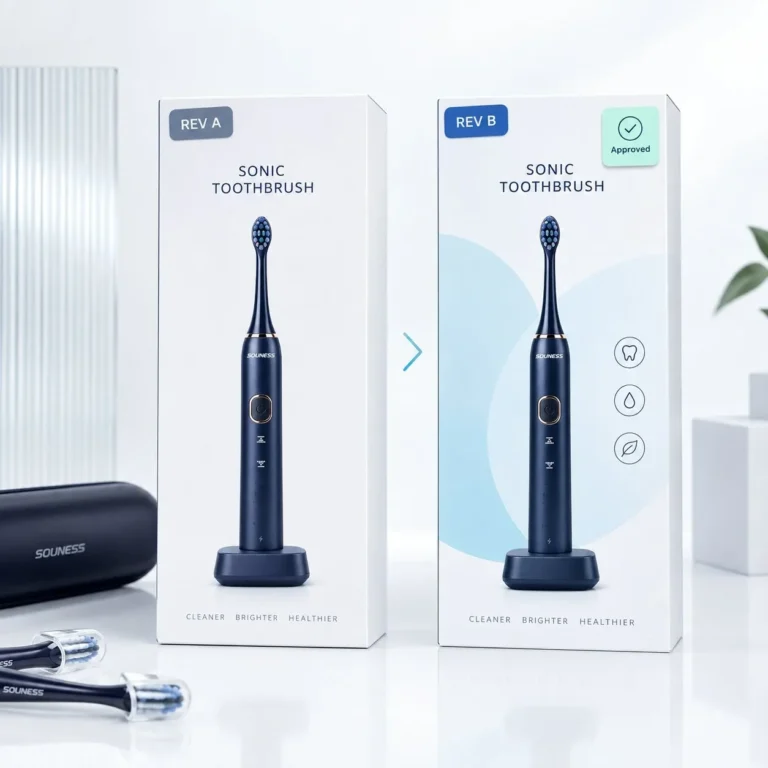
Packaging approval means more than confirming that the box looks right.
Before mass printing, a buyer should confirm that the physical package and its controlled files match the sellable configuration: the correct product, accessories, packaging structure, artwork revision, SKU, barcode, documents, market version and final pack-out.
A digital proof can confirm layout and content. It does not, by itself, confirm physical fit, final print appearance, special finishes or whether the complete retail unit contains the right components.
This guide explains how to review packaging as a complete, SKU-specific sellable configuration rather than simply as a printed box.
Packaging errors are not always obvious design errors.
A front panel may look correct while another part of the configuration is wrong: the barcode belongs to another variant, the insert no longer fits after an accessory change, the manual still describes the previous model, or a refill pack uses artwork for a different pack count.
Once packaging has been printed at volume, correcting these mismatches may require reprinting, relabeling, repacking or separating affected inventory.
The purpose of packaging sample approval is to identify these issues before the approved files are released for volume production.
Many of these mismatches can be prevented earlier, when the packaging content itself is planned. See our guide on packaging artwork and label planning for how to define the controlled inputs before design begins.
A useful way to think about the approval is:
Product configuration + packaging structure + artwork revision + SKU/barcode + accessories and documents + physical pack-out = approved packaging configuration.
This is not a formal industry formula. It is a practical way to make sure every part of the package refers to the same sellable unit.
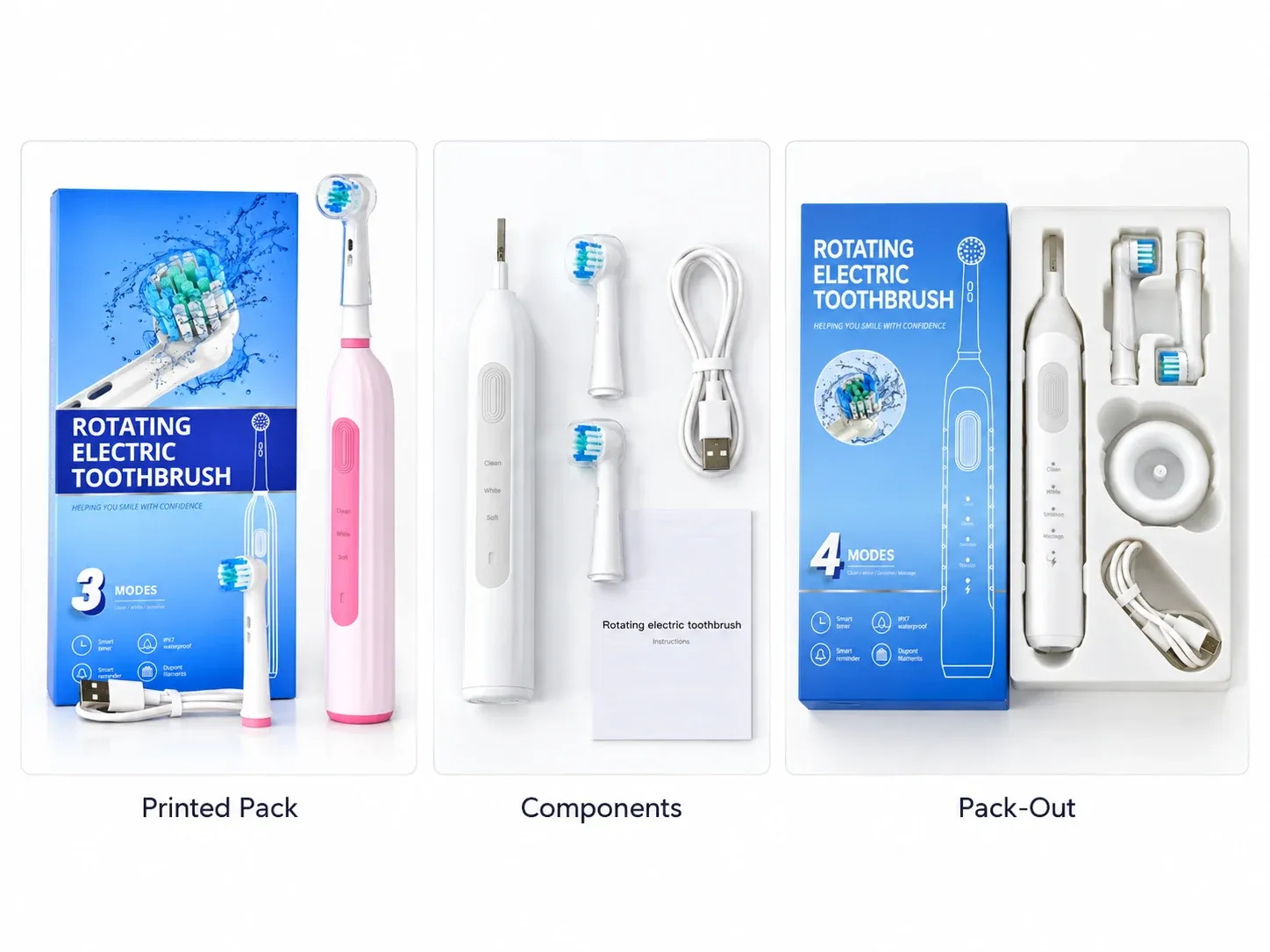
Before reviewing a sample, first understand what it is intended to prove.
Terminology varies between printers, packaging suppliers and packaging formats. The purpose of the sample matters more than the label used for it.
| Review Object | Main Question | What It Does Not Confirm |
|---|---|---|
| Structural / blank sample | Does the package physically work: dimensions, folding, closure, insert fit and product access? | Final artwork, colour, finishes or barcode print quality |
| Digital artwork proof | Is the intended content in the correct location: copy, model, pack count, barcode data and language? | Physical fit, substrate effects, final printed colour or finish |
| Printed / physical proof | Does the actual printed package look and read as intended? | It may not represent the final production press, process or full pack-out |
| Final pack-out sample | Does the completed retail unit contain and present the correct sellable configuration? | Transit performance unless evaluated separately |
Not every project requires every type of proof.
The better question is:
Which packaging risks are still unverified by the sample or proof currently available?
A digital proof may be enough to approve copy and layout. It cannot verify a package whose fit, closure, finish or complete pack-out has never been physically reviewed.
Packaging can only be approved against a sufficiently defined product configuration.
If the handle model, brush-head quantity, nozzle set, charging accessory, case or manual is still changing, the physical insert and printed information may no longer match the product that will actually ship.
Packaging development can begin in parallel with product development using controlled assumptions.
Final packaging approval for production, however, should use a packaging-relevant configuration stable enough to confirm:
If one of these changes after approval, review the packaging again for the affected fit, artwork, document and SKU implications.

This is the core of packaging sample approval.
Do not review only the empty box.
Approve the sellable pack-out, not just the empty package.
Load the intended product, accessories and documents into the package and review the complete retail unit.
Check that:
An empty packaging sample may appear correct but behave differently after the full product and accessory set is inserted.
That is why the final pack-out should be reviewed with the actual intended contents wherever practical.
A dieline is a two-dimensional production reference.
The finished package is a three-dimensional object affected by board thickness, folds, score lines, glue areas, windows, lamination and internal inserts.
For that reason, a dieline alone does not prove that the finished package works.
On the assembled sample, review:
Also confirm that the dieline revision used for the sample is the revision currently approved for the project.
For oral-care products, the accessory set is part of the sellable configuration.
Check the sample against the intended SKU.
For example:
Documents should also be checked for:
A common mismatch occurs when the box artwork is updated but the manual or insert still describes an earlier product configuration.
The final pack-out should therefore be checked physically, while the underlying document files remain separately controlled.
Review every printed panel, not only the front.
Confirm that the packaging matches the project definition for:
The product image should also match the actual SKU being packed.
For example, a white-handle SKU should not carry an image of the black variant simply because the packaging layout is otherwise identical.
Separate this project-consistency review from market-specific legal or regulatory review.
Packaging sample approval confirms that the pack reflects the agreed product and project information. It does not, by itself, establish that every destination-market labeling requirement has been independently satisfied.
Requirements for warnings, business-entity information, symbols, battery information, electrical information or other market-specific statements can depend on the product and destination market.
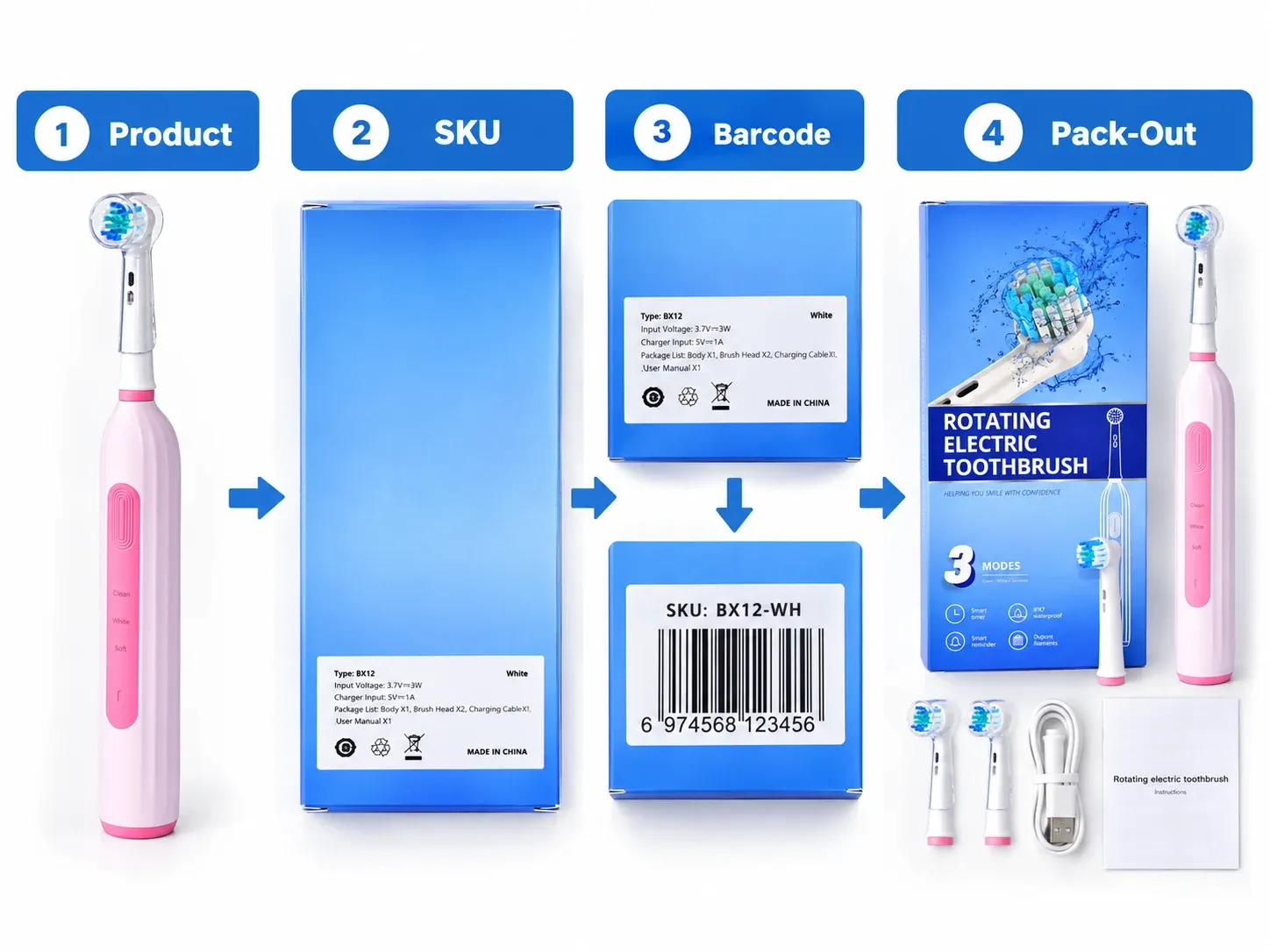
A package can be visually correct and still belong to the wrong sellable item.
This becomes especially important when a product family contains similar variants, such as:
The review should follow one chain:
Product → Model / SKU → Accessory Configuration → Packaging Revision → Barcode → Market / Language
Every field should identify the same sellable configuration.
On the physical sample, check:
Useful project controls may include:
The purpose is simple: when someone asks which packaging belongs to which product, the answer should come from controlled information rather than visual recognition.
Barcode review has two separate parts.
First, confirm the data: the printed barcode belongs to the intended sellable item.
Second, review the physical print: placement, contrast and surrounding print treatment should support reliable scanning.
Avoid placing decorative elements, special finishes or other print treatments where they interfere with barcode readability.
A successful scan can be a useful spot check, but it should not be treated as proof that every production print condition has been fully verified.
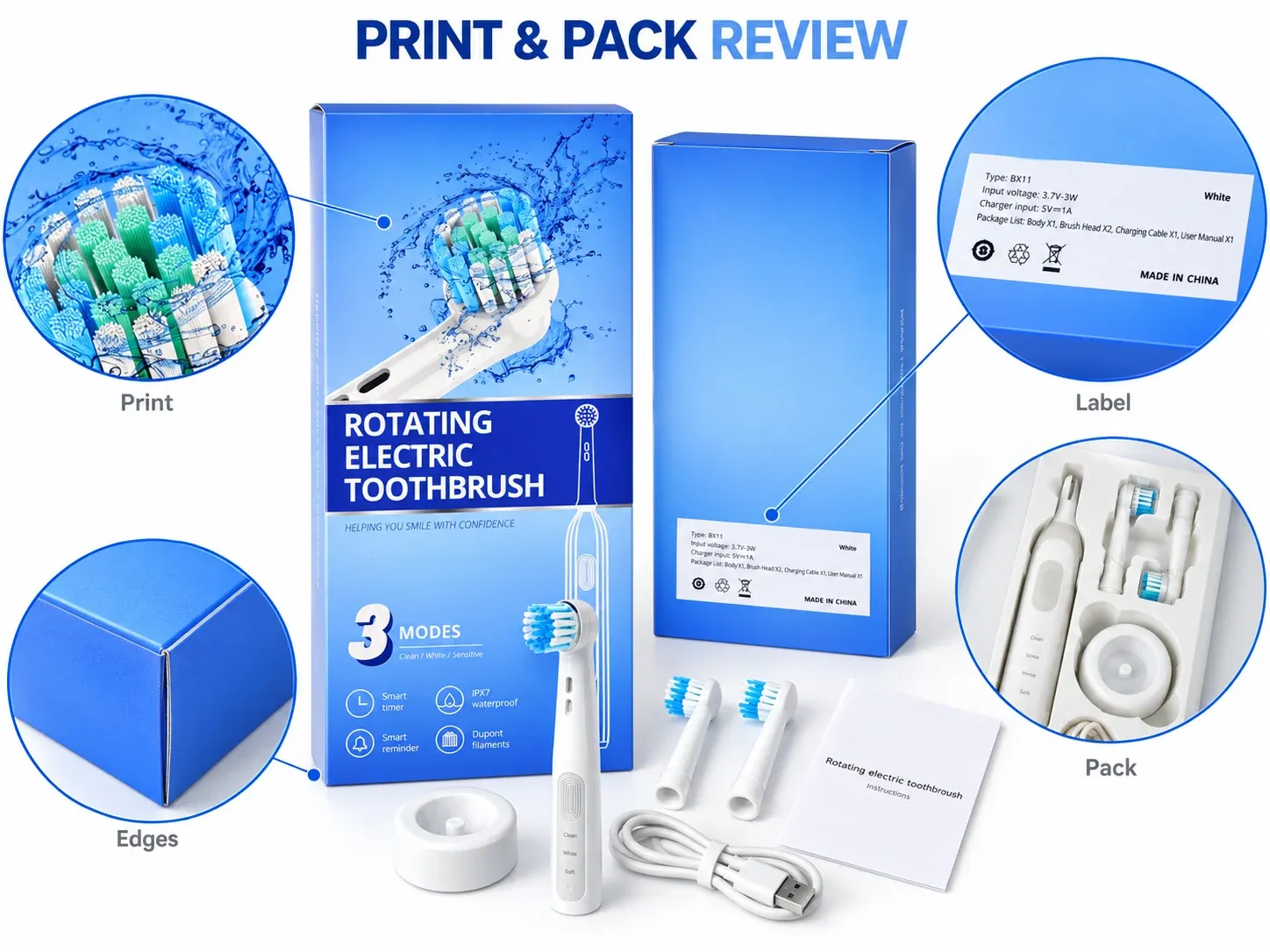
A screen PDF is useful for artwork review, but it cannot fully predict the appearance of printed packaging.
Physical colour may be affected by:
On the physical proof or sample, review:
If the package uses special finishes such as foil stamping, embossing, debossing, spot UV or matte/gloss lamination, also check:
Not every project needs Pantone matching, a press proof or a separate physical colour proof.
The appropriate control depends on the printing process, brand requirements, special finishes and project risk.
An approved physical package is a reference.
It is not the production artwork file.
Volume printing will use released dieline and artwork files. The sample approval is useful only when the approved physical sample can be linked to the correct file revisions.
A box that “looks approved” but cannot be traced to a specific artwork revision creates uncertainty when production files are released.
The principle is simple:
Approve the physical reference and the corresponding file revision together.
These approvals answer different questions.
The approved product sample, often referred to as the golden sample or approved production reference, defines the physical product baseline.
Packaging sample approval defines how that product is:
They do not have to occur at exactly the same time.
For example:
The important point is that the approval record states exactly what has been approved and what remains open.
For the product-side reference, see our guide on Golden Sample Approval for Oral-Care OEM Projects.
Before packaging is released for volume printing, someone reviewing the project should be able to identify exactly which version is approved.
A practical approval record may include:
Each packaging component may also require separate control.
For example:
“Approved with comments” can create ambiguity before printing.
If a comment affects:
it should normally be closed through a defined revision before the final production file is released.
If a comment remains, make its status explicit:
Otherwise, the item is still open.
Changes can also happen after approval.
If the product, accessory set, manual, artwork, component or market version changes, re-check the areas affected by that change rather than assuming the original packaging approval remains valid.
The same approval process can emphasize different issues depending on the sales channel.
Pay particular attention to:
Pay particular attention to:
Retail-unit correctness still matters, but additional attention may be needed for:
Packaging format selection and protection strategy are covered separately in our Oral-Care Packaging Guide for OEM Projects.
This guide focuses on whether the selected package is physically and informationally correct before production.
A package may look correct, fit correctly and pack out correctly without having been evaluated for distribution hazards.
Packaging sample approval and transit-performance validation answer different questions.
Transit evaluation may consider conditions such as:
Not every oral-care project requires the same testing approach.
Where distribution conditions, product fragility, customer requirements or project risk justify it, transport performance should be reviewed separately using an appropriate method.
The same principle applies to the product itself: packaging approval does not replace product-level verification.
For product-side production readiness, see Electric Toothbrush Reliability Testing.
| Product Type | Packaging Sample Approval Priorities |
|---|---|
| Electric toothbrushes | Correct handle and market configuration; brush-head type and quantity; charger, cable, base or case; accessory retention; manual fit; correct product image and model |
| Replacement brush heads | Exact head type; compatibility wording; pack count; colour-ring or variant identification; caps where included; blister/carton fit; SKU and barcode distinction between refill variants |
| Water flossers | Nozzle count and storage; reservoir protection; charging accessory; product orientation; accessory retention; correct manual and product image |
| Sets and bundles | Complete and compatible component set; insert layout; pack-out sequence; bundle SKU/barcode mapping; document and accessory completeness |
Replacement brush-head packs deserve particular attention because different variants may use nearly identical packaging while differing only in head type, pack count or colour identification.
That makes SKU and barcode control particularly important.
A practical packaging release sequence is:
Packaging approval establishes the intended production reference.
It does not guarantee that every printed unit will be defect-free. Printing controls and later inspection still matter.
What it does provide is a clear answer to a more basic question:
Is production working toward the correct package for the correct sellable product?
It may be enough to approve artwork content such as copy, layout, model information, barcode data and language.
It does not confirm physical fit, actual printed colour, special finishes or the complete pack-out.
Whether a physical sample is also needed depends on which project risks remain unverified.
Where practical, yes.
The complete intended contents are needed to review product fit, accessory retention, closure under load, orientation and whether the printed accessory statements match what is actually packed.
They belong to the complete pack-out review but should also remain separately controlled documents.
Check their language, model, product revision, accessory information, quantity and physical fit.
Yes.
Packaging development can proceed using controlled assumptions.
Final production approval should use a stable packaging-relevant configuration so that dimensions, contents, images and printed statements reflect the product intended for sale.
No.
Physical sample approval confirms structure, contents, print and pack-out. Transport-performance evaluation is a separate activity and should be considered where distribution conditions or project requirements justify it.
It should only be used when every comment has a clear status.
A comment should either be non-production-affecting, closed in a documented revision or explicitly accepted as a known deviation.
If a comment still affects artwork, barcode, structure, colour, fit or product information, treat the package as requiring revision rather than fully approved.