Start Your Electric Toothbrush Project
Tell us your product requirements and target market. We will review the details and reply with the relevant next steps.
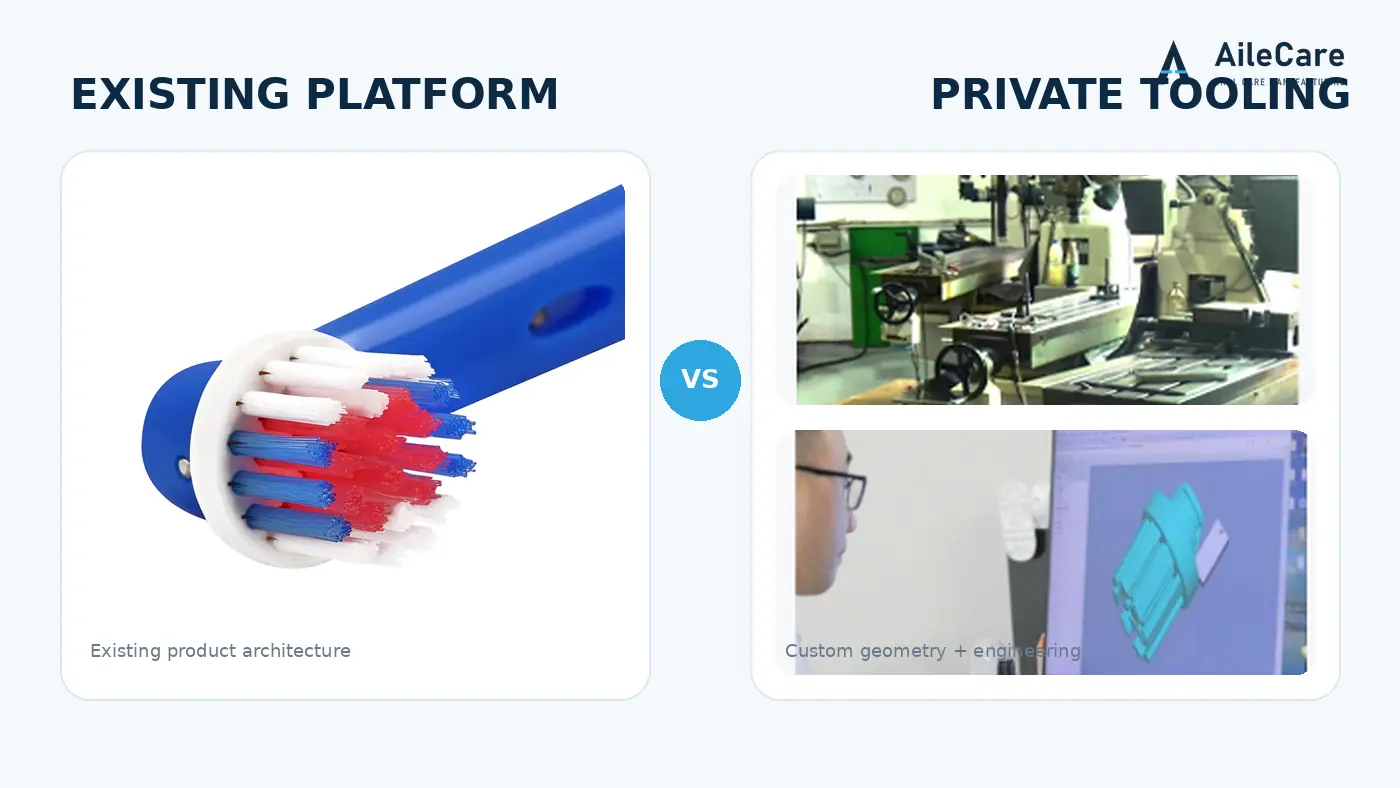
For most private-label oral-care projects, the choice is not simply between a “public mold” and a completely custom product.
There are usually three development routes: using an existing supplier platform, partially customizing an existing platform, or developing fully private tooling.
An existing platform can reduce initial engineering work and shorten the development path. Private tooling can provide greater control over product geometry and differentiation, but it also adds tooling investment, engineering, validation, and change-control requirements.
The right route depends on what must be unique, what can remain platform-based, the technical scope of the project, expected product lifecycle, launch timing, budget, and the commercial rights the buyer needs.
In China-based OEM sourcing, buyers often hear the term “public mold” used for an existing product platform.
In international manufacturing language, terms such as existing tooling, supplier-owned platform tooling, or shared tooling are often clearer.
“Public mold” does not mean the tooling has no owner. It generally describes tooling that already exists and is available for use in one or more product programs. Ownership, permitted use, and exclusivity depend on the actual commercial arrangement.
Existing or supplier-owned platform tooling refers to an already-developed product or component platform that a supplier can use for private-label projects.
Private or custom tooling refers to new or substantially modified production tooling created for a specific product program.
Customer-owned tooling should only be used when the agreement clearly establishes that the customer owns the relevant tool.
Exclusive tooling describes restrictions on who may use the tool or platform. Exclusivity and ownership are separate issues.
Tooling is also broader than an injection mold. A product program may involve molds, inserts, fixtures, gauges, assembly jigs, and test fixtures.
In oral-care OEM and ODM projects, most private-label programs start from an existing platform rather than new tooling.
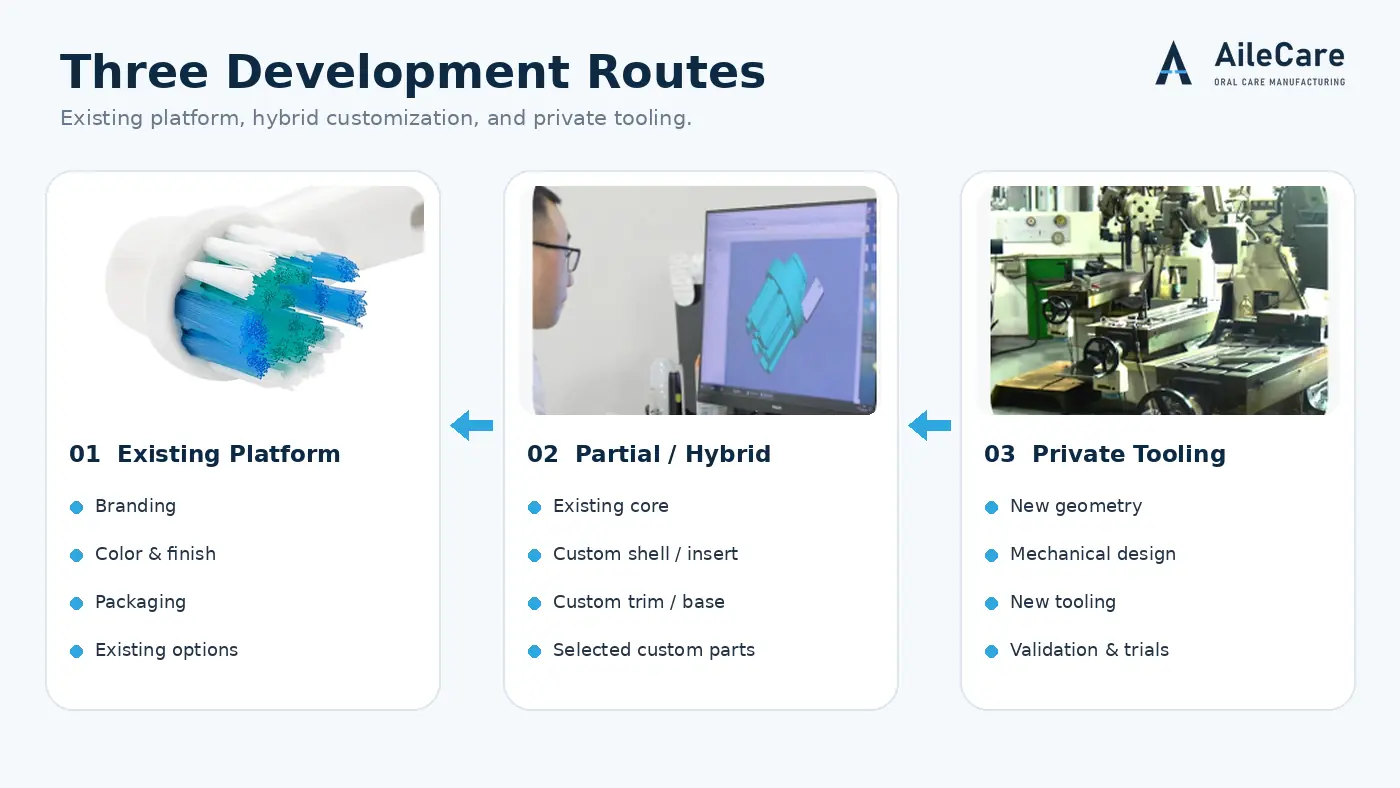
The main product architecture, tooling, electronics, and production process already exist.
The buyer may customize elements such as:
This route can make sense when speed, market validation, and lower initial engineering exposure are important.
The core product platform remains existing, but selected parts become buyer-specific.
Examples may include:
This route can increase product differentiation without requiring every part of the product to be redeveloped.
Private tooling becomes more relevant when the buyer needs substantial changes to the product architecture.
Examples include:
This is not simply a more expensive version of private label. It is a product-development program involving engineering, tooling, trials, validation, and production release.
On many existing platforms, several changes can be made without developing a new primary product mold.
Depending on the platform, these may include:
“Usually” is important.
A change that does not require a new injection mold may still require sample approval, material checks, coating or adhesion validation, artwork approval, firmware verification, or other project-specific checks.
Existing tooling does not mean there is no development work.
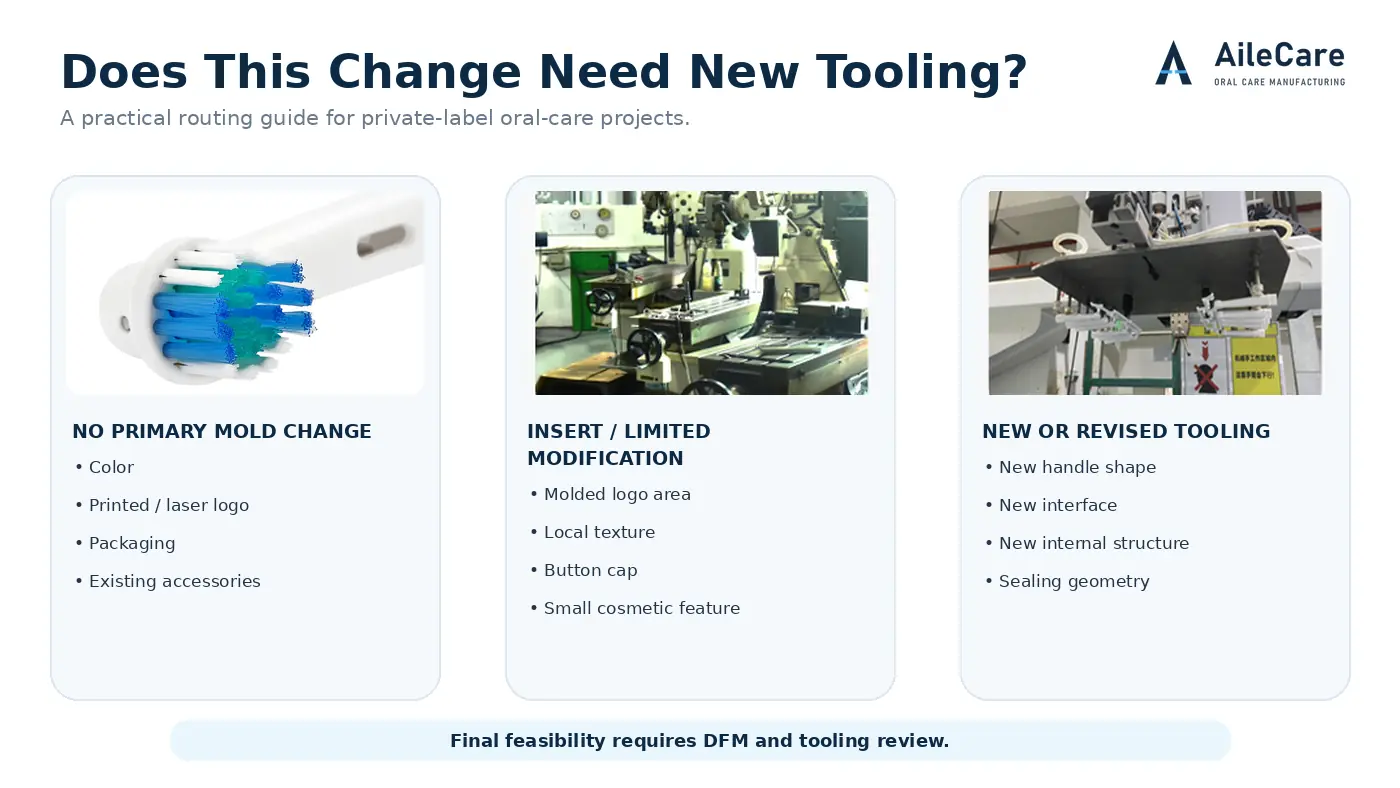
Product changes can be divided into three broad categories.
Changes such as color, printing, packaging, accessory selection, or configuration within an existing platform often do not require changes to the main injection mold.
Some localized changes may be possible through a mold insert or limited modification.
Examples can include:
Whether this is possible depends on how the original mold was designed.
A related concept is steel-safe design. In injection molding, a design may leave room for future changes that can be achieved by removing steel from the tool, which adds plastic to the molded part.
Removing steel is generally easier than trying to add steel back into an existing mold, although every change still requires tooling review.
A new tool or major tool revision may be needed when the requested change affects fundamental product geometry or architecture.
Examples include:
The correct route should be determined through DFM and tooling review rather than appearance alone.
A change that looks cosmetic can still affect sealing, assembly, ejection, internal clearances, or product fit.
Existing platform:
Usually lower because the main architecture already exists.
Private tooling:
Higher because industrial design, mechanical design, DFM, tooling, and validation work may be required.
Existing platform:
Usually shorter because the main tooling-development stage has already been completed.
Private tooling:
Includes additional design, fabrication, tool-trial, correction, and approval stages.
Existing platform:
Limited by the existing product architecture and approved options.
Private tooling:
Provides greater control over product geometry and selected architecture.
Existing platform:
Differentiation can come from branding, color, finish, packaging, accessories, and product configuration.
Private tooling:
Can support distinctive industrial design and buyer-specific geometry.
Existing platform:
A new main product mold may not be necessary, although inserts, fixtures, accessories, or packaging tooling can still create costs.
Private tooling:
May involve several molds plus fixtures, gauges, assembly tools, and test equipment.
Existing platform:
Often controlled by the supplier or another tooling owner, subject to the relevant agreement.
Private tooling:
Ownership still needs to be documented. Paying for tooling does not automatically establish ownership.
Existing platform:
Often non-exclusive unless another arrangement has been agreed.
Private tooling:
Exclusivity is still not automatic. It should be defined separately.
Existing platform:
Changes are limited by the existing architecture.
Private tooling:
There may be more control over revisions, but changes can require tool modification or retooling.
Both routes can create supplier dependence.
An existing platform may rely on supplier-specific components. A private tool may still be difficult to relocate if another factory cannot run, maintain, or qualify it.
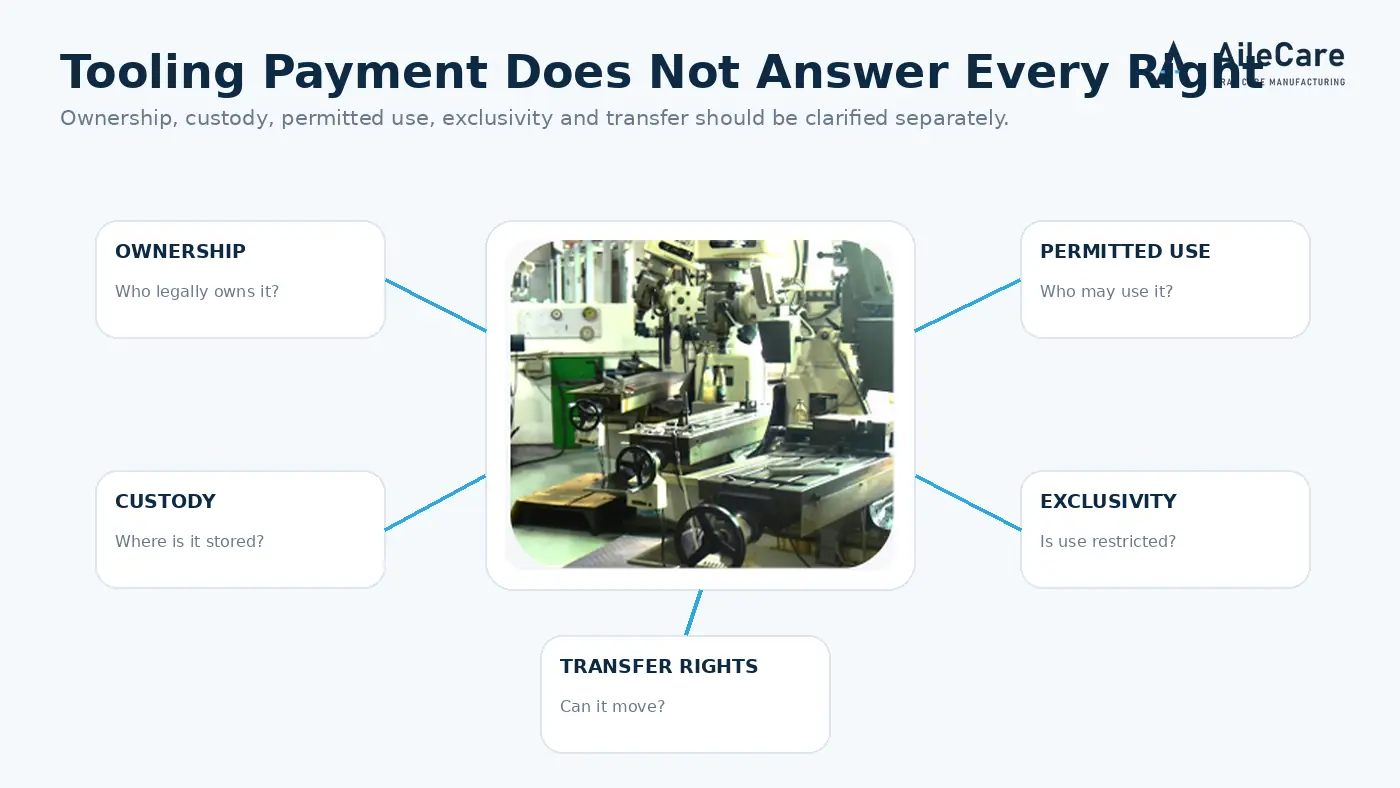
A tooling fee and tooling ownership are not the same thing.
Before paying for private tooling, buyers should separate five different questions.
The agreement should identify who owns each mold, insert, fixture, or other project-specific tool and when ownership transfers, if it transfers at all.
Do not assume ownership solely because the buyer paid a tooling charge.
A customer-owned tool may remain physically at the manufacturing facility during production.
Physical possession and legal ownership are different questions.
The agreement should clarify whether the tool can be used only for one buyer’s products or whether another use is permitted.
Exclusivity may relate to a specific product, market, territory, customer group, channel, or time period.
It should not be inferred from the words “private mold.”
A contractual transfer right does not necessarily mean transferring the tool will be simple.
The receiving factory may need compatible machinery, tool dimensions, hot-runner controls, fixtures, gauges, material specifications, maintenance records, process information, and the technical capability to requalify the tool.
The key point is simple:
Ownership, custody, permitted use, exclusivity, and transfer rights should be answered separately.
Owning a physical mold does not automatically prevent a supplier from manufacturing a similar product using different tooling.
It also does not automatically define whether the supplier may reuse:
Likewise, owning a mold does not automatically create product, territory, channel, or market exclusivity.
The reverse can also be true.
A buyer may negotiate a limited exclusive-use arrangement for a supplier-owned product platform without owning the underlying mold.
These rights should be documented rather than inferred from the phrase “private tooling.”
The physical mold is only one asset in a product-development project.
Other assets and rights may include:
Opening a custom mold does not automatically transfer all of these assets or rights to the buyer.
If product architecture, design ownership, source files, or exclusivity are strategically important, buyers should clarify them separately in the project documentation.
Jurisdiction-specific IP ownership, registration, and enforcement questions should be reviewed with qualified legal counsel where necessary.
There is no universal “electric toothbrush mold price.”
Tooling cost depends on the actual product and tooling scope.
Important cost drivers can include:
One point buyers often underestimate is that a “custom toothbrush mold” may involve more than one tool.
A custom electric toothbrush can contain separate molded parts for the housing, end cap, buttons, trim components, brush-head parts, and charging base.
The project can also require assembly fixtures, gauges, leak-test fixtures, and functional-test equipment.
For this reason, buyers should evaluate the complete tooling package, not only one quoted mold fee.
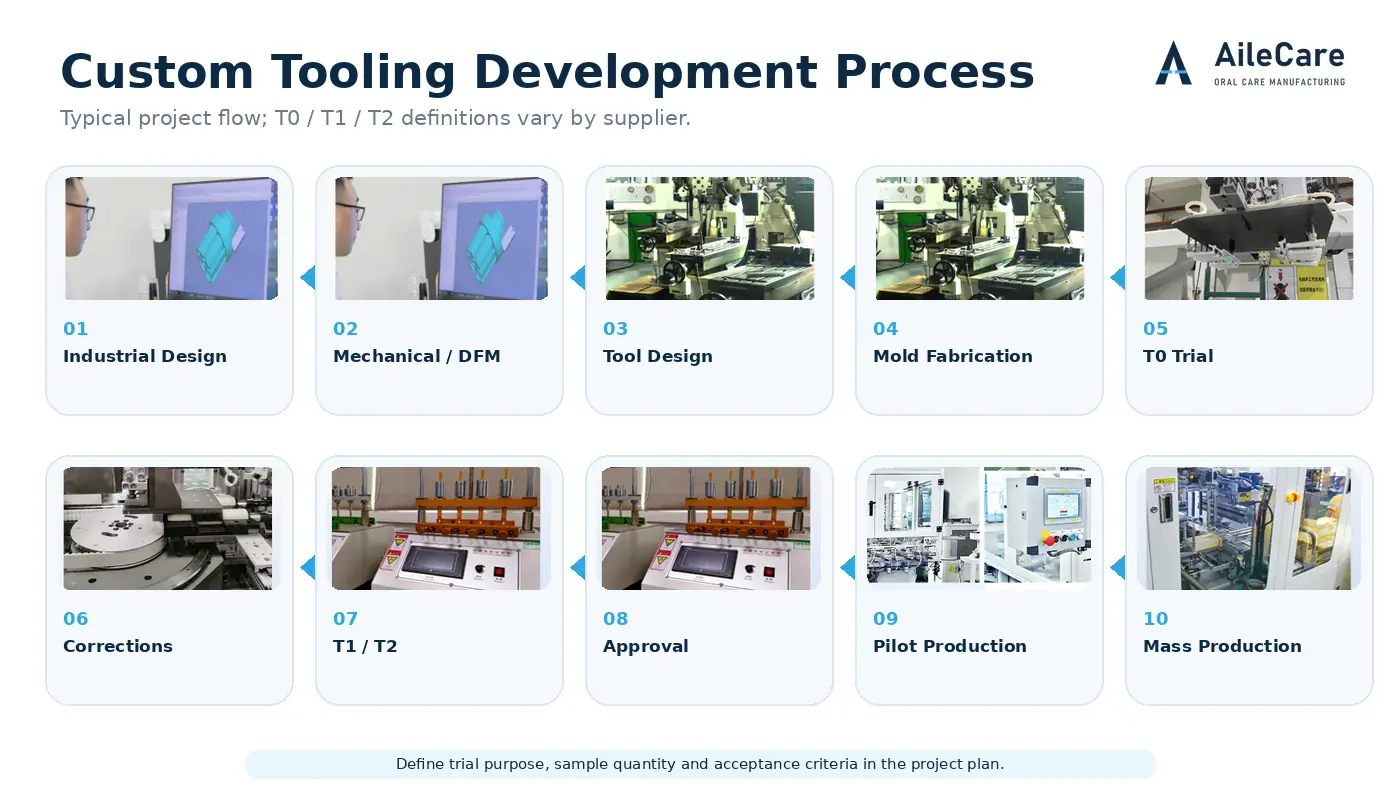
A typical custom-tooling development sequence may look like this:
Industrial Design
→ Mechanical Design
→ DFM
→ Tool Design
→ Mold Fabrication
→ Tool Trial
→ Corrections
→ Additional Trial Samples
→ Sample Approval
→ Pilot Production
→ Mass Production
T0, T1, and T2 are commonly used labels for different mold-trial or sample stages.
T0 often refers to an early or first tool trial. Later stages such as T1 and T2 may be used to verify corrections, dimensions, cosmetics, assembly, or functional performance.
However, these labels are industry conventions rather than universally standardized definitions.
Instead of relying on the stage name alone, buyers should confirm:
Before steel cutting, the buyer and supplier should also confirm the approved CAD revision, materials, critical dimensions, cosmetic requirements, functional requirements, and validation plan.
Changes made before tooling fabrication are generally easier to manage than major geometry changes requested after the tool has been built.
Testing impact depends on what changed, the final product configuration, the intended market, and the applicable requirements.
A logo, packaging, artwork, or other cosmetic change may have a relatively narrow validation impact.
Changes to the following areas can require broader engineering review:
For battery-powered products, the U.S. CPSC recommends a system approach that considers the cells, battery, charger, and end product together. The exact requirements for an oral-care product still depend on the product and intended market.
Two principles are important.
An existing platform does not automatically remove testing or documentation obligations for the final configuration.
Private tooling also does not automatically mean every previous test must be repeated.
The required scope should be determined for the actual product configuration and destination market.
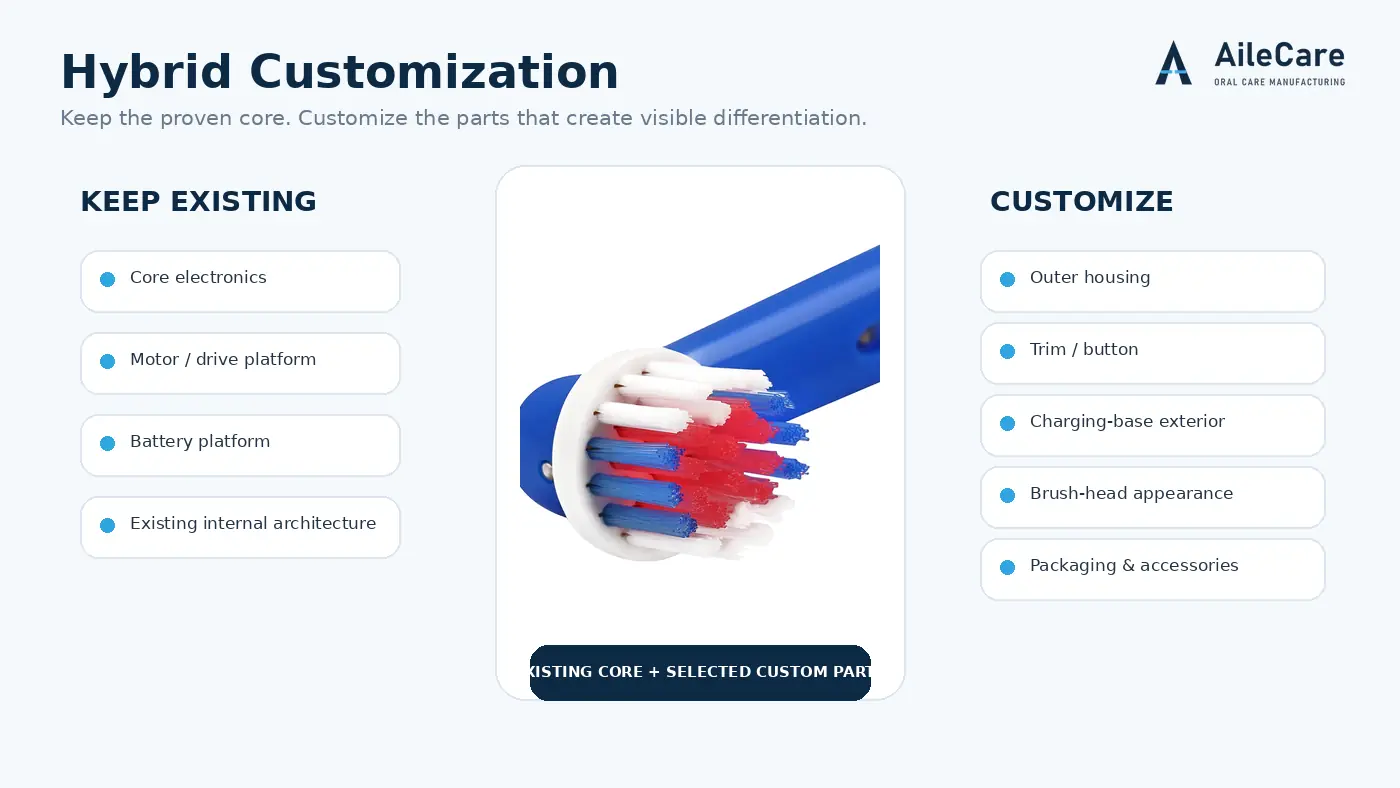
Buyers do not always need to choose between an unchanged existing product and a completely ground-up development.
Hybrid routes can include:
The purpose is to concentrate development and tooling investment on the parts that create meaningful differentiation.
Hybrid development still requires engineering review.
For example, a new outer shell can affect internal fit, sealing, button construction, assembly, or charging-base alignment. A new brush head must remain compatible with the drive and connection system.
An existing platform may be appropriate when the priority is:
This should not be interpreted as a lower-quality route.
The quality of an existing platform depends on its engineering, materials, manufacturing controls, maintenance, and validation — not simply on whether the tooling already existed.
Private tooling may be worth considering when the project requires:
Private tooling is not automatically superior.
It introduces additional engineering, trials, tooling management, validation, maintenance, and change-control responsibilities.
The commercial case should therefore be based on the product strategy rather than the assumption that “private mold” always means a better product.
Before committing to tooling, buyers should clarify:
These are sourcing questions, not universal contract terms.
The answers depend on the supplier, tooling arrangement, product, jurisdiction, and written agreement.
“Public mold” is common sourcing shorthand, particularly in China-based OEM discussions, for existing tooling or a supplier platform that may be available for more than one product program.
It is not a standardized international engineering or legal term. It also does not mean the tooling has no owner. Buyers should confirm who owns the tooling and what use rights apply.
Usually not when the logo is applied through printing, laser marking, or another secondary decoration process.
A raised or recessed logo molded directly into the plastic is different. Depending on the existing tool, it may require a replaceable mold insert, localized modification, or other tooling work. Logo application and packaging artwork are typically handled as branding and packaging work on the existing platform.
On existing oral-care platforms, the review usually starts from the available product customization scope before any tooling decision is made.
Not automatically.
Ownership should be established in the written agreement, including when title transfers and which tools are covered.
Payment, ownership, physical custody, permitted use, exclusivity, and transfer rights should not be treated as the same thing.
No.
Exclusive use is a separate commercial arrangement.
A buyer may own one physical mold while the supplier still has rights to common components, existing architecture, or separately developed products unless the agreement says otherwise.
The required restrictions should be documented clearly.
Tooling decisions are normally part of the wider product development and tooling stage of an OEM project.
Potentially, but contractual ownership alone does not guarantee easy portability.
The receiving factory needs suitable machines and controls, appropriate fixtures and gauges, technical documentation, compatible processes, and the ability to requalify the tool.
Transfer conditions should therefore be discussed before the buyer needs to change suppliers.
They are common labels for mold-trial or sample stages.
T0 often describes an early first tool trial, while later stages such as T1 and T2 may verify corrections and move closer to final approval.
Definitions vary by supplier. Each tooling project should define the purpose, samples, inspection requirements, and acceptance criteria for each stage.
The tooling decision should start with the product strategy, not the mold quotation.
Define which parts of the product must be unique, which can remain platform-based, how much engineering change is actually required, and what ownership, exclusivity, documentation, and validation rights matter to the project.
For many private-label oral-care products, the most efficient route may be an existing platform or selective customization. For projects where product geometry itself is part of the brand strategy, private tooling may be justified.
The correct route is the one that matches the product rather than the label placed on the mold.
Whether a project uses existing tooling or a new mold, it still moves through the same sampling to mass production process.